
Thomas Aquinas Commentary Hebrews 1
Thomas Aquinas Commentary
Hebrews 1
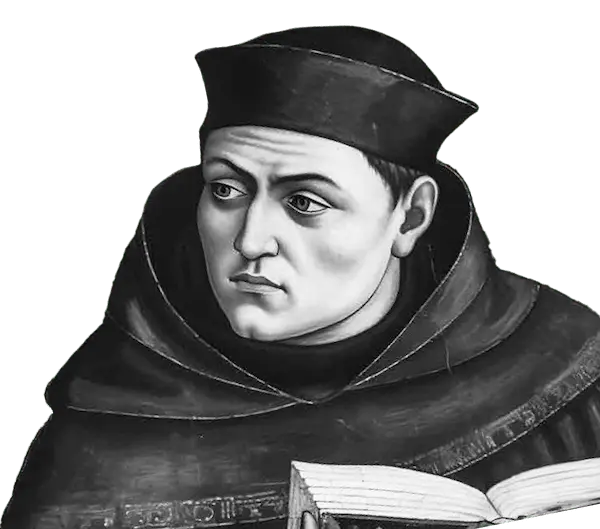
Thomas Aquinas Commentary
Hebrews 1
"God, having of old time spoken unto the fathers in the prophets by divers portions and in divers manners, hath at the end of these days spoken unto us in [his] Son, whom he appointed heir of all things, through whom also he made the worlds;" — Hebrews 1:1-2 (ASV)
The author of Hebrews wrote this epistle against the errors of converts from Judaism who wanted to preserve legal observances alongside the Gospel, as if Christ’s grace were not sufficient for salvation. The epistle is therefore divided into two parts. In the first, the author exalts Christ’s grandeur to show the superiority of the New Testament over the Old. In the second, he discusses what unites the members to the head: namely, faith (see chapter 11).
The author intends to show the New Testament’s superiority over the Old by proving Christ’s preeminence over the key figures of the Old Testament. These include the angels, by whom the Law was handed down—The law was ordained by angels in the hand of a mediator (Galatians 3:19)—and Moses, by or through whom it was given: The law was given by Moses (John 1:17); There arose no more a prophet in Israel like unto Moses, to whom the Lord spoke face to face (Deuteronomy 34:10). It also includes the priesthood by which the Law was administered: Into the first tabernacle the priests indeed entered, accomplishing the offices of sacrifices (Hebrews 9:6).
Therefore, he first shows Christ’s superiority over the angels, secondly over Moses (chapter 3), and thirdly over the priesthood of the Old Testament (chapter 5). Regarding the first point, he does two things: first, he demonstrates Christ’s greatness; secondly, by showing this to be true of Christ, he demonstrates that the angels lack this same greatness (chapter 2).
In regard to the first point, he indicates Christ’s excellence in four matters:
- As to His unique origin, by calling Him the true, natural Son of God.
- As to the extent of His rule (verse 2c).
- As to the power of His activity (verse 2d).
- As to the sublimity of His glory (verse 2e).
Because the author intends to exalt Christ in a way that contributes to the glory of the New Testament, his argument demonstrates the New’s superiority over the Old.
Concerning the Old Testament, he mentions five things:
- How it was proclaimed.
- The time (verse 1b).
- The author or giver (verse 1c).
- To whom it was given (verse 1d).
- By which ministers (verse 1e).
He says, therefore, In many ways, referring first of all to various persons, because God spoke not to one person but to many, namely, Abraham, Noah, and others. Secondly, it refers to the various times, and always with the same certainty: He went out early in the morning… And about the third hour… And again about the sixth hour… (Matthew 20:1 and following). It was also “many” in regard to the matters treated, namely, divine things: I am who am (Exodus 3:14); future events: She knows signs and wonders before they be done ; and promises of future benefits, at least in figure: Many things are show to you above the understanding of men .
It was also “many” in the variety of figures, because at one time he uses the figure of a lion, at another the figure of a stone: A stone was cut out of a mountain without hands (Daniel 2:34); That he might show you that his law is manifold (Job 11:6). And in various ways. This refers to the three kinds of vision: first, ocular vision: In the same hour there appeared fingers, as it were the hand of a man writing over against the candlestick upon the surface of the wall (Daniel 5:5); secondly, imaginary vision: I saw the Lord sitting upon a throne high and elevated (Isaiah 6:1); and thirdly, intellectual vision, as with David: I have had understanding above the ancients (Psalms 119:100). Hence, Hosea includes all of these: I have multiplied visions (Hosea 12:10).
This phrase also refers to the various ways He spoke, because sometimes He spoke plainly and sometimes obscurely. In fact, there is no manner of speaking that has not been employed in the writings of the Old Testament: Behold, I have described it to you three manner of ways, in thoughts and knowledge (Proverbs 22:20). Thirdly, it refers to how He spoke by rebuking the wicked, by encouraging the righteous, and by instructing the ignorant: All scripture, inspired of God, is profitable to teach, to reprove, to correct, to instruct in justice (2 Timothy 3:16).
Then he touches upon the time when this teaching was delivered: the past. He spoke of old, meaning not suddenly, because the things spoken about Christ were so great as to be incredible unless they had been taught bit by bit as time went on. Hence, St. Gregory says, “As time went on, the knowledge of divine things grew.” The former things of old I have declared, and they went forth out of my mouth, and I have made them to be heard (Isaiah 48:3).
Next, he mentions the author, namely, God, who speaks: I will hear what the Lord God will speak in me (Psalms 85:9). For He does not lie: God is not a man that he should lie (Numbers 23:19). These, then, are the first three things that commend the Old Testament: its authorship, because it is from God; its subtlety and sublimity, because it was given in so many and various ways; and its duration, because it was given of old.
Fourthly, he shows to whom it was delivered: to our fathers. This is why it is familiar and known to us: We declare unto you the promise which was made to our fathers (Acts 13:32); As he spoke to our fathers (Luke 1:55).
Fifthly, he indicates the ministers, because it was delivered not by deceivers but by prophets: Which he had promised before by his prophets (Romans 1:2); To whom all the prophets give testimony (Acts 10:43).
Then (verse 2) he describes the doctrine of the New Testament and mentions five properties. Four of these are differences from the Old Testament, and one is the same. For when he had said, in many and various ways, he was indicating that every ordered multitude should be referred to one thing. Therefore, although the manner is varied, all is ordained to the final goal: Be in the fear of the Lord all the day long (Proverbs 23:17); The consumption abridged shall overflow with justice. For the Lord God of hosts shall make a consumption and an abridgement in the midst of all the land (Isaiah 10:22). Likewise, of old referred to the time of waiting and of darkness, but in these last days refers to our days, that is, to the time of grace: The night is passed and the day is at hand (Romans 13:12).
It should be noted that in regard to the Old Testament he says God was “speaking,” but here he says God “has spoken,” to designate that the speech of the New Testament is more perfect than that of the Old. To understand this, we should note that three things are required for our speech: first, the conception of a thought, by which we preconceive in our mind what is to be spoken by the mouth; second, the expression of the conceived thought to indicate what has been conceived; and third, the manifestation of the thing expressed, so that it becomes evident.
God, therefore, when speaking, first conceived, so that there was but one conception, and that from all eternity: God speaks once (Job 33:14). This eternal conception is the begetting of the Son of God, concerning whom it says in Psalm 2:7: The Lord said to me: you are my Son, this day have I begotten you.
Secondly, God expressed His concept in three ways. First, in the production of creatures, for the conceived Word, existing as the likeness of the Father, is also the likeness according to which all creatures were made: God said: Be light made. And light was made (Genesis 1:3). Secondly, through certain notions, for example, in the minds of the angels, into whom the forms of all things concealed in the Word were infused, and in the minds of holy men, through sensible, intellectual, or imaginary revelations. Hence, every such manifestation proceeding from the eternal Word is called a “speaking”: The word of the Lord which came to him (Jeremiah 1:2). Thirdly, by assuming flesh, concerning which it says in John 1:14: And the Word was made flesh. Hence, Augustine says that the Incarnate Word is related to the uncreated Word as the voice’s work is related to the heart’s word.
But the first expression, in creation, is not for the purpose of manifesting. It is clear that this expression cannot be called a “speaking”; hence, it is never said that God “speaks” when making creatures, but that He is known: The invisible things of him, from the creation of the world, are clearly seen, being understood by the things that are made (Romans 1:20). The second expression, which is the infusion of forms in the minds of angels or of men, is directed only to the knowledge of divine wisdom; hence, it can be called a “speaking.” The third expression, the assuming of flesh, took place for the purpose of existing and of knowing, and for expressly manifesting. By assuming flesh, the Word was made man and brought us to a complete knowledge of God: For this was I born, that I should give testimony of the truth (John 18:37). And He clearly manifests Himself to us: Afterwards he was seen upon earth, and lived among men .
Thus, although God speaks in both the New and the Old Testaments, He speaks more perfectly in the New. In the Old, He speaks in the minds of men, but in the New, He speaks through the Son’s Incarnation. Furthermore, the Old Testament was handed down to the Fathers, who looked on from afar and saw God from a distance. The New has been handed down to us—namely, to the apostles—who have seen Him in His very person: That which we have heard, which we have seen with our eyes, and our hands have handled the Word of life, we declare unto you (1 John 1:1); He made not the covenant with our fathers but with us who are present and living. He spoke to us face to face (Deuteronomy 5:3). Hence, it is clear that that speaking was a promise—To Abraham were the promises made (Galatians 3:16)—but the New was a manifestation: Grace and truth came by Jesus Christ (John 1:17). Also, in the Old He spoke in the prophets; in the New He spoke in His Son, who is the Lord of the prophets: The only begotten, Who is in the bosom of the Father, He has declared Him (John 1:18).
Does this mean that all the ones through whom God spoke were prophets? I answer that five things are required of a true prophet:
- The revealing of things that transcend human knowledge; otherwise, he would not be called a prophet but a sage, like Solomon, whose mind was enlightened regarding things within the scope of human reason. Hence, not even the Jews called him a prophet but a sage.
- The understanding of the things revealed; otherwise, he would not be a prophet: There is need of understanding in a vision (Daniel 10:1). That is why Nebuchadnezzar, not understanding the revelation made to him, is not called a prophet, but Daniel, who did understand it, was.
- It is required that in the things he sees, by which he is transported, he not be held by them as if they were things themselves, but as figures. Otherwise, he would not be a prophet but a lunatic, who apprehends imaginary things as if they were real: The prophet that has a dream, let him tell a dream: and he that has my word, let him speak my word with truth (Jeremiah 23:28).
- That he perceive the things revealed with certainty, as if known through demonstration; otherwise, it would be a dream and not a prophecy: The Lord God has opened my ear and I do not resist: I have not gone back (Isaiah 50:5).
- The fifth requirement is that he has the will to announce the thing revealed. Accordingly, some claim that Daniel is not a prophet because he did not receive the thing revealed in an expressible way. Hence, it is not said that “the word of the Lord was made to Daniel,” as it is said of the other prophets: The word of the Lord is made a reproach to me, and a derision all the day. Then I said: I will not make mention of him, nor speak any more in his name; and there came in my heart as a burning fire (Jeremiah 20:8).
But another question arises: Why does he say, in the prophets, when he might better have said, “by the prophets?” The answer is that he did this because he wished to exclude certain errors:
- The error of Porphyry, who claimed that prophets invented their statements and were not inspired by the Holy Spirit. To counter this, the Apostle says God spoke in the prophets. As if to say: They were not speaking of themselves, but God was speaking in them. For prophecy came not by the will of men at any time: but the holy men of God spoke, inspired by the Holy Spirit (2 Peter 1:21).
- To exclude the error of those who maintained that prophecy is something natural and can be possessed by one’s natural disposition, as a melancholy person might have a very strong imagination—so strong, indeed, that he considers the things he imagines to be real. Hence, it says, God spoke in the prophets. As if to say: Prophecy does not come about through a natural disposition but by an inward utterance of God. The Spirit breathes where he will (John 3:8).
- Against the error of those who claim that prophecy can be possessed like a habit, as science is possessed, so that whenever a person decides to do so, he can prophesy. But this is not true, because the spirits of prophecy are not always present in the prophet, but only when their minds are enlightened by God. Hence, in 2 Kings 4:27, Elisha says: Her soul is in anguish, and the Lord has hid it from me. Therefore, the Apostle says, in the prophets. As if to say: Not that prophecy is possessed by all or always, as habits are, but only in those in whom it pleases God to speak.
- To exclude the error of Priscilla and Montanus, who maintained that prophets do not understand their utterances. But this is not true; hence, it is stated in Haggai 1:3: The word of unbelievablenessthe Lord came by the hand of Haggai, the prophet; and in 1 Corinthians 14:32: The spirits of the prophets are subject to the prophets. What he says, in the prophets, means in the understanding and power of the prophets. Thus, Christ’s unique property is clear: He is the natural Son. The Father is in me and I in the Father (John 14:10).
But is He one of those sons of whom it is said, I have said: you are gods, and all of you the sons of the Most High (Psalms 82:6)? No, because these are called sons in a general sense, but He is the Son who was appointed heir and lord of all things.
Is He one of those sons of whom it is said, He gave them the power to become the sons of God, i.e., who believe in his name (John 1:12)? No, those are said to become sons, but Christ is the Son through whom God made the world.
Is He one of those sons who glory in the hope of the glory of the sons of God (Romans 5:2)? No, because they are sons through the hope they have of God’s glory, but He is the splendor of that glory.
Others are called sons because they were made in the image of this Son: Whom he foreknew to be made conformable to the image of his Son (Romans 8:29). But He is the image itself and the figure of His substance.
Others are called sons insofar as they contain within themselves the Word of God: That you may be blameless and sincere children without reproof in the midst of a crooked and perverse generation: among whom you shine as lights in the world. Holding for the word of life (Philippians 2:15). But He is the true Son who carries all things by the word of His power. Therefore, Christ’s preeminence is clear from His unique origin and from His relationship to other sons of God. It is these things that make the New Testament greater than the Old.
Yet in regard to both testaments he says God was “speaking” or “has spoken” to indicate that both have the same author. This is against the Manicheans: By him we have access both in the same Spirit to the Father (Ephesians 2:18); Is he the God of the Jews only? Is he not also of the Gentiles? (Romans 3:29). Again, the Old was given to our fathers, but the New to us, through His Son, who is the Lord of the prophets: The only begotten Son, Who is in the bosom of the Father, he has declared him (John 1:18).
Then he shows the greatness of Christ’s power when he says, whom he appointed the heir of all things. For as it says in Galatians 4:7: And if a son, an heir also through God. But in Christ are two natures, the divine and the human. Insofar as He is the natural Son, He is not an appointed heir (for He is so by nature); but insofar as He is man and has become a son of God—Concerning his Son who was made to him of the seed of David (Romans 1:3)—He has been appointed heir of all things, just as He has become a son of God. All power is given to me in heaven and in earth (Matthew 28:18), and it extends to every creature that He has taken under His rule. It extends, therefore, not only to one type of person, but to all, both Jews and Gentiles: Ask of me and I will give you the Gentiles for your inheritance (Psalms 2:8).
Having shown Christ’s excellence as to His unique origin, he now shows His excellence as to the majesty of His dominion. It is suitable that these two be joined: He has spoken to us through his Son, whom He appointed the heir of all things. For, If a son, then an heir (Romans 8:17). It should be noted that in Christ are two natures: the divine and the human. According to the divine nature, since He was not appointed Son (as He is the natural Son from all eternity), neither was He appointed heir, since He is the natural heir from all eternity. But according to His human nature, just as He was made Son of God—He was descended from David according to the flesh (Romans 1:3)—so He was made heir to all things: whom he appointed the heir of all things. This is the heir, come, let us kill him (Matthew 21:38); I will again bring an heir to you, inhabitants of Mareshah; the glory of Israel shall come to Adullam (Micah 1:15).
Indeed, according to His divine nature it belongs to Christ to be the begotten heir of the Lord. First, because He is the power and wisdom of God (1 Corinthians 1:24) through whom the Father makes all things. Therefore, if the Father is called the God of all by reason of creation, the Son also, through whom all things were brought into existence, is called Lord. I was with him forming all things (Proverbs 8:30). Secondly, because the Son is the Father’s wisdom, by which He governs all things. In Wisdom 8:1 it says of wisdom: She reaches mightily from one end of the earth to the other and she orders all things well. Therefore, if the Father is called Lord by reason of governing—You, the Father, govern all things ()—the Son, too, has dominion. Furthermore, the Father is Lord insofar as all things are ordered toward Him as the first principle and end of all things. So, too, the Son, who is the wisdom of God preceding all things, is Lord: Wisdom was created before all things. Who can search it out? .
But according to His human nature it also belongs to Christ to be heir and Lord of all things. First, by reason of the union, that is, from the fact that that man was assumed into the person of the Son of God: The Lord God exalted him as Savior (Acts 5:31); He set him over every principality and power and dominion (Ephesians 1:21). Secondly, by reason of power, because all things obey and serve him: All power has been given to me in heaven and in earth (Matthew 28:18). Thirdly, by reason of subjection: At the name of Jesus every knee should bow of those in heaven, on earth and, below the earth (Philippians 2:10).
He says, of all things, which refers to the totality of all nature, over which He obtains dominion, as it says in Psalm 8:6: You have subjected all things under his feet. It also refers to the whole human race, so that the sense would be: of all things, meaning not only the Jews but also other people, as it says in Psalm 2:8: Ask of me and I will give you the Gentiles as your inheritance and the ends of the earth as your possession. And of this it is said: You are Lord of all (Esther 13:11, Vulgate).
Then, when he says, by whom also he made the world (verse 2), he shows the power of Christ’s activity, explaining why He has been appointed heir of all things. It was not because He was born at a certain moment of time and merited this by leading a good life, as Photinus says, but because all things were originally made by Him, just as they were made by the Father. For it was through Him that the Father made all things.
But it should be noted that the object of the preposition “by” or “through” designates the cause of an act. In one way, it can designate the final cause motivating the maker (as an artisan works for gain), the formal cause (as fire warms by heat), or even the efficient cause (as a bailiff acts through the king). But the Son is not the cause making the Father act through Him in any of these ways, any more than He is the cause of His proceeding from the Father. Sometimes, however, the object of “by” designates the cause of the action from the viewpoint of the thing made, as an artisan acts through a hammer. The hammer is not the cause of the artisan’s action, but it is the cause of why an artifact made of iron should proceed from the artisan. This is the way the Son is the cause of things made and the way the Father works through the Son.
But is the Son inferior to the Father? It seems so, because that which is the cause of a thing’s being made seems to be an instrument. The answer is that if the power in the Father and in the Son were not numerically the same, and the activity not the same numerical activity, the objection would hold. But the fact is that the power and activity, as well as the nature and the being of the Father and of the Son, are the same. Therefore, the Father is said to make the world through Him because He begot Him who forms the world: Whatever the Father does, the Son also does (John 5:19). “World” (saeculum) here means the temporal span of a created thing. Worlds, therefore, are successions of times. He made not only everlasting things, but also temporal things, which the Apostle calls worlds (saecula): By faith we understand that the world was framed by the Word of God (Hebrews 11:3); All things were made by him (John 1:3). Thus he removes the Manichean error in two ways: first, in calling God the author of the Old Testament; secondly, in saying that He made temporal things.
"who being the effulgence of his glory, and the very image of his substance, and upholding all things by the word of his power, when he had made purification of sins, sat down on the right hand of the Majesty on high;" — Hebrews 1:3 (ASV)
Having shown Christ’s greatness concerning His unique origin, the majesty of His dominion, and the power of His activity, the Apostle now shows His greatness concerning the sublimity of His glory and dignity.
This argument is divided into two parts. In the first, the Apostle shows that Christ is worthy of His dignity. In the second, he discloses what this dignity is. He shows that Christ is worthy for two reasons: one is the ease with which He acts, and the other is His diligence and effort in acting. He first describes this ease, and secondly, His effort.
Regarding the first point, it should be noted that three things are required for a high office to be administered with ease. The first is wisdom, to avoid mistakes in governing, for as Scripture says, There is an evil that I have seen under the sun, as it were an error proceeding from the face of the prince: a fool set in high dignity (Ecclesiastes 10:15), and, Through me kings reign (Proverbs 8:15). Secondly, a person must be of noble stock, so that his commands are not scorned: Her husband is honorable in the gates, when he sits among the senators of the land (Proverbs 31:33). The third requirement is power in acting: Seek not to be made a judge, unless you have strength enough to eradicate iniquities .
These are the three marks the Apostle uses to show that Christ is worthy of His dignity. First, He is not only wise but is Wisdom itself; therefore, the Apostle says He reflects the glory of God. Secondly, He is not only noble but is nobility itself, because He bears the very stamp of God's substance. Thirdly, He is not only powerful but is power itself, upholding all things by His word of power. These three things make a person worthy to possess great dignity.
The first mark is the clarity of wisdom: The wise shall possess glory (Proverbs 3:35). Hence, the Apostle shows Christ’s wisdom when he says He reflects the glory of God. Here it should be noted that according to Ambrose, “Glory is fame accompanied by praise,” meaning the public knowledge of someone’s goodness. But as it says in Luke 18:19, No one is good but God alone. God is good essentially and by His very nature, while other things are good by participation. Therefore, God alone is good in the highest sense: My glory I give to no other (Isaiah 42:8); To the king of ages, immortal, invisible, the only God, be honor and glory for ever and ever (1 Timothy 1:17).
Therefore, knowledge of God’s goodness is called glory in the most excellent sense, meaning a clear knowledge of the divine goodness accompanied by praise. Humans possess such knowledge to a certain degree—I know now in part (1 Corinthians 13:12)—but only God possesses it perfectly: No one has ever seen God (John 1:18). Indeed, not even the angels, but God alone, comprehends it. Therefore, only God’s knowledge of Himself is glory in the full sense, because He has perfect and clearest knowledge of Himself.
Splendor is what is first emitted by a bright object, and His wisdom is something bright: The wisdom of a man shines in his countenance (Ecclesiastes 8:1). It follows that the first conception of wisdom is like a splendor. Therefore, the Word of the Father, which is a concept of His intellect, is the splendor and wisdom by which He knows Himself. That is why the Apostle calls the Son the splendor of glory—that is, of the clear divine knowledge. In this way, he identifies Him not only as wise but as begotten wisdom: I will not rest till her just one comes forth as brightness, and her savior be lighted as a lamp (Isaiah 62:1).
The second mark that makes a person worthy of great dignity is noble birth, which the Apostle shows is in Christ, because He is the very stamp of God's substance. It is proper that a prince possess nobility along with wisdom: And I took out of your tribes men over fifties and over tens, who might teach you all things (Deuteronomy 1:15). The word “stamp” (or “figure”) here is used to denote a mark or an image, as if to say, the image of His substance.
It should be noted that although an image implies a likeness, not every likeness is an image. For example, the whiteness on a canvas is not my whiteness, but an image is a likeness in species. Therefore, something is properly called an image of someone if it bears a likeness to his species or is an expressed sign of that species. Among accidents, none is such an expressed sign of a species as a thing’s figure. Hence, one who draws the figure of an animal draws its image. Therefore, the Son, Who is the image of the invisible God (Colossians 1:15), is properly called the figure, or stamp.
But the stamp of what? Of His substance. There are many kinds of images. Sometimes an image is a sign representing the species but not agreeing with it in being, like the image of a man on canvas, which in no sense possesses the true species of man. Other times, it is similar to it in species not only in representation but also in being, as a son is the true image of his father: Adam begot a son in his own image (Genesis 5:3), that is, in the nature of his species. Therefore, the Apostle adds, of His substance, because according to Augustine, a son is called the image of the father because he is of the same nature as he. He says, therefore, that He is the stamp of His substance.
But why does he not say that He is the stamp of His nature? Because it is possible for the nature of a species to be multiplied according to the number of individuals composed of matter and form. Hence, the son of Socrates does not have the same numerical nature as his father. But the substance is never multiplied, for the substance of the Father is not distinct from the substance of the Son, since substance is not divided among different individuals. Therefore, because there is one and the same numerical nature in the Father and in the Son of God, he does not say “the stamp of His nature,” but of His substance, which is indivisible: I and the Father are one (John 10:30); I in the Father and the Father in me (John 14:10).
The third factor that makes a person worthy is strength. Hence, it is stated in Sirach 7:6: Seek not to be made a judge, unless you have strength enough to eradicate iniquities. The Apostle shows this strength when he says, upholding all things by His word of power. For it is proper for princes and potentates to uphold: Under whom they stoop that bear up the world (Job 9:13). Therefore, He upholds.
But what does He uphold, and by what means? Regarding the first question, it should be noted that anything that cannot stand or move by itself needs to be upheld. No creature can subsist or act on its own. This is clear because when the cause is removed, the effect is removed. God is the cause of all subsistence; He is no less the cause of a thing’s continuance in existence than a builder is the cause of a house’s coming into existence. Just as the house stops being built when the builder ceases to act, and just as the air ceases to be illuminated when the sun no longer shines, so too, when the divine power is removed, the being and substance of every creature are removed. Therefore, He upholds all things in their existence and in their activity. When the divine influence is removed, all the activities of secondary causes are removed, because He is the first cause, and the first cause does more than the second: Upon what are its bases grounded? (Job 38:6).
But by what means does He support them? By His word of power. The Apostle, when speaking of creation, said that God made all things through the Son: by whom also He made the world. Since that through which a thing acts might seem to act not by its own power but by the power of another—as a bailiff acts through the king—the Apostle clarifies that the Son acts by His own power. Hence, he says, He upholds all things by His word of power. Since the cause of existence and of conservation are the same, when he says that the Son is the cause of conservation, he is showing that He is also the cause of existence.
But is it not also by the Father’s power? It is, because the power of both is identical. The Son works, therefore, both by His own power and by the Father’s power, because His power comes from the Father. Yet the Apostle does not say, “by His power,” but by His word of power, to show that just as the Father produced all things by the Word—He spoke and they were made: He commanded and they were created (Psalms 32:8)—so the Son, by the same Word that He is, made all things. By these words, therefore, the Apostle shows the strength of His power, because He has the same power as the Father.
A question arises here: when the Father speaks, He produces a Word. When the Word speaks, should He not also produce a word? If so, the Word of the Father would be the word of the Son. The Greeks answer this by saying that just as the Son is the image of the Father, so the Holy Spirit is the image of the Son. This is how Basil explains the phrase, supporting all things by His word of power—that is, by the Holy Spirit. For just as the Son is the Word of the Father, they say, so the Holy Spirit is the Word of the Son. Consequently, the Son acts through Him just as the Father acts through the Son. Yet, properly speaking, an utterance is not called a word unless it proceeds as something conceived by the intellect in a likeness of species. The Holy Spirit, even though He is like the Son, is not like Him by reason of His procession, because He does not proceed as a concept from an intellect, but as Love from the will.
A question still remains about that Word. What is it? A human command is either expressed externally by a sound, which has no place in the Godhead, or it is conceived inwardly in the heart. But even that cannot be, because nothing is conceived in God’s mind but the eternal Word. Consequently, there would be two eternal Words, which is blasphemous to say. Therefore, the answer, as Augustine says when explaining John 12:48 (The word that I have spoken, the same shall judge him in the last day), is that Christ means, “I myself, Who am the Word of the Father, shall judge him.” Similarly, the phrase, by the word of His power, means “by Himself, Who is the powerful Word.”
Consequently, by these three characteristics, the Apostle shows three things about Christ. By the fact that He is the brightness, he shows His co-eternity with the Father, for splendor is co-eternal with its source. This is against Arius. When he says, the image of His substance, he shows the consubstantiality of the Son with the Father. Since splendor is not of the same nature as the thing from which it shines, he adds that the Son is the image or figure of His substance, so that no one would suppose He is not similar in nature. But because the Son, even though He is of the same nature as the Father, would be lacking if He were weak, the Apostle adds, supporting all things by the word of His power. Therefore, the Apostle commends Christ on three points: co-eternity, consubstantiality, and equality of power.
Next, he shows the second trait that makes one worthy of great dignity: effort and diligence in acting. For it was a display of great diligence to merit for His assumed human nature, through suffering, that which He already possessed by His divine nature. Hence it is stated in Philippians 2:8, He became obedient unto death, even to the death of the cross: for which cause God also exalted him. Therefore, purifying from sin, though it belongs to Him by virtue of His divine nature, also belongs to Him by the merit of His Passion. As Sirach 47:13 says, The Lord took away his sins and exalted his horn forever; and, He will save his people from their sins (Matthew 1:21).
It belongs to Christ to cleanse from sin both by reason of His divine nature and by reason of His special status as the Son. It belongs to Him by His divine nature because guilt, or sin, is an evil unique to the rational creature, and only God can repair such an evil. Sin lies in the will, which God alone can move: The heart is perverse above all things, and unsearchable; who can know it? I am the Lord who searches the heart and proves the reins (Jeremiah 17:9). The reason for this is that only the first cause can bring something to its ultimate end. The will is concerned with the ultimate end, because it is made for enjoying God; therefore, it is moved by God alone. Since Christ is true God, it is obvious that He can cause purification from sins: Who can forgive sins but God alone? (Luke 5:21).
But by appropriation, cleansing from sin also belongs to Christ. To understand this, it should be noted that sin involves several things:
- A transgression of the eternal law and of God’s rights, since all sin is an iniquity that transgresses the law: They have transgressed the law, they have changed the ordinance, they have broken the everlasting covenant (Isaiah 24:5). Therefore, since the eternal law and divine right stem from the eternal Word, it is clear that cleansing from sins is Christ’s prerogative, inasmuch as He is the Word: He sent his Word and healed them (Psalms 107:20).
- A loss of the light of reason and, consequently, of God’s wisdom in humanity, since such a light is a participation in divine wisdom: And because they had not wisdom, they perished in their folly ; They err that work evil (Proverbs 14:22). Furthermore, according to the Philosopher, all evil is ignorance. Therefore, setting things right according to divine wisdom belongs to the One who is divine Wisdom. This is Christ: We preach Christ, the power of God and the wisdom of God (1 Corinthians 1:24); For by wisdom they were healed .
- A deformity of the likeness of God in humanity: The heart of fools shall be unlike (Proverbs 15:13). Therefore, it belongs to the Son to correct this deformity, because He is the image of the Father: Therefore, as we have born the image of the earthly, let us bear also the image of the heavenly (1 Corinthians 15:49).
- A loss of the eternal inheritance, the sign of which was humanity’s expulsion from Paradise: God sent his Son, made of a woman, made under the law, that he might redeem them that were under the law, that we might receive the adoption of sons (Galatians 4:4).
But how did He accomplish this purgation? It is clear from the following points.
- In sin there is a perversity of will by which a person withdraws from the unchangeable good. To correct this, Christ bestowed sanctifying grace: Justified freely by his grace (Romans 3:24).
- There is in the soul a stain left by this perversity of the will. To remove this stain, He gave His blood: He loved us and washed us from our sins in his blood (Revelation 1:5).
- There is a debt of punishment that a person must pay. To satisfy this debt, He offered Himself as a victim on the altar of the cross: Christ loved the Church and gave himself for it in order to sanctify it (Ephesians 5:25).
- There is slavery under the devil, to whom humanity subjected itself by sin, because whoever commits sin is the servant of sin (John 8:34). To save us from this slavery, He redeemed us: You have redeemed me, O Lord, the God of truth (Psalms 31:5).
Then, the Apostle describes His dignity. It is as if to say: It does not seem improper for Him to sit at the right hand of majesty, because He is the splendor, the stamp, and the upholder of all things. In the word “sit,” three things are usually implied. One is the authority of the one seated: When I sat as a king with the army standing about him (Job 29:25). In the divine court there are many who serve, for Daniel 7:10 says, Thousands of thousands ministered to him and ten thousand times a hundred thousand stood before him. But no one is described as sitting there, because all present are servants and ministers: Are they not all ministering spirits, sent to minister for them? (Hebrews 1:14). He alone has royal dignity: And he came even to the ancient of days: and he gave him power and glory and a kingdom (Daniel 7:13); When the Son of man shall come in his majesty and all the angels with him, then shall he sit upon the seat of his majesty (Matthew 25:31). Then he continues, Then shall the king say to them that shall be on his right hand: ‘Come, you blessed of my father’ (Matthew 25:34).
The second implication is the stability of the one sitting: Stay you in the city till you be endued with power from on high (Luke 24:49); His power is an everlasting power (Daniel 7:14); Jesus Christ, yesterday and today and the same for ever (Hebrews 13:8). Sitting can sometimes imply humility, because the person seated is below those who stand: You have known my sitting down (Psalms 138:2). But that is not the sense in which it is taken here; rather, it is taken in the first two senses.
On the other hand, it says in Acts 7:55, I see the heavens opened and the Son of man standing on the right hand of God. The answer is that sitting, standing, and all such postures are said of God metaphorically. Consequently, there are various reasons why He is said to be standing and sitting. He is seated because of His immortality, but standing because that posture is best for resisting firmly. Hence, He stood as though prepared to help Stephen in his agony.
The Apostle continues that He sits at the right hand. If this is referred to the divine nature, the sense is this: at the right hand means on a par with the Father. But if it is referred to the human nature, the sense is at the right hand, meaning in the more excellent goods of the Father: He sits on the right hand of God (Mark 16:19); The Lord said to my Lord, sit thou on my right hand (Psalms 110:1). Among those who have assistants, some are simply greater, like a king and emperor; others are not absolutely greater, but only in some sense, like overseers and bailiffs. But Christ is not seated at the right of any of His inferior judges, as though He were a bailiff, but at the right of one who is absolutely great, because He sits at the right hand of majesty. Christ, even though He is seated at the right hand of majesty, has a majesty of His own, because He has the same majesty as the Father: When the Son of man comes in his majesty (Matthew 25:31); Of him the Son of man shall be ashamed, when he comes in his majesty and that of the Father (Luke 9:26).
But he does not say of His majesty alone, but on high, meaning above every creature: I dwell in the highest places . Therefore, He sits on high because He is raised above all creatures: For your magnificence is elevated above the heavens (Psalms 8:2). According to Chrysostom, the Apostle is speaking here in the manner of one who is teaching a child, who cannot bear to have everything proposed at once but must be led gradually, now saying difficult things, now proposing easy things. So here, he says divine things when he says, “by a Son,” and human things when he says, whom he has appointed heir of all things.
"having become by so much better than the angels, as he hath inherited a more excellent name than they. For unto which of the angels said he at any time, Thou art my Son, This day have I begotten thee? and again, I will be to him a Father, And he shall be to me a Son? And when he again bringeth in the firstborn into the world he saith, And let all the angels of God worship him. And of the angels he saith, Who maketh his angels winds, And his ministers a flame a fire:" — Hebrews 1:4-7 (ASV)
As mentioned, the Apostle devotes this entire first chapter to exalting Christ over the angels because of His excellence. Therefore, he lists four things concerning Christ’s excellence:
- His origin, because He is the Son;
- His dominion, because He is the heir;
- His power, because He made the world;
- His honor, because He sits at the right hand of majesty.
The Apostle now shows that Christ exceeds the angels in these four points: first, in His sonship; second, in His dominion (verse 6); third, in the work of creation (verse 10); and fourth, in the Father’s declaration (verse 13). Concerning the first point, he does two things: first, he states his proposition, and second, he proves it (verse 5).
He says, therefore, that Christ has become as much superior to the angels as He is holier and nearer to God. In these words, he suggests Christ’s excellence compared with the angels: Setting him on his right hand in the heavenly places above all principality and power (Ephesians 1:20–21). But here a question arises: How does the Apostle mean this? Is it according to Christ’s divine nature or His human nature? According to the divine nature, it does not seem to be true, for in that nature He was begotten, not made. Yet according to the human nature, He is not better than the angels: But we see Jesus, who was made a little lower than the angels (Hebrews 2:9).
The answer is that in this life, Christ had two aspects to His human nature. First was the infirmity of the flesh, and in this way, He was lower than the angels. But He also had the fullness of grace, so that even in His human nature He was greater than the angels in grace and glory: We have seen his glory, the glory as of the only begotten of the Father, full of grace and truth (John 1:14). However, this is not how the Apostle understood it. He does not mean that Christ was made better in regard to grace, but because of the union of His human nature with the divine. He is said to be “made” superior, insofar as by this union He became better than the angels and is rightly called, and truly is, the Son of God.
For this reason, he continues, as he has obtained a more excellent name than they. Concerning this name, he reveals three differences:
- The first is the meaning of the name. The proper name for angels is “angels,” which is the name of a messenger, for an angel is a messenger. But the proper name of Christ is that He is called the Son of God. This name is vastly different from “angel,” because no matter how great a difference you might imagine, a still greater difference would remain, for they are infinitely apart. What is his name, and what is the name of his son, if thou knowest? (Proverbs 30:4). For the name of the Son, like that of the Father, is incomprehensible: He gave him a name which is above every name (Philippians 2:9).
- The second difference is the mode of sonship. One might say that even angels are called sons of God: On a certain day when the sons of God came to stand before the Lord (Job 1:6). I answer that if they are called sons of God, they are not so essentially and by nature, but by participation. Christ, however, is essentially the Son of God and therefore has a more excellent name. As the psalmist asks, Who among the sons of God shall be like to God? (Psalms 89:6). It is as if to say: No one is like Him by nature.
- The third difference is that He inherited that name, for inheritance follows from origin. Christ is the Son by origin and by nature, but the angels are sons by a gift of grace: Here is the heir (Matthew 21:38). Therefore, He inherited that name, but the angels did not.
Then, in verse 5, he proves what he has said. First, he discusses the name insofar as it belongs to Christ according to His divinity; second, insofar as it belongs to Him according to His human nature (verse 5b).
Regarding the first, he cites the authority of Psalm 2:7: The Lord said to me: You are my son; this day have I begotten you. He poses this in contrast to the question: To what angel has God ever said, You are my son? It is as if to say: He never said these words to any of the angels, but to Christ alone. Here, three things are to be noted: first, the manner of His origin, in the word, “said”; second, the uniqueness of His sonship, in the words, You are my son; third, its eternity, when he says, This day have I begotten you.
The manner of His origin is not fleshly, but spiritual and intellectual. For God is spirit (John 4:24); therefore, He does not beget in a fleshly way, but in a spiritual and intellectual way. The intellect, when it speaks, begets a word, which is its concept. It is significant, then, that he says the Lord “said” to me, meaning that the Father spoke to the Son. For the Father’s intellect to speak is to conceive the Word in His heart: My heart has uttered a good word (Psalms 45:1); God speaks once, and repeats not the selfsame thing the second time (Job 33:14); I came out of the mouth of the Most High .
Although many others are called sons, it is Christ’s unique property to be the natural Son of God. Others are called sons of God because they partake of the word of God: He called them gods to whom the word of God came (John 10:35). Regarding the third point, this generation is not temporal but eternal, because he says, this day I have begotten you. Time differs from eternity because time varies with the motions it measures and is thus defined by the succession of past and future. Eternity, however, is the measure of that which is unchangeable. Consequently, in eternity, there is no variation due to the succession of past and future; there is only the present. It is therefore signified by an adverb of the present tense: this day, that is, in eternity.
That which is coming to be is incomplete because it does not yet fully exist, whereas that which has come to be is complete and therefore perfect. For this reason, He does not say, “I begot you,” but I have begotten, because He is perfect. Yet, lest it be supposed that His entire begetting took place only in the past, he adds, today, joining the past to the present. This teaches us that this begetting is always happening and is always complete. In the word today, permanence is designated; in I have begotten, perfection is designated. It is as if to say: You are a perfect Son, and yet your generation is eternal and you are always being begotten by me, just as light is perfect in the air and yet is always proceeding from the sun. His going forth is from the beginning, from the days of eternity (Micah 5:2); From the womb before the day star I have begotten you (Psalms 110:3). This could, however, also be explained as His temporal generation, as if to say: today, that is, in time, I have begotten you.
Then (verse 5b), he clarifies that this name also belongs to Christ according to His human nature, and he does this with another authority: I will be to him a Father, and he shall be to me a Son. According to one gloss, this is from Isaiah, yet nothing like this is found there, except the statement: A son has been given to us (Isaiah 9:6). But in 2 Samuel 7:14 and 1 Chronicles 28:6, we find these very words spoken by the Lord to David regarding Solomon, by whom Christ was prefigured.
It should be noted that in the Old Testament, some things are said of figures not in their own right, but insofar as they are figures, and in that case, they apply to Christ only as He is prefigured. For example, in Psalm 72, certain things are said of David or Solomon only as they prefigured Christ, while other things are said of them as men. Such things can be considered as applying to them as well as to Christ. Thus, the phrase and he will rule from sea to sea can never be fully true of Solomon. So, in the present instance, although certain things are said of Solomon, they can also be said of Christ, who was prefigured by him.
Therefore, he says, I will be, which is in the future tense, to denote that the Incarnation of the Son was to occur at some future time: But when the fullness of time was come, God sent his Son, made of a woman (Galatians 4:4). Above, when speaking of the eternal generation, He said, You are, implying no movement. But here, when speaking of the temporal generation, He says, unto me a Son, which denotes the end point of some motion, for the assumption of human nature implies a movement toward sonship. Because every movement occurs through the action of something heading toward a definite effect, he first mentions the action of the maker: I will be to him a Father. This is because the assumption was made not by human power but by divine power, which assumed him into a union with the person of the Son. Then he mentions the resulting effect: He shall be to me a Son. Luke speaks of the first part: The power of the Most High will overshadow you (Luke 1:35). Of the second, it says in Romans 1:3: Who was made to him of the seed of David.
Alternatively, I will be to him means I will glorify him for his honor and benefit: Glorify me, Father (John 17:5). And he will be to me means he will be to my honor by revealing my name to humanity: I have manifested your name to the men (John 17:6).
Then (verse 6), he speaks of Christ’s dominion, by which He is heir of all things. Here he does three things: first, he describes His dominion, particularly over the angels; second, the nature of that dominion from the side of the angels (verse 7); and third, from the side of Christ (verse 8).
Regarding the first, he cites the authority of a psalm, saying, And let all God’s angels worship him. This is from Psalm 97:7, which begins, The Lord has reigned, let the earth rejoice. For worship is paid only to the Lord; therefore, if the angels worship Him, He is their Lord. When the Apostle cites this authority, he first touches on the Psalmist’s intention with the words, and again, when he brings the first-born into the world. Thus, the Psalmist is speaking of Christ’s coming into the world. It is as if to say: We have already said that Christ is a Son above the angels; therefore, He is principally begotten by the Father. For this reason, He deserves to be called the first-born: That he might be the first-born among many brethren (Romans 8:29). But this first-born would have to be introduced into the world.
Note how precisely the Apostle speaks. First, he says that Christ is from the Father: I will be to him a Father. Second, that He was assumed into a unity of person: and he will be to me a Son. Now, he brings Him to the notice of humanity, calling the Incarnation His introduction to the world. On the other hand, Christ calls it a departure: I have come out of the Father, and am come into the world (John 16:28). The answer is that His going out is also an introduction. If a person seeks to be reconciled to a prince, a mediator first goes out to him and later introduces him. A similar situation is found in 1 Samuel 20:42 between David and Jonathan. Thus, Christ, the mediator of God and humanity, first went to humanity and then brought them back reconciled: For it became him who had brought many children into glory (Hebrews 2:10). Alternatively, He introduces Him to human hearts, because Scripture, speaking of Christ’s coming, says that He must be received into human hearts. This acceptance takes place by faith: That Christ may dwell by faith in your hearts (Ephesians 3:17); Declare his glory among the Gentiles (Psalms 96:3).
The use of the word again is explained in several ways.
- Chrysostom says that Scripture speaks of the Incarnation of the Word, which is an introduction, not just once but again and again.
- Another way: He was first in the world invisibly by the power of His divinity, but He is introduced into the world again according to the visible presence of His humanity.
- Another way: He had said above, to him a Father, meaning, “I will assume Him to my personal unity.” And when He introduced Him again, namely, the first-born, He is introduced to the unity of person. It is not enough to say that He is introduced, unless mention is made of how He is introduced. He is not introduced as belonging to the world or as the angels are, but as above all: The host of heaven adored you (Nehemiah 9:6); All the angels stood round about the throne, and the ancients fell down before the throne and adored God (Revelation 7:11).
Then (verse 7), the reason is given from the side of the angels why they adore Him. It is as if to say: It is just that they adore, because they are ministers. Therefore, he says, He makes his angels winds and his servants flames of fire. God sometimes acts by enlightening the intellect—He enlightens every man coming into the world (John 1:9)—and sometimes He moves a person to His work: You have worked all our works in us (Isaiah 26:12). God does the first of these by means of His angels: You enlighten wonderfully from the everlasting hills (Psalms 76:4). He also does the second in us through His angels, as Dionysius said.
Insofar as God enlightens through them, they are called messengers, for it is the office of a messenger to declare what is in his master’s heart. But insofar as they are mediators of divine works, they are both messengers and ministers. Their nature is described by physical things best suited for this. One is air, whose properties are well suited to a messenger, while the property of fire best suits a minister. Air is receptive of light and impressions; it gives a true picture of what it receives, and it moves rapidly. These are the characteristics a good messenger should have: that he receives the news well, reports it accurately, and does so swiftly. These are found in angels, for they receive divine illuminations well, since they are clean mirrors, according to Dionysius: Their angels in heaven always see the face of my Father who is in heaven (Matthew 18:10). Furthermore, they best transmit what they receive: God signified the things which must shortly come to pass, sending by his angel to his servant, John (Revelation 1:1). And they are swift: Go, you swift angels, to a nation rent and torn to pieces (Isaiah 18:2).
They are called spirits because every invisible substance is called a spirit; for this reason, even the air is called a spirit. Furthermore, they are fire, insofar as they are ministers. Of all the elements, fire is the most active and most effective for acting; hence, Psalms 104:4 says of angels: You make your ministers a burning fire. Fire also causes heat, by which love is signified: The lamps thereof are fire and flames (Song of Solomon 8:6). Again, fire always moves upward; so, too, the angels and good ministers always refer what they do to God’s glory, as is clear from the angel in Tobit: Bless the God of heaven . He does not say, “Bless me,” but “bless the God of heaven.”
This is not so for the evil angel, who says, All these will I give you, if falling down you will adore me (Matthew 4:9). But the good angel, as a good minister, says, See you do it not, and continues, Adore God (Revelation 22:9).
"but of the Son [he saith,] Thy throne, O God, is for ever and ever; And the sceptre of uprightness is the sceptre of thy kingdom. Thou hast loved righteousness, and hated iniquity; Therefore God, thy God, hath anointed thee With the oil of gladness above thy fellows." — Hebrews 1:8-9 (ASV)
Having proved by scriptural authority that the angels are spirits, the Apostle now offers a proof drawn from Christ himself. Here, he intends to prove Christ’s royal dignity. He does this by first commending that dignity, and secondly, by showing Christ’s fitness for it, as mentioned in the second part of verse 9. Regarding the first point, he commends Christ's royal dignity by addressing three aspects:
- Christ’s royal dignity itself.
- The equity of His rule (verse 8b).
- The goodness of His rule (verse 9a).
He says, therefore, But of the Son he says: Your throne, O God, is forever and ever. These are the words of the Father, speaking through the tongue of a prophet as if through a writer’s pen. He says, in effect, “O God the Son, your throne is forever and ever.” This denotes His royal majesty, for a throne is the king’s seat, a chair is the seat of a teacher, and a tribunal is the seat of a judge. All of these belong to Christ.
He is our king, as it is written, He will reign in the house of Jacob (Luke 1:32), and therefore deserves a throne: His throne is as the sun (Psalms 88:38). He is a teacher and therefore requires a chair: We know that you have been sent as a teacher from God (John 3:2). He is also our judge: The Lord, our judge, the Lord our lawgiver (Isaiah 33:22). Therefore, He deserves a tribunal: All of us must be made manifest before the tribunal of Christ (2 Corinthians 5:10).
The throne belongs to Him according to His divine nature, insofar as He is God: The king of the whole earth is God (Psalms 46:8). But as man, it belongs to Him as a result of His Passion, victory, and resurrection: To him who overcomes I will give the right to sit with me on my throne, just as I also have overcome and have sat down with my Father on His throne (Revelation 3:21). This throne is eternal: And of his kingdom there will be no end (Luke 1:33); His power is an eternal power, which will not be taken away (Daniel 7:14).
This kingdom is clearly eternal and belongs to Him because He is God: Your kingdom is a kingdom of all ages (Psalms 144:13). It also belongs to Him as man for two reasons. First, His kingdom is not directed toward temporal affairs, but to eternal ones: My kingdom is not of this world (John 18:36). For He reigns in order to direct people to eternal life. This is not so for human kingdoms; therefore, their kingdoms end with this present life. The second reason is that the Church, which is His kingdom, will last until the end of the world, when Christ will deliver the kingdom to God the Father to be brought to its consummation and perfection.
Next, he commends His kingdom for its equity when he says, a righteous scepter is the scepter of your kingdom. This kingdom is appropriately described by the scepter. A tyrannical kingdom differs from that of a king because the former exists for the tyrant’s benefit, causing great harm to the subjects, whereas a kingdom is specifically ordered to the benefit of its subjects. As a result, the king is a father and shepherd. A shepherd corrects not with a sword, but with a scepter: I will visit their iniquities with a rod (Psalms 88:33). Furthermore, a shepherd uses a rod to direct his flock: Feed your people with your rod (Micah 7:14). A rod sustains the weak: your rod and your staff have strengthened me (Psalms 22:2). It also strikes the enemy: A scepter will spring up from Israel and will strike the chiefs of Moab (Numbers 24:17).
This is the scepter of justice: He will reprove with equity for the meek of the earth (Isaiah 11:4). It should be noted that sometimes a person rules according to the strictness of the law, observing things that are just in and of themselves. However, something may be just in itself, but if observed in a particular situation, it causes suffering. In such cases, it is necessary to apply the law with discretion; when this is done, there is a rule of equity. The kingdom of the Old Testament was ruled according to the strictness of justice: A yoke which neither our fathers nor we have been able to bear (Acts 15:10). But the kingdom of Christ is a kingdom of equity and justice, because in it, only a gentle observance is required: My yoke is sweet and my burden is light (Matthew 11:30); He will judge the world with justice (Psalms 95:13).
Then, in verse 9, he commends the goodness of the ruler. Some observe equity not for the love of justice but from fear or for glory, and such a kingdom does not last. But Christ observes equity for the love of justice. He says, therefore, You have loved justice. It is as if to say: Your scepter is just because you have loved justice. Love justice, you who judge the earth . One who does not love justice is not just: Blessed are they who hunger and thirst for justice (Matthew 5:6). Yet some love justice but are lax in correcting injustice. However, Christ hates injustice, that is, he reproves it: I have hated the unjust (Psalms 118:113). Similarly, He hates the wicked and his wickedness: The Most High hates sinners, and has mercy on the penitent . Therefore, he says, you have hated iniquity.
Then, in the second part of verse 9, he shows Christ’s fitness to accomplish and govern. But a question arises concerning the statement, Therefore, God, your God, has anointed you. These words speak of a spiritual anointing, by which Christ is filled with the Holy Spirit. But is He filled in this way because He loved justice? If so, then He merited grace. But this is contrary to Romans 11:6: If it is from works, it is no longer from grace. This is a general principle, because Christ in His conception was filled with the Holy Spirit: full of grace and truth (John 1:14). Therefore, He did not merit it.
Here one must avoid the error of Origen. He held that all spiritual creatures, and even the soul of Christ, were created from the beginning, and that a distinction was made among them according to how they clung to God more or less in the freedom of their judgment. In his work On First Principles, he says that the soul of Christ merited a greater fullness of grace than other spiritual substances because it adhered more strongly to God by loving justice and hating iniquity. But it is heretical to say that any soul, even the soul of Christ, was created before its body. This is especially true of Christ, because His soul was created and His body formed in the same instant, and this whole—soul and body—was assumed by the Son of God.
Why, then, does the text say, therefore? One commentary seems to agree with Origen. But if we are to interpret this commentary charitably, we must say that in Scripture something is said to “come to be” when it is being made known. For example, it is stated in Philippians 2:8: He was made obedient to death, even death on a cross. Therefore, God has exalted Him and given Him a name which is above every name. Did Christ, then, merit to be God through His Passion? Not at all, for this is the error of Photinus. Therefore, it should be said that Christ, being God, exceeds all merit; but by His Passion He merited to be revealed everywhere as God, and that God gave Him a name that would be above every name. So, when the text says, therefore, God has anointed you, it means: Since you have loved justice, you deserve to have this matter known.
Or, another and better way, the word “therefore” does not refer to a cause of merit, but to a final cause. It is as if to say: So that you might have these things—namely, a perpetual throne, a scepter of justice, and the other things mentioned—God has anointed you with the oil of holiness. The Lord commanded this to be done when the vessels and priests were anointed, as well as the kings, as is clear in regard to Solomon and the prophets, namely, Elisha.
But why was that sanctification brought about by anointing? There is a literal reason. Men in eastern lands were anointed before celebrations to prevent exhaustion, because they live in a very warm climate. But even poor people were anointed at festivities: I, your servant, have nothing in my house but a little oil to anoint myself (1 Kings 4:2). In Scripture, men were anointed for the celebration of a feast or for a celebrated person. To show Christ’s excellence, he says that He was anointed with the oil of gladness. For He is a king: Behold, the king will reign in justice (Isaiah 32:1); For the Lord is our judge, the Lord is our lawgiver, and he will save us (Isaiah 33:32). He is also a priest: You are a priest forever according to the order of Melchizedek (Psalms 109:4). He was also a prophet: The Lord your God will raise up for you a prophet like me from your nation and from your brothers (Deuteronomy 18:15).
It is also fitting for Him to be anointed with the oil of holiness and gladness, for the sacraments, which are vessels of grace, were instituted by Him: And they will hang on him all the glory of his father’s house, vessels of every kind (Isaiah 22:24). This anointing also befits Christians, for they are kings and priests: You are a chosen race, a royal priesthood (1 Peter 2:9); You have made us a kingdom and priests for our God (Revelation 3:10). Furthermore, He has the Holy Spirit, who is the spirit of prophecy: I will pour out my spirit upon all flesh; and your sons and your daughters will prophesy (Joel 2:28). Therefore, all are anointed with an invisible anointing: Now he who has confirmed us with you in Christ and who has anointed us is God, who has also sealed us and given the pledge of the Spirit in our hearts (2 Corinthians 1:21); But you have an anointing from the Holy One and know all things (1 John 2:20).
But what comparison is there between the anointed Christ and anointed Christians? The comparison is this: He has it first and foremost, while we and others receive it from Him: Like the precious ointment on the head that ran down upon the beard, the beard of Aaron (Psalms 132:2). And, therefore, he says, above your companions: Of his fullness we have all received (John 1:16). Hence, others are called holy, but He is the Holy of Holies, for He is the root of all holiness. He says, with the oil of gladness, because spiritual gladness proceeds from that anointing: The kingdom of God is not food and drink, but justice and peace and joy in the Holy Spirit (Romans 14:17); The fruit of the Spirit is love, joy, peace... (Galatians 5:22); That he may make the face cheerful with oil (Psalms 103:15); The oil of joy for mourning (Isaiah 61:3).
The phrase, God, your God, is explained in two ways. One way is to see it as a repetition in the nominative case. It is as if to say: God has anointed you with God Himself, while we are anointed through you, the mediator between God and men, the man Christ: By whom he has given us most gracious promises (2 Peter 1:4). Another way, according to Augustine, is that one “God” is in the nominative case and the other is in the vocative case. It is as if to say: O God, who are God the Son, God the Father has anointed you with the oil of gladness.
But since Christ was not anointed as God (for as God, it is not fitting for Him to receive the Holy Spirit, but rather to give Him), the second explanation does not seem to be true. I answer that He is the same person, both God and man, but He was anointed as man. And when it is said, God, your God, has anointed you with the oil of gladness, it refers to the one person of Christ. The one who is anointed is God and man, and this anointing applies to Him as man, who is one and the same person with God.
"And, Thou, Lord, in the beginning didst lay the foundation of the earth, And the heavens are the works of thy hands: They shall perish; but thou continuest: And they all shall wax old as doth a garment; And as a mantle shalt thou roll them up, As a garment, and they shall be changed: But thou art the same, And thy years shall not fail." — Hebrews 1:10-12 (ASV)
Previously, the Apostle mentioned four ways in which Christ excelled the angels, and he has already proven two of them: that Christ excels them because He is the Son and because He is the heir. Now he proves the third point: that Christ excels them in His power to act, because through Him the Father made the world. The Apostle proves this on the authority of the same prophet.
In this regard, he does two things. First, he shows the power of Christ's activity as Creator. Second, he shows the difference between the Creator and the creature. Concerning the first point, he again does two things: first, he describes the creation of the earth, and second, the creation of the heavens (v. 10b).
Regarding the first point, it should be noted that this can be interpreted in two ways. In one way, it can be taken as a word from the prophet directed to the Father. It is as if to say: You, Lord—that is, God the Father—founded the earth in the beginning, meaning in your Son, who is the beginning: “I am the beginning, who also speak to you” (John 8:25). This is the same as saying: You founded the earth through the Son, as in, “You have made all things in your wisdom” (Psalms 103:24). But the Son is Wisdom begotten; hence, the Apostle earlier called him the splendor of His glory. What he says here corresponds to what he said before: through whom He also made the world.
Alternatively, it can be interpreted as a word directed to the Son, as if to say: And you, O Lord, founded the earth in the beginning—that is, at the beginning of time. This excludes the opinion of those who say the world is eternal. Or, it means “in the beginning” of the production of things, which excludes the opinion of those who say that bodily things were not created with spiritual things, but after them. As Scripture says, “In the beginning God created heaven and earth” (Genesis 1:1), and, “He that lives forever created all things together” .
It should be noted that the earth can be distinguished from heaven in three ways. First, “earth” can be understood as the element of earth, and “heaven” as the higher bodies. Just as Moses did not mention the air because it exists with water, so here “heaven” is understood to include the sky itself and the other two elements, air and fire, which most resemble the nature of the heavens, as is clear from their place. This is the way Moses took it (Genesis 1:1).
He says, you founded, to show three things that pertain to the earth. First, the earth’s rest, for all other things share in motion, but the earth alone, in its totality, remains motionless. It is as if to say: You have founded, meaning firmly established it: “Who has founded the earth upon its own bases” (Psalms 103:5). Second, to show the permanence of the world, for the foundation of a building is its most enduring part: “But the earth remains for ever” (Ecclesiastes 1:4). In this sense, he says, You have founded, meaning you have established it forever. Third, to show the order of the earth; because just as the foundation, which is the first part of a building, is below, so the earth holds the lowest place among the elements: “My hand also has founded the earth” (Isaiah 48:13); “His hands formed the dry land” (Psalms 94:5).
He does not say, “You made the heavens,” but the works of your hands are the heavens, because that which a person makes with his hands, he seems to make with greater care. Consequently, he speaks this way to signify their nobility and beauty: “My right hand measured the heavens” (Isaiah 48:13).
Second, “earth” can be understood as all bodily nature, with its matter being the place and foundation of forms, while “heavens” can be understood as spiritual substances: “Praise him, you heavens of heavens” (Psalms 148:5). And these are the works of His hands because He made them in His own image and likeness.
Third, “earth” can refer to the imperfect in the Church, who are the foundation of the others (for if there were no active life in the Church, the contemplative life could not exist), and “heavens” can refer to the contemplatives. These were made in the Church in the beginning, that is, by the Son: “I have placed my words in your mouth, that you might found the earth”—that is, the imperfect—“and plant the heavens” (Isaiah 51:16).
Regarding the heavens, the author says, the works of your hands are the heavens. He says this, and not simply “you made the heavens,” for four reasons:
- First, to exclude the error of those who say that God is the soul of the world and that, consequently, the whole earth and its parts should be worshipped as God, as idolaters did. But he excludes this when he says, the works of your hands are the heavens. It is as if to say: They are not proportioned to you as the body is to the soul, but they are subject and proportioned to your power and will: “Lest perhaps, lifting up your eyes to heaven, you see the sun and the moon and all the stars of heaven, and being deceived by error, you adore them” (Deuteronomy 4:19).
- Second, to designate the dignity and beauty of the heavens, because we say that we make that with our hands which we make carefully. Therefore, to show that the heavens were made by divine wisdom in a more excellent way than the other bodily creatures, he says, the works of your hands are the heavens. This is clear, because the diversity in these lower things can be traced to the disposition of the matter, but the diversity of heavenly bodies can be traced only to divine wisdom. That is why, whenever mention is made of the creation of the heavens, prudence and understanding or something of that sort are also mentioned: “The Lord has established the heavens by prudence” (Proverbs 3:19); “Who made the heavens in understanding” (Psalms 135:5).
- Third, to show that the divine power of the Creator is more striking in the heavens, for there is nothing in creatures in whose condition so much of God’s power appears. This is because of their magnitude and order: “For by the greatness of the beauty and of the creature, the Creator of them may be seen” .
- Fourth, to show that of all bodies the heavenly body receives God’s influence more directly: “Do you know the order of heaven, and can you set down the reason thereof on the earth?” (Job 38:33). It is as if to say: “If you consider carefully the disposition of the heavens, you cannot attribute the cause of its order to any earthly thing, but to God.”
Alternatively, this can be explained so that by “earth” is meant all bodily matter, and by “heavens,” spiritual substances. Then the sense is this: In the beginning of time you founded the earth, that is, corporeal matter; you have established it as the foundation of forms. This is the way to understand the statement of Psalm 148:7: “Praise the Lord from the earth, you dragons and all you deeps.” But the heavens, that is, spiritual substances—“Praise him, you heavens of heavens” (Psalms 148:4)—are the works of your hands, because you made them in your image and likeness.
A third explanation is that “earth” is understood to mean the lowly ones in the Church. They are said to be founded because they are, as it were, the foundation of the others, for unless there were active members in the Church, the contemplatives would have no subsistence. But the “heavens”—the contemplatives and more perfect—are the work of your hands, that is, endowed with a more outstanding excellence: “The heavens published the glory of God” (Psalms 18:2); “Hear, O you heavens, and give ear” (Isaiah 1:2).
Then (v. 11) he shows the difference between Creator and creature, and this in regard to two things which are proper to the Creator: the first is eternity; the second is immutability (v. 11c). In regard to the first he does two things: first, he puts a limitation on the creature; second, no limitation on God (v. 11b).
He says, therefore: they—that is, the heavens—shall perish. But Ecclesiastes 1:4 says that “the earth stands forever.” It seems, therefore, that the earth will last longer than the heavens. I answer according to Augustine and the Philosopher that in every change there is a coming into being and a passing away. Therefore, when he says that the heavens shall perish, this is not to be understood of their substance—concerning which Job 37:18 says, “The heavens are most strong, as if they were of molten brass”—but of the state they now have: “I saw a new heaven and a new earth” (Revelation 21:1); “The fashion of this world passes away” (1 Corinthians 7:31).
But how will they change their state? In various ways. The higher heavens are moving in regard to place but are not altered, whereas the lower heavens—namely, fire and air—are moved, altered, and subject to corruption. Therefore, the state of all the heavens is changeable. But in the end, movement will cease in the higher heavens and corruption in the lower heavens, because the air will be purged by fire: “But the heavens and the earth which exist now, by the same word are kept in store, reserved unto fire against the day of judgment and perdition of ungodly men” (Psalms 101:13).
Here he shows the permanence of the Creator. It is as if to say: “In you there is no change nor shadow of change” (James 1:17). This can be understood of Christ as man: “Jesus Christ, yesterday and today and forever” (Hebrews 13:8).
Then (v. 11b) he shows the difference between God and creature with regard to immutability. In this regard he does two things: first, he mentions the mutability of the creature; second, the immutability of God (v. 12b). Concerning the first, he does two things: first he describes the nature of the creature’s mutability; second, he mentions that mutability (v. 12).
Regarding the first point, it should be noted that “old” and “new” are consequences of time. Hence, only that which is somehow measured by time can grow old, whereas a mobile thing is measured by the “now” of time. Therefore, newness and oldness can be found in the heavens. But the heavens do not grow old as though their substance shrinks or is changed into something else, but only in regard to the length of time by which they will no longer be measured. Therefore, he says, as a garment shall you change them, not as though the cause of their change will be the loss of their power. For if the motion of the heavens ceased from a lack of power, that cessation would have a natural cause and could be determined by natural reason, the contrary of which is stated in Matthew 24:36: “Of that day and hour no one knows, not even the angels of heaven, but the Father alone.”
Therefore, this motion will cease for the sake of some end. All bodily creatures are ordered toward spiritual creatures, and all changes that serve generation and corruption are ordered toward the generation of humanity. Therefore, when the generation of humans ceases—that is, when the number of the elect and predestined is filled—that motion will cease. Hence, it is called a garment, which is put on to be used and cast off when it can be used no more. Just as a person removes a warm garment in summer and a cool one with the coming of winter, so the state of the world, which is now adjusted to that end, will no longer be adjusted when the number of the elect is filled. Then it will be cast aside as a garment: “Heaven and earth shall pass away” (Luke 21:33).
Then he states that mutability when he says, and as a garment shall you change them—that is, the heavens. He rightly says, you shall change them, because they will not be changed by their own power or of themselves, but by God’s power. They will be changed from motion like a garment that is put on for use and, after it is used, is put off as the seasons require. He says, a garment, because a person’s glory is both disclosed and hidden by a garment. So, too, God is both revealed and hidden by creatures: “The invisible things of God from the creation of the world are clearly seen, being understood” (Romans 1:20); “For by the greatness of the beauty of the creature, the Creator of them may be seen” .
He says, they shall be changed, because they will remain changed forever. The same is true of the spiritual heavens, which will perish from the present life through the death of the body: “We all die and like waters that return no more, we fall down into the earth” (2 Samuel 14:14); “The just perishes, and no man lays it to heart” (Isaiah 57:1). Likewise, they shall fail, because as it says below (Hebrews 8:13): “That which decays and grows old is near its end.” And you shall change them—namely, their bodies, when this corruptible thing puts on incorruption (1 Corinthians 15:53)—and they shall be changed—namely, as to their mind, when they pass from seeing in a dark manner to seeing face to face: “All the days in which I am now in warfare I expect until my change come” (Job 14:14).
Then he mentions God’s immutability when he says, but you are the same. Here he does two things: first, he states his intention; second, he shows this by a sign: and your years will never end. He says, therefore, they shall perish, but you—namely, the Son of God—are the same, meaning you continue the same and are never changed: “I am the Lord and I change not” (Malachi 3:6); “With whom there is no change nor shadow of alteration” (James 1:17). He gives the sign of this immutability when he says, your years will never end. Here it should be noted that God’s “years” are His duration, just as a person’s years are. But a person’s duration fails in two ways: first, in its parts, because since a person is temporal, one part succeeds another, and when one part arrives, the previous one fails; second, as a whole, because it ceases altogether. But neither of these failures is found in God’s duration, because He continues forever, and the “parts” of His duration are eternal and all exist together without succession: “The number of his years cannot be computed” (Job 36:26).
But if His duration is one and unchangeable, why does the text say “years” in the plural and not “year” in the singular? The reason is that our intellect gains its knowledge of intelligible realities from sensible things, because all our knowledge is drawn from the senses. Hence, even God, who is absolutely simple, is described under the likeness of bodily things: “I saw the Lord sitting upon a throne, lofty and elevated” (Isaiah 6:1). So, too, His duration is described by us in terms familiar to us, even though it is uniform and simple. For this reason, it is sometimes called a year, and sometimes a day or a month, because it includes all of time’s differences.
Jump to: