
Thomas Aquinas Commentary Hebrews 5
Thomas Aquinas Commentary
Hebrews 5
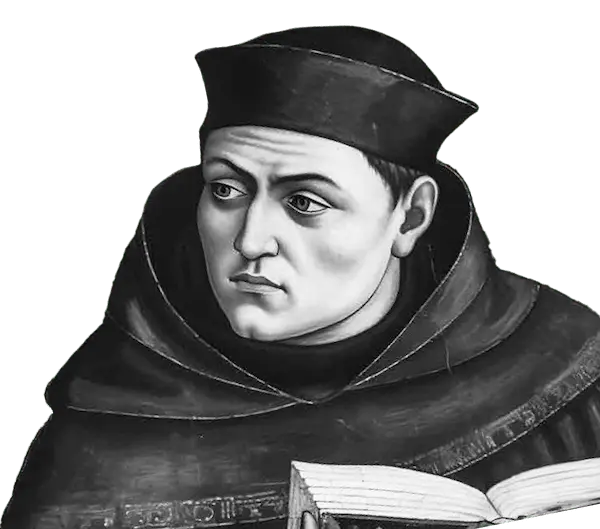
Thomas Aquinas Commentary
Hebrews 5
"For every high priest, being taken from among men, is appointed for men in things pertaining to God, that he may offer both gifts and sacrifices for sins: who can bear gently with the ignorant and erring, for that he himself also is compassed with infirmity; and by reason thereof is bound, as for the people, so also for himself, to offer for sins. And no man taketh the honor unto himself, but when he is called of God, even as was Aaron. So Christ also glorified not himself to be made a high priest, but he that spake unto him, Thou art my Son, This day have I begotten thee: as he saith also in another [place,] Thou art a priest for ever After the order of Melchizedek. Who in the days of his flesh, having offered up prayers and supplications with strong crying and tears unto him that was able to save him from death, and having been heard for his godly fear," — Hebrews 5:1-7 (ASV)
As we said at the beginning of this letter, the Apostle’s intention is to show that Christ is more excellent than all those from whom the Law derives its authority. These include the angels, by whose ministry it was given—Being ordained by angels in the hand of a mediator (Galatians 3:19)—and Moses, who was the lawgiver—The law was given by Moses (John 1:17). It also includes the priesthood and high priesthood of Aaron, by whom the Law was administered.
Having finished discussing the first two, the author now deals with the third point: the excellence of Christ’s priesthood over that of Aaron. In this regard, he does two things:
- He shows that Christ is a high priest.
- He shows that Christ is more excellent than the high priest of the Old Law (see chapter 7).
Concerning the first point—that Christ is a high priest—the author again does two things:
- He demonstrates that Christ is a high priest.
- He prepares his hearers for what follows (v. 11).
To demonstrate that Christ is a high priest, the author does three things:
- He shows what is required of a high priest.
- He shows the compassion necessary in a high priest (v. 2).
- He shows the way of attaining the high priesthood (v. 4).
Regarding the office of high priest, the author mentions four aspects:
- The exalted nature of the office: chosen from among men.
- Its purpose: appointed to act on behalf of men.
- Its context: in relation to God.
- Its function: to offer gifts and sacrifices for sins.
Therefore, the author says this office suits a man, not an angel. Since we have a great high priest, and He is Christ, it follows that He must be a man, for every high priest chosen from among men ought to be a man. God willed that humanity should have someone like themselves to whom they might run for help. For this reason, the Church also has ordained that when a suitable person is found within a community, a foreigner should not be chosen: I will give her vine-dressers out of the same place (Hosea 2:15); You shall set him whom the Lord, your God, shall choose out of the number of your brethren. You may not make a man of another nation king that is not your brother (Deuteronomy 17:15).
A high priest is chosen from the people because he should excel the others, as Saul did (1 Samuel 10:23). Accordingly, Christ asked Peter, whom He wished to set over the others, if he loved Him more than the others (John 21:15).
The end and purpose of the office is that the high priest is appointed to act on behalf of men, that is, for their benefit. He is not appointed for his own glory, for accumulating riches, or for enriching his family: And ourselves, your servants for Jesus’ sake (2 Corinthians 4:5); according to the power which the Lord has given me for edification and not for destruction (2 Corinthians 13:10). If he seeks his own interests, he is not a shepherd but a hired hand.
The nature of this dignity is that the high priest is set over the others in things that pertain to God, just as a leader or ruler is set over a city. As it is written, you shall be for the people to God-ward (Exodus 4:16); and again, for the weapons of our warfare are not carnal, but mighty through God to the pulling down of strong holds (2 Corinthians 10:4). Therefore, just as the things that pertain to the worship of God transcend temporal things, so the pontifical dignity exceeds all other dignities. High priests, then, should not entangle themselves with secular business and neglect the things that pertain to God: No man that warreth entangleth himself with the affairs of this life (2 Timothy 2:4).
The act of the high priest is to offer gifts—that is, voluntary offerings, not extorted ones: Of every man that giveth it willingly with his heart you shall take my offering (Exodus 25:2)—and sacrifices for sins, which are offered to make satisfaction for sins: The priest shall make an atonement for him as concerning his sin, and it shall be forgiven him (Leviticus 4:26). This indicates that everything offered, whether voluntary, under a vow, or for satisfaction, should be offered according to the disposition of the presiding leader.
Then (v. 2) the author shows what is required in the exercise of the high priesthood, namely, pity. In this regard, he does three things:
- He shows that mercy and compassion are required for the exercise of the high priesthood.
- He gives the motive for this mercy (v. 2b).
- He provides the sign of this mercy (v. 3).
The author says that the high priest must act in things that pertain to God, yet he should be a mediator between God and man: I stood between the LORD and you at that time (Deuteronomy 5:5). Therefore, just as he should reach God through the devotion of prayer, so by mercy and compassion he should reach man. Hence, he says the high priest is one who can have compassion on the ignorant and on them that are out of the way. As the Apostle says elsewhere, Who is weak, and I am not weak? (2 Corinthians 11:29). On the other hand, some are not grieved for the affliction of Joseph (Amos 6:6). Defects are of two kinds: some fail from ignorance, and others fall with full knowledge. Regarding the first, he says, on the ignorant, which properly means lacking knowledge of things one ought to know. Regarding the second, he says, and on them that are out of the way, meaning those who err.
The motive for mercy is mentioned when he says, for that he himself also is compassed with infirmity. That motive is weakness. As it is written, But we have this treasure in earthen vessels (2 Corinthians 4:7). The reason for this is so that he may have compassion on the weaknesses of others. This is why the Lord permitted Peter to fall: Judge of the disposition of your neighbor by yourself . Therefore, he says, because he himself also is compassed with infirmity, namely, with penalty and guilt: Have mercy upon me, O LORD; for I am weak (Psalms 6:3); for I am a feeble man, and of short time, and too young for the understanding of judgment and laws .
Note that he says the priest is compassed with (or beset by) infirmity. Carnal men have the weakness of sin within themselves, but they are also beset by the weakness of the flesh: So then with the mind I myself serve the law of God; but with the flesh the law of sin (Romans 7:25).
The sign of this is that it was decreed, both in the Old Law (Leviticus 9) and now, as is clear from the canon of the Mass (“and to us sinners”), that the priest must offer sacrifice for himself. He would not do this unless he were oppressed by the weakness of sins with which he is beset. Indeed, if he is in mortal sin, he should not celebrate the Mass. Therefore, the author says: And by reason hereof he ought, as for the people, so also for himself, to offer for sins.
Next, he describes how one attains the priesthood, saying, And no man taketh this honour unto himself. It is contrary to nature for anything to raise itself to a state higher than its own nature, just as air does not make itself fire but is made so by something higher. Hence, God’s order does not allow anyone to take this honor to himself by favor, money, or power: Have we not taken to us horns by our own strength? (Amos 6:13); they have set up kings, but not by me (Hosea 8:4). Rather, one must be called of God, as was Aaron. The Lord confirmed Aaron’s priesthood with a rod that flowered. Therefore, only those should be accepted who do not impose themselves. In former times, they were indicated by a visible sign, as were Saint Nicholas and many others.
Then (v. 5) he shows how Christ is a high priest. In this regard, he first shows that the previously mentioned qualities belong to Christ, and from this he draws a conclusion (v. 10). To do this, he demonstrates that Christ was made a high priest not by Himself but by God, then treats of His office (v. 7), and finally of His mercy (v. 8). First, he shows that Christ did not promote Himself, and second, by whom He was promoted (v. 5b).
He says, therefore: So also Christ glorified not himself to be made an high priest. It should be noted that he does not say Christ did not make Himself a priest, but that He did not glorify Himself to be made one. Some people exalt themselves to become a priest, like hypocrites who display certain qualities to be chosen or to obtain church offices. Yet no one makes himself a high priest. But Christ not only did not make Himself high priest, He did not even exalt Himself to be made one: I seek not my own glory: there is one that seeketh and judgeth (John 8:50), and later, it is my Father that honoureth me (John 8:54). This is true insofar as He is man, because as God He has the same glory as the Father.
Then (v. 5b) he shows by whom Christ was promoted. He was glorified by the divine judgment, because the Lord spoke to Him in Psalm 2:7: You are my Son; this day have I begotten you, and in Matthew 3:17: This is my beloved Son, in whom I am well pleased. By showing Him begotten from eternity, He shows His glory: Who being the brightness of his glory, and the express image of his person . As man, He also receives the high priesthood from God, as it says in another place: You are a priest for ever after the order of Melchizedek. The Apostle uses the authority of the Psalms as they were more famous and more often consulted.
He says, priest, because Christ offered Himself to God the Father: He loved us, and has given himself for us an offering and a sacrifice to God (Ephesians 5:2). But lest anyone suppose Christ’s priesthood is like that of the Old Law, he distinguishes it on two points. First, its authority, because it is for ever, whereas the other was temporary and passed away with the coming of the One it prefigured. Likewise, its victim has the power to bring one to eternal life, and it lasts forever. Second, its ritual, because animals were offered in the old one, but here bread and wine were offered by its type, Melchizedek. Hence, he says, after the order of Melchizedek.
Then (v. 7) he shows that what pertains to the priestly office belongs to Christ. He shows:
- His condition.
- His act (v. 7b).
- His efficacy (v. 7c).
His condition was that He was taken from men, because, as has been stated, a high priest is taken from among men. Therefore, he says, Who in the days of his flesh. Here, "flesh" is taken to mean the entire human nature: The Word was made flesh (John 1:14). But are the days of His flesh no longer here? It seems they are, for it says in Luke 24:39: a spirit hath not flesh and bones, as you see me have. Why, then, is the time before His Passion and resurrection considered the "days of his flesh" more than now? I answer that "flesh" can stand for the weakness of the flesh, as in 1 Corinthians 15:50: flesh and blood cannot inherit the kingdom of God. Before the Passion, Christ had weak and corruptible flesh. Therefore, he says, in the days of his flesh, meaning the time in which He wore flesh that was like a sinner’s, but was not sinful.
His act was to offer prayers and supplications, which is the spiritual sacrifice Christ offered. They are called prayers, or petitions: The effectual fervent prayer of a righteous man availeth much (James 5:16). They are also called supplications on account of the humility of the one praying: He fell on his face, and prayed (Matthew 26:39). To whom did He pray? To God the Father, who was able to save him from death. He was able to do this in two ways: first, by saving Him from dying: O my Father, if it be possible, let this cup pass from me: nevertheless not as I will, but as you will (Matthew 26:39). Second, by raising Him up from death: because you will not leave my soul in hell (Psalms 16:10); and again: But you, O LORD, be merciful unto me, and raise me up (Psalms 41:10). The priesthood of Christ is ordained for that spiritual sacrifice; hence, He was appointed to offer gifts and sacrifices for sins: Whoso offereth praise glorifieth me (Psalms 50:23); so will we render the calves of our lips (Hosea 14:2).
His efficacy is shown by the way He prays. Two things are necessary in one who prays: fervent love, along with pain and groans. These are mentioned in Psalm 38:9-10: Lord, all my desire is before you, as to the first, and my groaning is not hid from you, as to the second. Christ had both of these. Therefore, regarding the first, he says, with strong crying, meaning with a most powerful intention: And being in an agony he prayed more earnestly (Luke 22:44). Again, in Luke 23:46: And when Jesus had cried with a loud voice, he said, Father, into your hands I commend my spirit. Because of the second, he says, and tears. By tears, the Apostle means the internal groans of the one praying. This is not mentioned in the Gospel, but it is probable that just as He wept at the resurrection of Lazarus, so also He wept during His Passion, for He did many things that are not written. He did not weep for Himself, but for us whom the Passion was to benefit, although it did benefit Him, inasmuch as He merited exaltation by it: Wherefore God also has highly exalted him, and given him a name which is above every name (Philippians 2:9). Therefore, He was heard in that he feared, which refers to the godly fear He had toward God: And the spirit of the LORD shall rest upon him, the spirit of wisdom and understanding... and shall make him of quick understanding in the fear of the LORD (Isaiah 11:2–3).
Nevertheless, it seems that He was not heard; first, for Himself, because the cup did not pass from Him; and second, for the others for whom He begged forgiveness: Father, forgive them; for they know not what they do (Luke 23:34). I answer that Christ was heard in regard to everything He truly willed. He shrank from death under the influence of the sensitive appetite and of the will acting as a natural appetite. It was under these influences that He prayed, thus showing Himself to be a true man. But under the influence of the will informed by reason, He willed to die; hence He says, not as I will, but as you will (Matthew 26:39). Furthermore, He did not will to forgive all of them, but only those who would believe; and many of them were converted later.
"though he was a Son, yet learned obedience by the things which he suffered; and having been made perfect, he became unto all them that obey him the author of eternal salvation; named of God a high priest after the order of Melchizedek. Of whom we have many things to say, and hard of interpretation, seeing ye are become dull of hearing. For when by reason of the time ye ought to be teachers, ye have need again that some one teach you the rudiments of the first principles of the oracles of God; and are become such as have need of milk, and not of solid food. For every one that partaketh of milk is without experience of the word of righteousness; for he is a babe. But solid food is for fullgrown men, [even] those who by reason of use have their senses exercised to discern good and evil." — Hebrews 5:8-14 (ASV)
Having listed three things that belong to a high priest and shown that two of them were fulfilled in Christ—namely, the office and the proper way of attaining it—the Apostle now considers the third requirement: mercy and compassion. In this regard, he does two things: first, he shows what Christ suffered; second, he shows what benefits resulted for others .
The Apostle has stated that a high priest must be able to have compassion, and now he shows that Christ is such a high priest. Since He is the Son of God from all eternity, He could not suffer or have compassion in His divine nature. Therefore, He assumed a human nature in which He could suffer and show compassion. This is what the Apostle means when he says that although Christ was a Son from all eternity, He learned obedience in time.
But only the ignorant can learn, while Christ, being God, had the fullness of knowledge from the very instant of His conception as a man. Therefore, He was not ignorant of anything and, as a result, could not learn in the ordinary sense. I answer that knowledge is of two kinds. The first is intellectual knowledge, and in this respect, the objection is valid because He was not ignorant of anything. But there is also knowledge gained by experience, and it is in this way that He learned obedience. The Apostle says, He learned obedience through what he suffered, meaning He experienced it.
The Apostle speaks this way because one who learns something comes to it voluntarily. Christ voluntarily accepted our weakness; therefore, the author says that He “learned obedience.” He learned how difficult it is to obey because He obeyed in the most challenging circumstances, even to the death of the cross (Philippians 2:8). This shows how difficult the good of obedience is. Those who have not experienced obedience or learned it in difficult situations believe it is very easy. But to truly know what obedience is, one must learn to obey in hard things, and one who has not learned to submit himself by obeying does not know how to rule others well. Therefore, although Christ knew what obedience is through His divine intellect, He nevertheless learned it experientially from the difficult things He suffered in His passion and death. As it is written, By the obedience of one many shall be made just (Romans 5:19).
Then, when he says, and being made perfect he became the source of eternal salvation to all who obey him, he mentions the fruit of His Passion, both in Christ and in His members. In Christ, the fruit was glorification. Hence, he says, and being made perfect. From the instant of His conception, Christ was perfectly complete in the happiness of His soul, as it was drawn to God. But He still had a nature that could suffer, although after His Passion He could not suffer. Therefore, because He was now completely perfect in this respect, He could perfect others, for it is the nature of a perfect thing to be able to produce its like. Because He arrived at that consummation through the merit of obedience—as it is written, The obedient man shall speak of victory (Proverbs 21:28)—He became the source of eternal salvation to all who obey Him, not temporal but eternal: Israel is saved by the Lord with an eternal salvation (Isaiah 45:17).
Therefore he says, being designated by God a high priest after the order of Melchizedech.
Then he prepares the souls of his hearers for what is to follow. In this regard, he does two things: first, he points out their slowness; secondly, he states his intention (see chapter 6). Regarding the first point, he shows the importance of what is to be said, and then he shows their slowness to understand it.
He says, therefore: I have said that Christ was called a high priest, and About this we have much to say. As it is written, Hear, for I will speak of great things (Proverbs 8:6). They are great because they deal with the salvation of souls: A faithful saying and worthy of all acceptation, that Jesus Christ came into the world to save sinners (1 Timothy 1:15). About this we have much to say which is hard to explain, meaning that it cannot be perfectly explained, for no words can express the things of Christ: Glorify the Lord as much as you ever can, for he will yet far exceed, and his magnificence is wonderful. Blessing the Lord, exalt him as much as you can, for he is above all praise . Alternatively, we have much to say which is hard to explain means it needs to be interpreted because of its height, magnitude, and depth: He shall understand a parable and the interpretation, the words of the wise and their mysterious saying (Proverbs 1:6). For the interpretation of Scripture is listed among the gifts of the Spirit (1 Corinthians 12:10).
It also needs to be interpreted because of our slowness: you have become dull of hearing. Those who are weak in intellect cannot understand profound things unless they are explained in detail: I have yet many things to say to you: but you cannot bear them now (John 16:12); I could not speak to you as to spiritual, but as to carnal (1 Corinthians 3:1).
Then he shows that their slowness is culpable. He does three things: first, he mentions the sin of slowness; secondly, he applies a simile; thirdly, he explains it (starting in verse 13).
Slowness is a sin when a person has been listening for a long time, though it is not a sin for a recent hearer. Negligence is not without sin. Therefore, the Apostle says, for though by this time you ought to be teachers of others, considering the time during which you have heard the law and the prophets—Search the Scriptures, for you think in them to have life everlasting (John 5:39)—as well as Christ Himself, the apostles, and many converted by them: Have I been so long a time with you, and have you not known me? (John 14:9).
Yet, you need someone to teach you again the first principles of God’s word. The principles are the first things taught in grammar, namely, the letters themselves. Therefore, the beginnings of the words of God, the first principles and elements, are the articles of faith and the precepts of the Decalogue. If a person studied theology for a long time and failed to learn these, that time would count against him. Therefore, he says, you need someone to teach you again the first principles of God’s word. This is like being one who is Ever learning and never attaining to the knowledge of the truth (2 Timothy 3:7); For the child shall die one hundred years old, and the sinner being a hundred years old shall be left accursed (Isaiah 65:20).
Next, he describes their situation with a simile. It should be noted that sacred doctrine is like the food of the soul: With the bread of life and understanding she shall feed him , and also, They that eat me shall yet hunger, and they that drink me shall yet thirst . Sacred doctrine, therefore, is food and drink because it nourishes the soul. Other sciences only enlighten the soul, but this one both enlightens—The commandment of the Lord is full of light, enlightening the eyes (Psalms 19:8)—and nourishes and strengthens it.
But in bodily food, there is a difference: children use one kind of food and adults another. Children use milk, as it is thinner, more suited to their nature, and easily digestible; but adults use more solid food. So it is in Sacred Scripture: beginners should listen to easy things, which are like milk, but the learned should hear more difficult things. Therefore, he says, you need milk, like children: As newborn babes, desire the rational milk without guile, that thereby you may grow to salvation (1 Peter 2:2); I gave you milk to drink, not meat (1 Corinthians 3:2). And this is what follows: and not solid food, which is lofty doctrine concerning the mysteries and secrets of God, which strengthen and confirm the soul.
Then he explains the simile: first, he explains what he said about milk; secondly, what he said about solid food (in verse 14). Regarding the first, he gives the explanation and then the reason behind it.
He says, therefore: I say that you need milk like little children, for everyone who lives on milk is unskilled in the word of righteousness. This means that everyone who must be nourished with milk is unskilled and cannot fully grasp the word of righteousness: unless your justice abound more than that of the Scribes and Pharisees, you shall not enter into the kingdom of heaven (Matthew 5:20). But children do not partake of such things: Whom shall he teach knowledge? and whom shall he make to understand the hearing? Them that are weaned from the milk, that are drawn away from the breasts (Isaiah 28:9).
But the Apostle had taught them many difficult things, namely, the mystery of the Trinity, the sacrament of the Incarnation, and many other lofty subjects. Therefore, either they were not children, or such things should not have been taught to children. I answer, according to Augustine, that in the teachings of faith we should not suppose that some things are taught to the mature and other things to the immature, for there is not such a difference between them. The same things should be presented to both. But for the little ones, these truths should be merely proposed, not explained or expanded upon, because their minds would falter instead of being elevated.
According to a Gloss, an example of milk would be that the Word was made flesh. But that seems just as hard to understand as that the Word was with God. Augustine says that the latter is found in Plato’s works, but not the former. But, said Augustine, Plato could not have suspected something contained in the mystery of the Word made flesh. I answer that to know by simple faith that the Word was made flesh is quite easy, because it can be imagined and, to a certain extent, perceived by the senses. But that the Word was with God is something that transcends all sensing and can be grasped by reason alone, and only with great difficulty.
Then he gives the reason when he says, for he is a child. This does not mean a child in age but in understanding. A person can be a little child in humility: You have revealed them to little ones (Matthew 11:25); in age: As long as the heir is a child, he differs nothing from a servant (Galatians 4:1); or in understanding: Do not become children in sense, but in malice be children and in sense be perfect (1 Corinthians 14:20). It is in this last way that “child” is meant here.
Then, when he says, but solid food is for the mature, he explains what he had said about solid food. This is evident in bodily food: when a man reaches maturity, he uses stronger, nobler, and more solid food. Likewise, when a spiritual person has reached spiritual perfection, a more solid doctrine should be proposed to him. But perfection is of two kinds. One is perfection of intellect, when a person has the wisdom to discern and judge correctly about matters proposed to him. The other is perfection of love, which charity produces, and it is present when a person adheres entirely to God. Hence, after laying down the precepts of charity, the Lord continues, Be you, therefore, perfect, as your heavenly Father is perfect (Matthew 5:48). But perfection of charity, as Augustine says, is present when there is no covetousness. For the closer a person comes to God, the more he scorns temporal things: For what have I in heaven? and besides you what do I desire upon earth? For you my flesh and my heart have fainted away: you are the God of my heart, and the God that is my portion for ever (Psalms 73:25–26).
The doctrine of Sacred Scripture contains matters not only for speculation, as in geometry, but also matters to be accepted by the will. Hence it is stated in Matthew 5:19: He that shall do and teach, he shall be called great in the kingdom of heaven. Therefore, in the other sciences it is enough that they perfect a person’s intellect, but in this one it is required that he be perfected in both intellect and will. Lofty mysteries should be proposed to the mature: However, we speak wisdom among the perfect (1 Corinthians 2:6). A person judges things according to his own disposition; thus, an angry person judges one way when he is angry and another way when he is calm. Similarly, an incontinent person judges that something is good when he is passionate, and otherwise when the passion has subsided. Consequently, the Philosopher says that as a person is, so his end appears to him. Because the things taught in Sacred Scripture pertain to the will and not only to the intellect, a person must be perfect in both. Therefore, the Apostle, desiring to show who the mature are to whom solid food should be given, says that they are those who have their faculties trained by practice.
He speaks properly here because, as the Philosopher says, the intellect, when it judges what to desire and what to do, is considered a sense because it deals with particular things. Hence the word “sense” is not used here to refer to an external sense. Therefore, one who “senses” the things of God is perfect: Let us, therefore, as many as are perfect, be thus minded (Philippians 3:15); But we have the sense of Christ (1 Corinthians 2:16). But those who sense only carnal things cannot be pleasing to God, as is clear in Romans (see Romans chapter 8).
The second thing to consider is the disposition of the one who has this sense: he should be exercised. Exercise yourself unto godliness (1 Timothy 4:7). One who is not exercised cannot form a correct judgment, which is required for perfection: A man that has much experience shall think of many things . On the other hand, one who is inexperienced knows few things.
Thirdly, the cause of this exercise is custom, not idleness but an abundance of activity. Hence, he says it comes by custom, namely, the custom of acting properly: A young man according to his way, even when he is old, he will not depart from it (Proverbs 22:6). Therefore, if you wish to be perfect, do not give yourself to idleness, but accustom yourself to what is good from your youth.
Fourthly, the end of this exercise is to distinguish good from evil. A person is perfect when he discerns between good and evil, between good and better, and between evil and worse. For many things seem good but are really evil: There is a way which seems just to a man: but the ends thereof lead to death (Proverbs 14:12). It is in these matters, therefore, that correct judgment is needed.
Jump to: