
Thomas Aquinas Commentary Hebrews 7
Thomas Aquinas Commentary
Hebrews 7
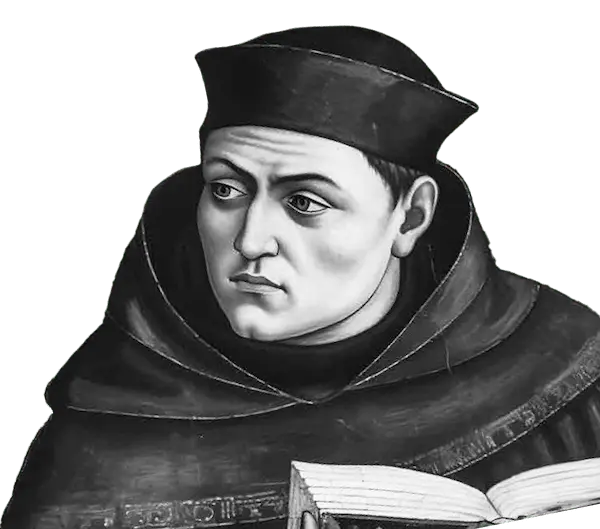
Thomas Aquinas Commentary
Hebrews 7
"For this Melchizedek, king of Salem, priest of God Most High, who met Abraham returning from the slaughter of the kings and blessed him, to whom also Abraham divided a tenth part of all (being first, by interpretation, King of righteousness, and then also King of Salem, which is King of peace; without father, without mother, without genealogy, having neither beginning of days nor end of life, but made like unto the Son of God), abideth a priest continually." — Hebrews 7:1-3 (ASV)
In Hebrews 5, the Apostle proved that Christ is a priest, but in Hebrews 6, he inserted certain points to prepare the minds of his hearers. Now he returns to his main theme, intending to prove the excellence of Christ’s priesthood over the Levitical priesthood.
In this regard, he does two things. First, he shows the excellence of Christ’s priesthood compared to the priesthood of the Old Testament. Second, he shows that believers should reverently subject themselves to the priesthood of Christ (Hebrews 10).
Concerning the first point, he again does two things. First, he shows the superiority of Christ’s priesthood over the Levitical regarding the person of the priest. Second, he addresses the superiority of Christ's ministry (Hebrews 8).
Focusing on the person of the priest, he first proves the existence of Christ’s priesthood because of a divine promise, and second, he proves the need for this priesthood (Hebrews 7:26). He demonstrates this promise from the words of Psalm 109:4: The Lord has sworn and he will not repent: You are a priest forever according to the order of Melchizedek.
From this verse, he draws three points to prove his thesis: first, the phrase, according to the order of Melchizedek; second, the statement He swore (Hebrews 7:20); and third, the statement, You are a priest forever (Hebrews 7:23).
Regarding the first point, he does two things: first, he shows the likeness of Christ to Melchizedek, and second, based on this likeness, he establishes the superiority of Christ’s priesthood over the Levitical (Hebrews 7:4). To show this likeness, he first describes Melchizedek’s qualities and then shows how they apply to Christ (Hebrews 7:2b).
He describes Melchizedek, first of all, by his name when he says, For this Melchizedek. Scripture names him this way in Genesis 14:18, where his history, which the Apostle assumes here, is recorded. According to a gloss, the Hebrews say that this was Shem, the first-born of Noah. When Abraham won the victory, Shem was 390 or 309 years old and met Abraham, his nephew.
Second, he describes him by his dignity, for he was both a king and a priest. Regarding his kingship, the text says he was king of Salem. Some say that Salem is another name for Jerusalem. However, Jerome denies this in a letter, arguing that based on its location, Melchizedek could not have run into Abraham from Jerusalem. Others say that Salem is the place where John baptized (John 3:23), and that the walls of that place still existed in Jerome’s time.
Regarding his priesthood, the text says he was a priest of the Most High God. In ancient times, the elder brother was often the priest. However, because the worship of idols was increasing in Abraham’s time, the author adds the phrase of the Most High God so that no one would think Melchizedek was a priest of idols. This refers to God by His essence, not by participation or by name only.
For God is the Creator of all who are called gods, whether by participation or in error, as the Psalm says, The Lord is a great king above all gods (Psalms 94:3). And elsewhere, You shall be called priests of the Lord: to you it shall be said: You ministers of our God (Isaiah 61:6).
Third, he describes him by his office: who met Abraham returning from the slaughter of the kings and blessed him. A priest stands between God and the people. Therefore, he should confer spiritual things upon the people and receive temporal things from them: If we then have sown unto you spiritual things, is it a great matter, if we reap your carnal things? (1 Corinthians 9:11).
First, a priest should offer strength through good counsel. Thus, it is said in Genesis 14 that the four kings represent the four principal vices opposed to the four cardinal virtues, which hold the emotions—the nephew of reason—captive after the five bodily senses are overcome. A person who overcomes and frees the emotions deserves to be comforted by a priest: Meeting the thirsty, bring him water (Isaiah 21:14); Strengthen the feeble hands, and confirm the weak knees (Isaiah 35:3).
Second, a priest should give strength by administering the sacraments with a blessing; hence, he blessed him. As the Psalm says, We have blessed you in the name of the Lord (Psalms 117:26). This is done by conferring the sacraments, through which a person is strengthened in grace: They shall invoke my name upon the children of Israel and I will bless them (Numbers 6:27). For God blesses by His authority, but the priest blesses by his ministry. In return, Abraham apportioned... a tenth part of everything, that is, he properly distributed tithes to him for his sustenance.
But it seems from Numbers 18:21 that the giving of tithes began with the Law, meaning there were none before the Law. I answer that the ceremonial precepts of the Old Testament are expansions of the precepts of natural law and moral law. Therefore, those aspects derived from natural law were observed before the Law, even without a specific command.
For example, it is natural to offer something to God in recognition of His creation and dominion, but the specific offering of goats and heifers is a ceremonial precept. Similarly, it is according to natural law that ministers serving God should be sustained by the people, as is clear from Genesis 47:22 that this was even observed among the Gentiles. There, priests were fed from public storehouses and were not compelled to sell their possessions.
Therefore, tithes existed before the Law, but the specific amount was fixed by the Law: All tithes are the Lord’s (Leviticus 27:30). A sign of this is that Jacob, before the Law, vowed to give tithes in the place where the temple was later built. This was done particularly because the main reason for rendering worship to God is to signify that whatever a person has, he has received from God, and that he depends on God for his entire perfection.
The number ‘ten’ is perfect because it is the sum of its parts (one plus two plus three plus four equals ten). Furthermore, we count up to ten, and all other numbers are repetitions of or additions to ten. Therefore, all numbers are imperfect until ten is reached. Likewise, all perfection is from God. To signify that the fulfillment of all perfection is from God, he gave tithes.
Then, in Hebrews 7:2b, the Apostle shows the likeness to Melchizedek. He does this in two ways: first, he suggests a likeness regarding the condition of the person, and second, a likeness regarding the priesthood (Hebrews 7:3b). Concerning the person, he again does two things: first, he states a likeness based on things recorded in Scripture, and second, a likeness based on things not mentioned in Scripture (Hebrews 7:3).
Two things are said of Melchizedek in Scripture. First is his name, Melchizedek, which by translation means king of righteousness. This signifies Christ, who was a king: And a king shall reign, and shall be wise: and shall execute judgement and justice in the earth (Jeremiah 23:5). Christ is not only called righteous, but the king of righteousness, because He was made wisdom and righteousness for us (1 Corinthians 1:30).
The second thing said of him is his status; he is called king of Salem, that is, king of peace. This also suits Christ: For he is our peace (Ephesians 2:14), and, In his days shall justice spring up and abundance of peace (Psalms 71:7). In this, the Apostle teaches us to use the interpretation of names in preaching.
He does well to join justice and peace, because no one can make peace who does not observe justice: The work of justice shall be peace (Isaiah 32:17). In this world, people are governed in justice, but in the world to come, they will be governed in peace: My people shall sit in the beauty of peace (Isaiah 32:18).
When the Apostle says Melchizedek was without father or mother or genealogy, he presents a likeness based on things not mentioned about him in Scripture. Because of this, some of the ancients fell into error, saying that since God alone is without beginning and end, Melchizedek must have been the Son of God. This, however, has been condemned as heretical.
It should be noted that whenever the Old Testament mentions an important person, like Isaac and many others, it names his father and the time of his birth and death. But here, Melchizedek is suddenly introduced with no mention of his birth or anything related to it. This was not done without reason.
Since it is said he was without father, this signifies the birth of Christ from the Virgin, which occurred without a human father: That which is born in her is of the Holy Spirit (Matthew 1:20). What is proper to God should not be attributed to a creature, and it is proper to God the Father to be the Father of Christ. Therefore, in the birth of the one who prefigured Him, no mention should be made of a carnal father.
Regarding Christ's eternal birth, the text says without mother, so that no one would think that birth was material, since the mother provides the matter for her offspring. Instead, it is a spiritual birth, like brightness from the sun: Who being the brightness of his glory and figure of his substance (Hebrews 1:3). Also, when generation proceeds from a father and a mother, it is not all from the father, as the mother provides the matter. Therefore, to exclude all imperfection from Christ and to show that all He has is from the Father, no mention is made of a mother. Hence the verse: ‘He is God without a mother; He is flesh without a father.’ As the Psalm says, From the womb before the day star I begot you (Psalms 109:3), meaning, ‘I alone.’
He is without genealogy for two reasons. First, because the generation of Christ is ineffable: Who shall declare his generation? (Isaiah 53:8). Second, because Christ, who is introduced as a priest, does not belong to the Levitical priesthood or to a genealogy of the Old Law. This is the Apostle’s intention.
Hence, he says Melchizedek has neither beginning of days nor end of life. He says this not because Christ was not born in time or did not die, but because of His eternal generation, in which He was born without the beginning of any time. As Basil explains, In the beginning was the Word (John 1:1) means that no matter what time you mention, the Word was before it. Likewise, no end of life is true regarding His divinity, which is eternal. Regarding His humanity, He no longer has an end of life, because Christ rising again from the dead, dies now no more (Romans 6:9). And as it says below, Jesus Christ, yesterday, and today; and the same forever (Hebrews 13:8).
When the Apostle says, but resembling the Son of God he continues a priest forever, he indicates a likeness regarding the priesthood. It should be noted that later things are sometimes said to be similar to earlier things, and vice versa. Consequently, so that no one would think that Christ’s priesthood is later than Melchizedek’s, the Apostle dispels this idea.
Although Christ as a man was born after Melchizedek and existed in time, as God and as the Son of God, He exists from eternity. Therefore, Melchizedek was like Christ, the Son of God, in all these features. This is true insofar as he continues a priest forever, which can be explained in two ways.
First, it can mean that no mention is made in Scripture of the end of his priesthood or of his successor, as God says, I have used similitudes by the ministry of the prophets (Hosea 12:10). Second, he is called a priest forever because that which he prefigured—namely, Christ’s priesthood—lasts forever.
For this reason, even in Scripture, temporary symbols are frequently referred to as perpetual, such as, It shall be a perpetual observance (Exodus 27:21), and, By a perpetual service and rite (Leviticus 24:3), because that which was symbolized by them is perpetual. In this way, the Apostle connects this point with what came before.
"Now consider how great this man was, unto whom Abraham, the patriarch, gave a tenth out of the chief spoils. And they indeed of the sons of Levi that receive the priest`s office have commandment to take tithes of the people according to the law, that is, of their brethren, though these have come out of the loins of Abraham: but he whose genealogy is not counted from them hath taken tithes of Abraham, and hath blessed him that hath the promises. But without any dispute the less is blessed of the better. And here men that die receive tithes; but there one, of whom it is witnessed that he liveth. And, so to say, through Abraham even Levi, who receiveth tithes, hath paid tithes; for he was yet in the loins of his father, when Melchizedek met him." — Hebrews 7:4-10 (ASV)
Having shown how Melchizedek was likened to the Son of God, the Apostle now shows the preeminence of Melchizedek’s priesthood over the Levitical. Regarding this, he does two things: first, he captures their attention; second, he states his thesis (verse 5).
He captures their attention by saying that he is about to speak of great and important matters: Hear, for I will speak of great things (Proverbs 8:6). Therefore, he says, see how great—that is, of what great dignity—he is, to whom Abraham the patriarch gave a tithe of the spoils. Cursed is the deceitful man, that has in his flock a male, and making a vow, offers in sacrifice that which is feeble, to the Lord (Malachi 1:14).
Abraham is called a patriarch—that is, the chief of fathers—not because he had no father, but because the promise of being the father of the Gentiles was made to him: You shall be a father of many nations (Genesis 17:4); Abraham was the great father of a multitude of nations ; I have made you a father of many nations before God whom he believed (Romans 4:17).
Then, in verse 5, he shows the preeminence of Melchizedek’s priesthood over the Levitical. In this regard, he does two things: first, he states his proposition; second, from this he concludes his thesis: that Christ’s priesthood is superior to the Levitical (verse 11). The first part is divided into two sections: in the first, he states his proposition; in the second, he rejects a certain response (verse 9). Regarding the first, he does two things:
- He shows the preeminence regarding the exercise of his priesthood.
- He shows the preeminence regarding the nature of the priesthood (verse 8).
Two things pertain to a priest: to receive tithes and to bless. Therefore, the author does two things: first, he shows Melchizedek’s excellence regarding the reception of tithes; second, regarding blessing (verse 6b). Concerning the first, he shows who is qualified to accept tithes, and then how Melchizedek did this more excellently (verse 8).
He says, therefore: And those descendants of Levi who receive the priestly office have a commandment in the law to take tithes from the people. In this, he shows that it belongs to priests to take tithes. It should be noted that the members of Levi’s tribe were appointed for divine worship, but among them, only the descendants of Aaron were priests: Take to you also Aaron, your brother, with his sons from among the children of Israel, that they may minister to me in the priest’s office (Exodus 28:1). Hence, those who belonged to the tribe of Levi through Aaron took tithes.
This would seem to indicate that the priests alone took tithes, which is contrary to what is said in Numbers 18:21: I have given to the sons of Levi all the tithes of Israel. I answer that the Levites received them only because they ministered to the priests; as a result, the tithes were given not for themselves but for the priests. Furthermore, the Levites received only one-tenth of the tithes, as it says in Numbers 18:26; therefore, only the priests received tithes and did not pay them.
Secondly, he shows by what right they received them: by a commandment of the Law. Hence, he says, they have a commandment in the law to take tithes. But if this is a commandment of the Law, then, since the observance of such a commandment is now a sin, it seems unlawful to give or to receive tithes now. I answer that there were some precepts in the Law that were purely ceremonial, such as circumcision and the sacrifice of the lamb. Since such laws were only figurative, it is no longer permissible to observe them, for they were a figure of something to come. Anyone who observes them now would be signifying that Christ is still to come.
Other precepts were purely moral, and these must be observed now. Among these was the giving of tithes, as was explained above. Hence, tithing was practiced under the Law and under the New Testament: The worker is worthy of his food (Matthew 10:10); The worker is worthy of his hire (Luke 10:7). The determination of such a portion is now made by the Church, just as in the Old Testament it was determined by the Law. Still others were partly ceremonial and partly moral, such as the judicial precepts. These laws are no longer to be used in regard to what is ceremonial, but in regard to what is moral, they must be obeyed. Yet it is not necessary that they be observed in their original form.
Another objection arises: If this commandment were still in effect, then one who does not take tithes sins, and those who do not give them also sin. I answer that some say that no one may lawfully renounce his right to take tithes, but it is lawful to renounce the practice of taking them to avoid causing scandal, following the example of the Apostle who took no sustenance from anyone. So they say that they are commanded not to renounce the right. But it is better to say that they are not commanded to take them; rather, they have this command established for their benefit, so that they are permitted to take tithes, and the people are bound to give them.
Thirdly, he shows from whom they received tithes: from the people, that is, from their brethren, even though these brothers also descended from the loins of Abraham. He anticipates an objection: someone might say that just as Melchizedek received tithes from Abraham, so too did his descendants, the Levites, and therefore, Melchizedek's priesthood is not superior to theirs. The author refutes this by stating that the Levites themselves were of Abraham's seed and were therefore inferior to Abraham, who paid the tithes.
Then when he says, But this man who does not have their genealogy received tithes from Abraham, he shows how Melchizedek was more worthy to receive tithes because he was not of Abraham’s lineage; hence, he does not share their genealogy—that is, the Levites'. Furthermore, it was lawful for the Levites to take tithes according to a commandment of the Law; consequently, their priesthood was subject to the observance of the Law. But Melchizedek took tithes not by reason of any law, but from his own authority. Therefore, his priesthood was a figure of Christ’s priesthood, which is not subject to the Law. Likewise, the Levites received tithes from a lesser people—namely, their own brethren—but Melchizedek received them from the highest, the patriarch Abraham.
Then when he says, and blessed him that had the promises, he shows Melchizedek’s excellence from the standpoint of the blessing. His reasoning is this: in Genesis 14:19 it says that Melchizedek blessed Abraham, but one who blesses is greater than the one blessed; therefore, Melchizedek is greater. Hence, he says that Melchizedek blessed Abraham, who had the promises. However, it says below in Hebrews 11:39: They received not the promise. I answer that Abraham did not receive the fulfillment of the promise, because he did not obtain it in his lifetime; but he possessed it in faith and hope, and the promises were made specifically to him.
Then when he says, it is beyond dispute that the inferior is blessed by the superior, he states the major premise of his reasoning. But here there are three objections. The first concerns the statement that the lesser is blessed by the better. On this point, the Poor Men of Lyons claim that any just person is greater than a sinner; consequently, a just layman is not blessed by a wicked priest, but the reverse. They would have it that every just man is a priest and no sinner is a priest.
I answer that this error is most destructive, because if a good minister is required for conferring the sacraments, in which salvation is found, it follows that no one could be sure of his salvation or know whether he was properly baptized, because he cannot know if the priest was just. For no one could be a minister, because no one knows whether he is worthy of hatred or love (Ecclesiastes 9:1). Therefore, it should be noted that a person can do something in two ways: either by his own authority or by someone else’s. When it is by his own authority, it is required that he be just. But a priest is only a minister; hence, he acts only in the power of Christ: Let a man so account of us as the ministers of Christ, and the dispensers of the mysteries of God (1 Corinthians 4:1). Therefore, it does no harm whether the priest is good or bad, because it is Christ Who blesses through him. Hence, without any contradiction, the one who is greater blesses.
The second objection is this: since Christ is greater than any priest, how can a priest consecrate the body of Christ? I answer that the priest blesses the elements, not the body of Christ. Furthermore, he does not act by his own authority, but by that of Christ, Who as God is greater than His body.
The third objection is that it does not seem true that the greater always blesses the lesser, because the Pope is consecrated by a bishop, and an archbishop by a suffragan, both of whom are of lower rank. I answer that a bishop does not consecrate the Pope, nor the suffragan the archbishop; rather, they consecrate this man to be Pope or archbishop. Furthermore, they do this as ministers of God, Who is greater than the Pope.
Then when he says, Here tithes are received by mortal men, he shows the preeminence of the priesthood regarding the priest's own state. His reasoning is this: That which is not corrupted is more excellent. But in the Levitical priesthood, mortal men—that is, men whose office passes on through death—receive tithes. But there, in the priesthood of Melchizedek, they are received by one of whom Scripture testifies that he lives. Scripture makes no mention of his death, not because he did not die, but because he signifies a priesthood that continues forever: Christ, rising again from the dead, dies now no more (Romans 6:9); I was dead, and behold I am living forever and ever (Revelation 1:18).
Then when he says, and one might say that even Levi who received tithes, paid tithes through Abraham, he refutes a potential objection. For someone might say: it is true that Melchizedek is greater than Abraham who gave him tithes, but Levi is greater than Melchizedek. The Apostle argues that this is not a valid counterargument, because one might say that through Abraham, even Levi paid tithes to him who received them, that is, to Melchizedek. Therefore, Melchizedek is still greater than Levi.
However, an objection could be raised: if a bishop's father gives tithes, that does not make the bishop lesser than the one who receives them. Therefore, the same should hold true here. I answer that the situations are not the same, because the entire dignity of the Jewish race and of its priests stemmed from Abraham; but in the case of a bishop, his entire dignity derives from Christ, not from his father.
Then, in verse 10, he explains what he had said. He says that Levi was still in the loins of his father, Abraham, when Abraham gave tithes to Melchizedek, who met him. Consequently, when Abraham paid tithes, Levi also paid tithes in him. However, another objection arises: Christ was also in Abraham's loins, just as Levi was: The son of David, the son of Abraham (Matthew 1:1). Therefore, if the reason Melchizedek is greater than Levi is that Levi paid tithes in Abraham, there seems to be no reason why Christ did not also pay tithes; consequently, Melchizedek would be greater than Christ.
The same difficulty applies to original sin, because as it says in Romans 5:12, In whom all have sinned—that is, in Adam. Therefore, it seems that Christ, Who existed in Adam in the same way as we, should have contracted original sin. I answer that all this is understood in regard to those who were in Abraham or in Adam according to seminal reasons or bodily substance. For Christ, with respect to His body, was conceived from the most pure and holy substance of the Blessed Virgin, as it says in the Sentences (Book 3, Distinction 5).
"Now if there was perfection through the Levitical priesthood (for under it hath the people received the law), what further need [was there] that another priest should arise after the order of Melchizedek, and not be reckoned after the order of Aaron? For the priesthood being changed, there is made of necessity a change also of the law. For he of whom these things are said belongeth to another tribe, from which no man hath given attendance at the altar. For it is evident that our Lord hath sprung out of Judah; as to which tribe Moses spake nothing concerning priests. And [what we say] is yet more abundantly evident, if after the likeness of Melchizedek there ariseth another priest, who hath been made, not after the law of a carnal commandment, but after the power of an endless life: for it is witnessed [of him,] Thou art a priest for ever After the order of Melchizedek. For there is a disannulling of a foregoing commandment because of its weakness and unprofitableness (for the law made nothing perfect), and a bringing in thereupon of a better hope, through which we draw nigh unto God." — Hebrews 7:11-19 (ASV)
Having proved the preeminence of Melchizedek’s priesthood over the Levitical, the Apostle now concludes that Christ’s priesthood is more excellent than the Levitical. As stated at the beginning of chapter 7, the Apostle proves his proposition from three statements taken from the Psalmist, starting with the phrase, according to the order of Melchizedek. He first proved the preeminence of Melchizedek over Levi. Now, based on the order of Melchizedek’s priesthood, he proves Christ’s preeminence over the Levitical.
Therefore, he emphasizes the phrase according to the order and gives two reasons. The first reason concludes that Christ’s priesthood is preferred to the Levitical; the second, that it even makes it void (as seen in verse 15). The first reason is conditional, presenting two antecedents and two consequents, which prompts the question: what further need would there have been for another priesthood to arise according to the order of Melchizedek?
His reasoning is as follows: If the Levitical priesthood, through whose ministry the Law was given, had been perfect, there would have been no need for another priest from another order, through whom another Law is administered. But another priest has arisen according to another order—that of Melchizedek. Therefore, the first priesthood was imperfect. And just as another priesthood has arisen, so it is necessary that another Law arise.
In this reasoning, it is clear that there are two antecedents: one relating to the priesthood and the other to the Law. Regarding the first antecedent, he says, if perfection was attainable by the Levitical priesthood. Regarding the second, he notes that a law is administered by a priesthood, which he proves, because under it (that is, by its administration) the people received the law. This does not mean the priesthood came before the Law; rather, the reverse was true. He states the second antecedent when he says, for under it the people received the law, for The lips of the priest shall keep knowledge; and they shall seek the law at his mouth (Malachi 2:7).
He mentions the priesthood specifically in order to transition to the Law, which was administered by the priestly office. For as a gloss says, there can be no priest without a covenant, a law, and precepts. But the priesthood brought nothing to perfection, for its entire perfection was tied to the Law they administered. And as will be shown later, The law brought no one to perfection, because it did not lead to the perfection of righteousness: Unless your justice abound more than that of the Scribes and Pharisees, you shall not enter the kingdom of heaven (Matthew 5:20). Likewise, it did not bring the perfection of heaven, because it did not bring one into life. A sign of this was that the lawgiver himself could not enter the promised land.
We have these two perfections, however, through Christ: The consumption abridged shall overflow with justice (Isaiah 10:22); and A short word shall the Lord make upon the earth (Romans 9:28). These, therefore, are the antecedents.
Next, he presents the consequents when he asks, what further need would there have been for another priest to arise after the order of Melchizedek, rather than one named after the order of Aaron? That is, God would not have said, according to the order of Melchizedek, but “according to the order of Aaron.” Because God did not say this, the Aaronic order was imperfect. This is the entire first reason, through which it is clear that Christ’s priesthood is preferred to the Levitical.
The second reason proves that Christ’s priesthood even made the Levitical one void, because the perfect makes void the imperfect: When that which is perfect is come, that which is in part shall be done away (1 Corinthians 13:10). Therefore, the priesthood of Christ does away with the Levitical priesthood.
The second consequent is that the new priesthood also does away with the Law that was administered by the old one. The author states this when he says, When there is a change in the priesthood, there is necessarily a change in the law as well. Since the Law was under the administration of the priesthood, it is necessary that the Law be changed when the priesthood is transferred, just as a person who changes his mind about traveling by water also changes his mind about finding a ship.
Every law is ordained for leading one’s life according to some rule. Thus, according to the Philosopher (Aristotle) in the Politics, when the way of life changes, the law must also change. Just as human law is ordained for human guidance, a spiritual and divine law is for divine guidance. But this guidance is regulated by a priesthood. Therefore, with the priesthood being transferred, it is necessary that the Law also be transferred.
The author speaks carefully, because he does not say, “the priest being transferred,” for the law does not concern the individual person of the priest. When a priest dies, the law is not changed, unless perhaps the entire method and order of guidance is changed. Jeremiah speaks of this change when he says: Behold, the days shall come, says the Lord, and I will make a new covenant with the house of Israel and with the house of Judah, not according to the covenant I made with your fathers (Jeremiah 31:31). Likewise, Paul says, For the law of the spirit of life in Christ Jesus has delivered me from the law of sin and of death (Romans 8:2). The Old Law is called the law of sin and of death because it did not confer grace ex opere operato, as the sacraments of the New Law do.
Here the Manicheans raise an objection: If the Old Law was given by divine providence, which is unchangeable, the Law itself should be unchangeable and should not be altered. Therefore, since it was changed, it must not have been given by divine providence.
I answer, as Augustine says in Against Faustus, that just as a wise dispenser, by one and the same providence, gives different laws according to different times and persons—one law for summer and another for winter, one for children and another for adults, one for the perfect and another for the imperfect—and yet it is the same providence at work. So too, with divine providence remaining unchanged, the Law was changed to fit the times. Before the coming of Christ, precepts were given to prefigure His coming; after His coming, precepts were given to signify that He had come. Furthermore, the precepts of the Old Law were given to people as if to children, but in the New Law, as to the perfect. Hence, the Law is called a “pedagogue,” a term for a guardian of children. Therefore, if anything in the Law suggests permanence, it is because of the One who was prefigured.
A gloss here states that this transfer of the priesthood was prefigured in 1 Samuel 2:28, when the priesthood was transferred to Samuel, who was not of the tribe of Levi. However, because Samuel was not a priest, this transfer seems instead to be prefigured by the transfer of the priesthood from Abiathar to Zadok, who was also a Levite. I answer that although Samuel was not a priest, he performed some priestly functions, offering sacrifices and anointing kings Saul and David. In this respect, the priesthood had been transferred to him. Hence, it says in Psalm 98:6: Moses and Aaron among his priests: and Samuel among them that call upon his name.
Furthermore, contrary to the gloss’s claim that Samuel was not a Levite, 1 Chronicles 7:23 numbers Elkanah, his father, among the sons of Levi. I answer that Samuel was, in a sense, from the tribe of Judah on his mother’s side, but on his father’s side he was of the tribe of Levi, though not descended from Aaron. Regarding his location, he was from Mount Ephraim. For although eleven tribes had their own provinces, the tribe of Levi did not; instead, they took up residence among the other tribes, and so Samuel dwelt in Mount Ephraim.
When the author says, he of whom these things are spoken belonged to another tribe, he clarifies his previous point that the priesthood was transferred, and he explains this further in verse 14.
He says that the priesthood was transferred because the one to whom the prophet said, You are a priest forever, is from another tribe—Judah, not Levi (as is clear from Matthew 1:3). And from this tribe of Judah, no one has served at the altar. An objection might be raised concerning King Uzziah, who entered the temple to burn incense, as it says in 2 Chronicles 26:16. I answer that no one from another tribe could lawfully serve at the altar or do so without punishment. Uzziah was severely punished, for he was struck with leprosy until the day he died.
Another objection might be that it is wrong to say “no one,” because the Blessed Virgin was related to Elizabeth, who was one of the daughters of Aaron (Luke 1:5), suggesting a Levitical connection. I answer that the priestly and royal families were the most illustrious and frequently intermarried. This is clear in the case of the first high priest, Aaron, who married the daughter of Amminadab, the sister of Nahshon, who was a leader of the tribe of Judah (Exodus 6:23). Furthermore, in 2 Kings 11, the priest Jehoiada married Jehosheba, daughter of King Joram. Therefore, it is possible that Elizabeth was of the tribe of Judah on one side of her family.
The author then explains his point further, saying, It is evident that our Lord descended from Judah, about whom it is also written, The lion of the tribe of Judah has conquered (Revelation 5:5). Regarding that tribe, Moses said nothing about priests. The Law commanded that only those from the tribe of Levi could be entrusted with the ministry of the tabernacle; therefore, Moses said nothing about priests from the tribe of Judah.
When the author says, This becomes even more evident, he introduces his second major reason. Having already presented one reason to prove that Christ’s priesthood is preferred over the Levitical and does away with it, he now shows why it is set aside and changed. He uses a conditional argument, laying out two antecedents and then two consequents. He first presents the antecedents and then clarifies them in verse 17.
His reasoning is this: If a new priest arises, he will not arise according to the law of a carnal commandment, but according to the power of an indestructible life. This is because the first priesthood was according to a carnal law, so it is fitting that the new one be according to a different law. And a new priest does, in fact, arise. The major premise contains two statements. The first relates to the Old Testament, calling it a “carnal commandment” because it involved carnal observances like circumcision and purifications of the flesh, and because it promised carnal rewards and punishments: If you be willing and will hearken to me, you shall eat the good things of the land (Isaiah 1:19); and they were Justices of the flesh laid on them until the time of correction (Hebrews 9:10).
The author lays down this antecedent when he says, and this becomes even more evident, if according to the likeness of Melchizedek there arises another priest. The second statement clearly relates to the New Testament, which is not administered through carnal things but consists of spiritual things. It is founded on a spiritual power that produces eternal life in us, and it promises eternal rewards and punishments: But Christ, being come a high priest of the good things to come (Hebrews 9:11); and And these shall go into everlasting punishment; but the just into life everlasting (Matthew 25:26). Furthermore, it does not consist in carnal observances but in spiritual ones: The words I have spoken to you are spirit and life (John 6:64). This is what he means by saying the new priesthood is according to the power of an indestructible life.
Then, when he says, For he testifies: ‘You are a priest forever, after the order of Melchizedek,’ he clarifies what he has said. He emphasizes the word forever, because if the priesthood is eternal, it clearly involves permanence.
Next, when he says, On the one hand, a former commandment is set aside, he presents two consequents: first, the setting aside of the Old Testament, and second, the institution of the New.
The first consequent is that the former commandment, which came about by the law of carnal commandments, is changed when the other is introduced. This is what the author means by a setting aside of the former commandment. But one might object that nothing is set aside unless it is evil, as Isaiah says, That he may know how to refuse the evil (Isaiah 7:15). The commandment, however, is not evil, for The law indeed is holy, and the commandment holy and just and good (Romans 7:12).
I answer that the commandment was not evil in itself, but only insofar as it was unsuited to the time. The practices of the Old Testament are not to be kept in the New: Sacrifice and oblation you did not desire: then said I: behold, I come (Psalms 39:8). Therefore, it is said to be set aside because of its weakness and uselessness. It is called “weak” because it cannot produce its proper effect, which for the Law and the priesthood is to justify. This the Law was unable to do: For what the law could not do in that it was weak through the flesh; God sending his own Son in the likeness of sinful flesh and of sin has condemned sin in the flesh (Romans 8:3). Paul also asks, How turn you again to the weak and needy elements, which you desire to serve again? (Galatians 4:9).
Likewise, it is called “useless” insofar as it only prepared one for the faith, but did not deliver the final reality: All these died according to the faith, not having received the promises (Hebrews 11:13). The author shows why it is weak and useless when he says, it made nothing perfect regarding either righteousness or eternal life. Hence, it was imperfect, but it was made perfect by Christ.
Then, when he says, on the other hand a better hope is introduced, he presents the second consequent from the second antecedent. He says that a better hope is introduced by the new priest, through which we draw near to God. The antecedent was: if a new priest arises, it is according to the power of an indestructible life. The consequent is the introduction of a better hope: He has regenerated us unto a lively hope by the resurrection of Jesus Christ (1 Peter 1:3). Through Him we draw near to God, for we are separated from God by sin: But your iniquities have divided between you and your God, and your sins have hid his face from you that he should not hear (Isaiah 59:2). He, therefore, is the one who removes this separation and makes us draw near to God. He is that new Priest, Christ, who takes away the sins of the world: Being justified, therefore, by faith, let us have peace with God through our Lord Jesus Christ, by whom also we have access into this grace (Romans 5:1).
"And inasmuch as [it is] not without the taking of an oath (for they indeed have been made priests without an oath; but he with an oath by him that saith of him, The Lord sware and will not repent himself, Thou art a priest for ever); by so much also hath Jesus become the surety of a better covenant. And they indeed have been made priests many in number, because that by death they are hindered from continuing: but he, because he abideth for ever, hath his priesthood unchangeable. Wherefore also he is able to save to the uttermost them that draw near unto God through him, seeing he ever liveth to make intercession for them. For such a high priest became us, holy, guileless, undefiled, separated from sinners, and made higher than the heavens; who needeth not daily, like those high priests, to offer up sacrifices, first for his own sins, and then for the [sins] of the people: for this he did once for all, when he offered up himself. For the law appointeth men high priests, having infirmity; but the word of the oath, which was after the law, [appointeth] a Son, perfected for evermore." — Hebrews 7:20-28 (ASV)
Having proved by the authority of the Psalmist that the priesthood of Christ is superior to the Levitical and replaces it, the Apostle now proves the same thing by two other arguments: first, from the fact that he says, “The Lord has sworn”; and secondly, that he says, “You are a priest” (Hebrews 7:21, 17).
Regarding the first point, he forms the following argument: That which is instituted without an oath is less valid than that which is instituted with an oath. The priesthood of Christ was instituted with an oath, as is clear from the words, the Lord has sworn. The priesthood of Aaron, however, was not, as is clear from Exodus 28:1: Take to you also Aaron, and so on. Regarding the major premise, the Apostle says it was not without an oath. Those who formerly became priests took their office without an oath, but this one was appointed with an oath. All this is written to prove that the priesthood of Christ is more secure, because, as has been stated, every promise made in the Old Testament with an oath is a sign of God’s unchangeable plan.
Therefore, because the promise about Christ was made with an oath through David and to Abraham, Christ is called their son in a special way (Matthew 1:1). That oath signifies the eternity of Christ’s power: His power is an everlasting power (Daniel 7:14); And of his kingdom there will be no end (Luke 1:33).
This makes Jesus the surety of a better covenant, because His priesthood is more secure, which is evident because it was established with an oath. Therefore, it is necessary that something better and more secure be obtained by it. It should be noted that a priest is a mediator between God and the people: I was the mediator and stood between the Lord and you (Deuteronomy 5:5). A priest should bring God and the people to concord. This was accomplished, so to speak, by a pact dealing with temporal goods, in which affection was fixed on carnal things. In contrast, it says in Psalm 73:25: For what have I in heaven? and besides you what do I desire upon earth?
Consequently, it was fitting that another priest should come to be a surety—that is, a guarantor—of a better testament and a better pact, because it is concerned with spiritual and eternal goods. This priest is Jesus: I will make a new covenant with the house of Israel and with the house of Judah, not according to the covenant which I made with their fathers (Jeremiah 31:31); Do penance, for the kingdom of heaven is at hand (Matthew 4:17).
Then, when he says, the former priests were many in number, he uses another clause from the authoritative text: You are a priest forever. In this regard, he does two things: first, he shows why the phrase forever is used; secondly, from this he shows that Christ’s priesthood has greater efficacy than the priesthood of the Old Testament (Hebrews 7:25).
He shows that Christ is the true priest because the others were prevented by death from continuing in office, for all must die. Thus, when Aaron died, Eleazar succeeded him, as is clear from Numbers 20:28, and so on. As we notice in natural things, which are signs of spiritual things, incorruptible things are not multiplied within the same species; for this reason, there is only one sun. So in the spiritual things of the Old Testament, which was imperfect, the priests were multiplied. This was a sign that the priesthood was corruptible, because incorruptible things are not multiplied in the same species.
But the priest who is Christ is immortal, for He remains forever as the eternal Word of the Father, from whose eternity, eternity is conferred upon His body, because Christ rising from the dead, dies now no more (Romans 6:9). Therefore, because He continues forever, He holds His priesthood permanently. Christ alone, therefore, is the true priest; others are His ministers: Let a man so account of us as the ministers of Christ (1 Corinthians 4:1).
Then, in Hebrews 7:25, he shows His efficacy. In this regard, he does two things: first, he shows His efficacy; secondly, he shows the manner of His efficacy (Hebrews 7:25b).
His efficacy lies in the fact that a cause is more potent than its effect; therefore, a temporal cause cannot produce an eternal effect. But Christ’s priesthood is eternal, while the Levitical was not, as has been proved. Therefore, Christ is able to save for all time. This could not be done unless He had divine power: Israel is saved in the Lord with an eternal salvation (Isaiah 45:17).
The manner of His efficacy is that He goes to God by Himself. The author describes this manner from three standpoints: the excellence of His power, of His nature, and of His piety.
The excellence of His power is shown in that He goes by Himself. On the other hand, one who goes to another is distant from him, but Christ is not distant from God. I answer that in these words the Apostle reveals the two natures: the human, according to which it is fitting for Him to come to God, because in it He is distant from God (though He does not go from a state of guilt to a state of grace, but goes by the intellect’s contemplation, by love, and by the attainment of glory); and the divine nature, by the fact that He says He goes to God by Himself. For if He were merely a man, He could not go by Himself: No one can come to me, unless the Father who sent me draw him (John 6:44). Therefore, when the Apostle says that He comes by Himself, he is demonstrating His power: Walking in the greatness of his strength (Isaiah 63:1). He comes, therefore, as man, but by Himself as God.
He shows the excellence of His nature when he says, always living; for otherwise His priesthood would come to an end: I was dead and behold I am living forever and ever (Revelation 1:18).
He shows the excellence of His piety when he says, to make intercession for them. For although He is so powerful and so exalted, He is also pious, for He makes intercession for us: We have an advocate with the Father, Jesus Christ, the just (1 John 2:1). He intercedes for us, first, by presenting His human nature, which He assumed for us; secondly, by the desire of His most holy soul for our salvation, with which He intercedes for us. Another version has, “coming by Him,” which then identifies those whom He saves as the ones who come to God by faith in Him: Being justified, therefore, by faith, let us have peace with God through our Lord Jesus Christ, by Whom also we have access by faith into this grace (Romans 5:1).
Then, when he says, for it was fitting that we have such a high priest, he shows the excellence of Christ’s priesthood from Christ’s own excellence. In this regard, he does two things: first, he shows that the perfections required for the priesthood of the Old Law were fulfilled in Him; secondly, that He has no imperfections (Hebrews 7:27).
So he sets down four qualities in Him that were required for the priesthood of the Law:
- He is holy: They offer the burnt offerings of the Lord and the bread of their God, and therefore they shall be holy (Leviticus 21:6). Christ possessed this quality perfectly. For holiness implies purity consecrated to God: Therefore, also the Holy which shall be born of you shall be called the Son of God (Luke 1:35); That which is conceived in her is of the Holy Spirit (Matthew 1:20); The saint of saints will be anointed (Daniel 9:24).
- He is innocent. Properly speaking, innocence is purity toward one’s neighbor: The innocent in hands, and clean of heart: who has not taken his soul in vain, nor sworn deceitfully to his neighbor (Psalms 24:4). The Law required this: Let them keep my precepts that they may not fall into sin (Leviticus 22:9). Christ was completely innocent, being one who did not sin: I have walked in my innocence (Psalms 26:11).
- He is unstained in regard to himself: Whosoever of your seed in their generations has any blemish, let him not approach to offer the bread of his God (Leviticus 21:17). Of Christ it is said in a figure: It shall be a lamb without blemish (Exodus 12:5).
- He is separated from sinners: He shall not mingle the stock of his kindred with the common people of his nation (Leviticus 21:15). Christ was perfectly separated from sinners: Blessed is the man who has not walked in the counsel of the ungodly nor stood in the way of sinners (Psalms 1:1). This is true, of course, in regard to a similar way of life—His life is not like other men’s ()—but not in regard to His dealings with others, because He conversed with men for their conversion: Why does your master eat with sinners? (Matthew 9:11). He was separated to such a degree that He was made higher than the heavens, that is, exalted above the heavens: He sits on the right hand of the majesty on high (Hebrews 1:3).
Therefore, He is a sufficiently competent priest.
Then, when he says, He has no need, like those high priests, to offer sacrifices daily, first for his own sins, he removes from Christ anything that was imperfect in the priesthood of the Law. What was imperfect was that the priest needed sacrifices of atonement: He shall offer the calf for himself; and the goat for the people (Leviticus 16:11). Therefore, he prayed for himself, and not only once but frequently.
The reason for this is that the law appoints men in their weakness as high priests: A weak man and of a short time . But the word of the oath established the Son, who had none of these imperfections but was completely perfect, and who is, after the Law, a priest who continues forever. For He did not offer for His own sins but for ours: He was wounded for our iniquities (Isaiah 53:5). Nor did He offer for us frequently, but only once: Christ died for our sins (1 Peter 3:18). His one offering is enough to take away the sins of the entire human race.
Jump to: