
Thomas Aquinas Commentary John 1
Thomas Aquinas Commentary
John 1
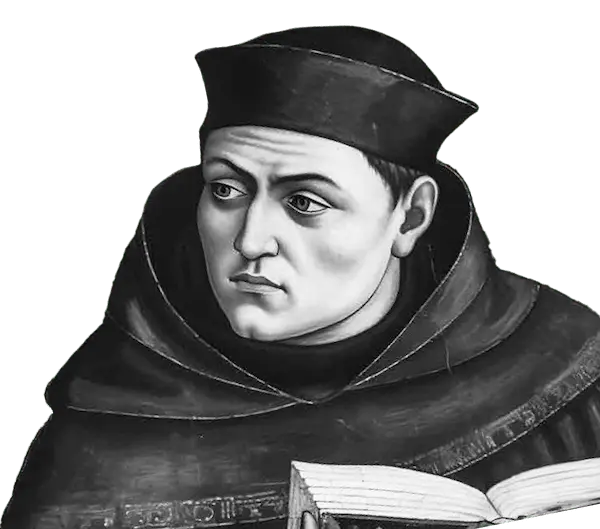
Thomas Aquinas Commentary
John 1
"In the beginning was the Word, and the Word was with God, and the Word was God." — John 1:1 (ASV)
John the Evangelist, as already indicated, makes it his principal object to show the divinity of the incarnate Word. Accordingly, his Gospel is divided into two parts.
- In the first, he states the divinity of Christ.
- In the second, he shows it by the things Christ did in the flesh, at and on the third day (John 2:1).
Regarding the first part, he does two things:
- First, he shows the divinity of Christ.
- Second, he sets forth the way Christ’s divinity is made known to us, at and we saw his glory, the glory as it were of the only begotten (John 1:14).
Concerning the first of these, he does two things:
- First, he treats of the divinity of Christ.
- Second, he treats of the incarnation of the Word of God, at there was a man sent from God, whose name was John (John 1:6).
Because two items are to be considered in each thing, namely, its existence and its operation or power, he first treats the existence of the Word in His divine nature, and second, His power or operation, at all things were made through him (John 1:3).
Regarding the first, he does four things:
- First, he shows when the Word was: in the beginning was the Word.
- Second, where He was: and the Word was with God.
- Third, what He was: and the Word was God.
- Fourth, in what way He was: he was in the beginning with God.
The first two points pertain to the inquiry of whether something exists; the second two pertain to the inquiry of what something is.
With respect to the first of these four points, we must examine the meaning of the statement, in the beginning was the Word. Here, three things present themselves for careful study according to the three parts of this statement. First, it is necessary to investigate the name Word; second, the phrase in the beginning; and third, the meaning of the Word was in the beginning.
To understand the name Word, we should note that according to the Philosopher, spoken words are signs of the concepts that exist in our soul (De interpretatione 1, 16a3–4). It is customary in Scripture for the things signified to be called by the names of their signs, as in the statement, and the rock was Christ (1 Corinthians 10:4). It is fitting that what is within our soul, and what is signified by our external word, be called a word. Whether the name ‘word’ belongs first to the external spoken word or to the conception in our mind is not our concern at present. However, it is obvious that what is signified by the spoken word, existing internally in the soul, exists prior to the spoken expression, since it is its actual cause.
Therefore, if we wish to grasp the meaning of the interior word, we must first look at the meaning of that which is externally expressed in words.
Now, there are three things in our intellect: the intellectual power itself; the species of the thing understood, which is its form (this form being to the intellect what the species of a color is to the eye); and third, the very activity of the intellect, which is to understand. But none of these is what is signified by the external spoken word.
The name ‘stone’ does not signify the substance of the intellect, because this is not what the one naming intends. Nor does it signify the species, which is that by which the intellect understands, since this also is not the intention of the one naming. Nor does it signify the act of understanding itself, since to understand is not an action proceeding externally from the one understanding, but an action remaining within. Therefore, that which the one understanding forms when understanding is properly called an interior word.
The intellect forms two things, according to its two operations. According to its operation called the understanding of indivisibles, it forms a definition. According to its operation by which it unites and separates, it forms a proposition or something of that sort. Hence, what is thus formed and expressed by the operation of the intellect, whether by defining or proposing, is what the external spoken word signifies. So the Philosopher says that the notion a name signifies is a definition (De interpretatione 16a20–b5). Therefore, what is expressed in this way—that is, formed in the soul—is called an interior word. Consequently, it is compared to the intellect not as that by which the intellect understands, but as that in which it understands, because it is in what is thus expressed and formed that it sees the nature of the thing understood. Thus we have the meaning of the name ‘word.’
From what has been said, we can understand that a word is always something that proceeds from an intellect existing in act. Furthermore, a word is always a notion and likeness of the thing understood. So if the one understanding and the thing understood are the same, then the word is a notion and likeness of the intellect from which it proceeds. On the other hand, if the one understanding is other than the thing understood, then the word is not a likeness and notion of the one understanding but of the thing understood, just as the conception one has of a stone is a likeness only of the stone. But when the intellect understands itself, its word is a likeness and notion of the intellect. And so Augustine sees a likeness of the Trinity in the soul insofar as the mind understands itself, but not insofar as it understands other things (De Trinitate 9.5.8).
It is clear then that it is necessary to have a word in any intellectual nature, for it is of the very nature of understanding that the intellect in understanding should form something. What is formed is called a word, and so it follows that in every being that understands, there must be a word.
However, intellectual natures are of three kinds: human, angelic, and divine. So there are three kinds of words. The human word, about which it is said: The fool has said in his heart, “There is no God” (Psalms 14:1). The angelic word, about which it is said in Zechariah, and in many places in Sacred Scripture, and the angel said to me, “I will show you what these are” (Zechariah 1:9). The third is the divine word, of which it is said, and God said, “Let there be light” (Genesis 1:3).
So when the Evangelist says, in the beginning was the Word, we cannot understand this as a human or angelic word. Both of these words have been made, since man and angel have a cause and principle of their existence and operation, and the word of a man or an angel cannot exist before they do. The word the Evangelist had in mind he shows by saying that this word was not made, since all things were made by it. Therefore, the word about which John speaks here is the Word of God.
We should note that this Word differs from our own word in three ways.
The first difference, according to Augustine, is that our word is formable before being formed. For when I wish to conceive the notion of a stone, I must arrive at it by reasoning (De Trinitate 15.4.25). This is true for all other things that are understood by us, with the sole possible exception of first principles, which, since they are known in a simple manner, are known at once without any discourse of reason.
So as long as the intellect, in its reasoning, casts about this way and that, the formation is not yet complete. It is only when it has conceived the notion of the thing perfectly that it has, for the first time, the notion of the complete thing and a word. Thus, in our mind there is both cogitation (meaning the discourse involved in an investigation) and a word, which is formed according to a perfect contemplation of the truth. So our word is first in potency before it is in act. But the Word of God is always in act. Consequently, the term cogitation does not properly apply to the Word of God. For Augustine says: The Word of God is spoken of in such a way that cogitation is not included, lest anything changeable be supposed in God (De Trinitate 15.4.25). Anselm was speaking improperly when he said: For the supreme Spirit to speak is for him to look at something while cogitating (Monologion 63).
The second difference is that our word is imperfect, but the divine Word is most perfect.
Since we cannot express all our conceptions in one word, we must form many imperfect words through which we separately express all that is in our knowledge. But it is not that way with God. For since He understands both Himself and everything else through His essence by one act, the single divine Word is expressive of all that is in God—not only of the persons but also of creatures; otherwise, it would be imperfect. So Augustine says: If there were less in the Word than is contained in the knowledge of the one speaking it, the Word would be imperfect; but it is obvious that it is most perfect; therefore, it is only one. God speaks once (Job 33:14).Augustine, De Trinitate (CPL 0329), bk. 15, ch. 14, par. 23.
The third difference is that our word is not of the same nature as we are, but the divine Word is of the same nature as God. Therefore, it is something that subsists in the divine nature.
The understood notion which the intellect is seen to form about something has only an intelligible existence in our soul. In our soul, to understand is not the same as the nature of the soul, because our soul is not its own operation. Consequently, the word which our intellect forms is not of the essence of our soul, but is an accident of it. But in God, to understand and to be are the same, and so the Word of the divine intellect is not an accident but belongs to its nature. Thus it must be subsistent, because whatever is in the nature of God is God. As Damascene says, God is a substantial word and a hypostasis, but our words are concepts in our mind (De fide orthodoxa 1.13).
From the above it is clear that the Word, properly speaking, is always understood as a person in the divinity, since it implies only something expressed by the one understanding.
It is also clear that in the divinity the Word is the likeness of that from which it issues; that it is co-eternal with that from which it issues, since it was not first formable before being formed but was always in act; that it is equal to the Father, since it is perfect and expressive of the whole being of the Father; and that it is co-essential and consubstantial with the Father, since it is His substance.
It is also clear that since in every nature that which issues forth and has a likeness to the nature from which it issues is called a son, and since this Word issues forth in a likeness and identity to the nature from which it issues, it is suitably and appropriately called a Son, and its production is called a generation.
So now the first point is clear: the meaning of the term Word.
There are four questions on this point, two of them from Chrysostom.
The first is: why did John the Evangelist omit the Father and begin at once with the Son, saying, in the beginning was the Word?John Chrysostom, Commentary on Saint John hom. 2, ch. 7.
There are two answers to this. One is that the Father was known to everyone in the Old Testament, although not under the aspect of Father, but as God; the Son, however, was not known. And so in the New Testament, which is concerned with our knowledge of the Word, he begins with the Word or Son.
The other answer is that we are brought to know the Father through the Son: Father, I have manifested your name to the men whom you have given me (John 17:6). And so, wishing to lead the faithful to a knowledge of the Father, the Evangelist fittingly began with the Son, at once adding something about the Father when he says, and the Word was with God.
The second question is also from Chrysostom.
Why did he say Word and not Son, since, as we have said, the Word proceeds as Son?Commentary on Saint John hom. 2, ch. 7.
There are also two answers to this. First, because Son means something begotten, and when we hear of the generation of the Son, someone might suppose that this generation is the kind he can comprehend—that is, a material and changeable generation. Thus he did not say Son, but Word, which signifies an intelligible proceeding, so that it would not be understood as a material and changeable generation. And so in showing that the Son is born of the Father in an unchangeable way, he eliminates a faulty conjecture by using the name Word.
The second answer is this. The Evangelist was about to consider the Word as having come to manifest the Father. But since the idea of manifesting is implied better in the name Word than in the name Son, he preferred to use the name Word.
The third question is raised by Augustine in his book Eighty-Three Questions, and it is this: In Greek, where we have Word, they have Logos. Since Logos signifies in Latin both notion and word, why did the translators render it as Word and not notion, since a notion is something interior just as a word is? (Question 63)
I answer that notion, properly speaking, names a conception of the mind precisely as in the mind, even if through it nothing external comes to be. But word signifies a reference to something external. And so because the Evangelist, when he said Logos, intended to signify not only a reference to the Son’s existence in the Father but also the operative power of the Son, by which all things were made through him, and without him was not anything made that was made, our predecessors preferred to translate it as Word, which implies a reference to something external, rather than notion, which implies merely a concept of the mind.
The fourth question is from Origen, and it is this.Origen, Commentary on John 2.37–41. In many passages, Scripture, when speaking of the Word of God, does not simply call him the Word but adds of God, saying, the Word of God, or of the Lord: The Word of God on high is the foundation of wisdom ; His name is the Word of God (Revelation 19:13). Why then did the Evangelist, when speaking here of the Word of God, not say, in the beginning was the Word of God, but said in the beginning was the Word?
I answer that although there are many participated truths, there is just one absolute truth, which is truth by its very essence—that is, the divine act of being—and by this truth all words are words. Similarly, there is one absolute wisdom elevated above all things—that is, the divine wisdom—by participating in which all wise persons are wise. Further, there is one absolute Word, by participating in which all persons having a word are called speakers. Now this is the divine Word which of itself is the Word elevated above all words.
So in order that the Evangelist might signify this supereminence of the divine Word, he pointed out this Word to us absolutely, without any addition. And because the Greeks, when they wished to signify something separate and elevated above everything else, did this by affixing the article to the name—as did the Platonists, who, wishing to signify separated substances such as the separated good or the separated man, called them the good per se, or man per se—so the Evangelist, wishing to signify the separation and elevation of that Word above all things, affixed an article to the name Logos, so that if it were stated in Latin we would say the Word.
Second, we must consider the meaning of the phrase, in the beginning.
We must note that according to Origen, the word ‘principium’ (principle or beginning) has many meanings.Origen, Commentary on John 1.90. Since the word ‘principium’ implies a certain order of one thing to another, one can find a ‘principium’ in all those things which have an order.
- First of all, order is found in quantified things; and so there is a principle of number and lengths, as for example, a line.
- Second, order is found in time; and so we speak of a beginning of time, or of duration.
- Third, order is found in learning. This occurs in two ways: as to nature, and as to ourselves, and in both cases we can speak of a beginning. By this time you ought to be teachers (Hebrews 5:12). As to nature, in Christian doctrine the beginning and principle of our wisdom is Christ, inasmuch as He is the wisdom and Word of God, i.e., in His divinity. But as to ourselves, the beginning is Christ Himself inasmuch as the Word became flesh (John 1:14), i.e., by His incarnation.
- Fourth, order is found in the production of a thing. In this perspective, there can be a principle on the part of the thing generated, that is, the first part of the thing generated or made, as we say that the foundation is the beginning of a house. Another is on the part of the generator, and in this perspective there are three principles: of intention, which is the purpose that motivates the agent; of reason, which is the idea in the mind of the maker; and of execution, which is the operative faculty.
Considering these various ways of using the term, we now ask how beginning is used here when it says, in the beginning was the Word.
We should note that this word can be taken in three ways.
In one way, principium is understood as the person of the Son, who is the principle of creatures by reason of His active power acting with wisdom, which is the conception of the things that are brought into existence. Hence we read: Christ the power of God and the wisdom of God (1 Corinthians 1:24). And so the Lord said about Himself: I am the beginning, who is also speaking to you (John 8:25).
Taking principium in this way, we should understand the statement, in the beginning was the Word, as if he were saying, the Word was in the Son, so that the sense would be: the Word Himself is the principle, in the sense in which life is said to be in God, when this life is not something other than God. This is the explanation of Origen.Origen, Commentary on John 1.116–17.
And so the Evangelist says in the beginning here in order, as Chrysostom says, to show at the very outset the divinity of the Word by asserting that He is a principle because, as determining all, a principle is most honored.Chrysostom, Commentary on Saint John hom. 2, ch. 3.
In a second way, principium can be understood as the person of the Father, who is the principle not only of creatures, but of every divine process. It is taken this way in, Yours is princely power in the day of your birth (Psalms 110:3).
In this second way, one reads in the beginning was the Word as though it means, the Son was in the Father. This is Augustine’s understanding of it, as well as Origen’s.Augustine, De Trinitate (CPL 0329), bk. 6, ch. 2, par. 3. Origen, Commentary on John 1.102.
The Son, however, is said to be in the Father because both have the same essence. Since the Son is His own essence, then the Son is in whomever the Son’s essence is. Since, therefore, the essence of the Son is in the Father by consubstantiality, it is fitting that the Son be in the Father. Hence it is said: I am in the Father and the Father is in me (John 14:10).
In a third way, principium can be taken for the beginning of duration, so that the sense of in the beginning was the Word is that the Word was before all things, as Augustine explains it.De Trinitate (CPL 0329), bk. 6, ch. 2, par. 3. According to Basil and Hilary, this phrase shows the eternity of the Word.Basil the Great, Homily on the Beginning of the Gospel of John 1. Hilary of Poitiers, The Trinity (CPL 0433), bk. 2, ch. 13.
The phrase in the beginning was the Word shows that no matter which beginning of duration is taken—whether of temporal things, which is time, or of aeviternal things, which is the aeon, or of the whole world or any imagined span of time reaching back for many ages—at that beginning the Word already was. Hence Hilary says: Go back season by season, skip over the centuries, take away ages. Set down whatever you want as the beginning in your opinion: the Word already was. And this is what Proverbs says: The Lord possessed me in the beginning of his ways, before he made anything (Proverbs 8:22).Hilary of Poitiers, The Trinity (CPL 0433), bk. 2, ch. 13. But what is prior to the beginning of duration is eternal.
And thus the first explanation asserts the causality of the Word; the second explanation affirms the consubstantiality of the Word with the Father, who utters the Word; and the third explanation affirms the co-eternity of the Word.
Now we should consider that it says that the Word was, which is stated in the past imperfect tense. This tense is most appropriate for designating eternal things if we consider the nature of time and of the things that exist in time. For what is future is not yet in act; but what is present is in act, and by the fact that it is in act, what is present is not described as having been. The past perfect tense indicates that something has existed, has already come to an end, and has now ceased to be. The past imperfect tense, on the other hand, indicates that something has been, has not yet come to an end, nor has ceased to be, but still endures. Thus, whenever John mentions eternal things he expressly says was, but when he refers to anything temporal he says has been, as will be clear later (Commentary 1, Lecture 4).
But as far as the notion of the present is concerned, the best way to designate eternity is the present tense, which indicates that something is in act, and this is always the characteristic of eternal things. And so it is said: I am who I am (Exodus 3:14). And Augustine says: He alone truly is whose being does not know a past and a future.Augustine, De Trinitate (CPL 0329), bk. 5, ch. 2, par. 3.
We should also note that this verb was, according to the Gloss, is not understood here as indicating temporal changes, as other verbs do, but as signifying the existence of a thing.The Gloss mentioned here and throughout was a collection of authoritative or celebrated commentaries that, in St. Thomas' time and throughout the middle ages, featured standardly as annotations in the margins and interlinear spaces of Vulgate manuscripts. Thus it is also called a substantive verb.
Someone may ask how the Word can be co-eternal with the Father since He is begotten by the Father. For a human son, born from a human father, is subsequent to his father.
I answer that there are three reasons why an originating principle is prior in duration to that which derives from that principle. First, if the originating principle of anything precedes in time the action by which it produces the thing of which it is the principle; thus a man does not begin to write as soon as he exists, and so he precedes his writing in time. Second, if an action is successive; consequently, even if the action should happen to begin at the same time as the agent, the termination of the action is nevertheless subsequent to the agent. Thus, as soon as fire has been generated in a lower region, it begins to ascend; but the fire exists before it has ascended, because the motion by which it tends upward requires some time. Third, sometimes the beginning of a thing depends on the will of its principle, just as the beginning of a creature’s coming-to-be depends on the will of God, such that God existed before any creature.
Yet none of these three is found in the generation of the divine Word. God did not first exist and then begin to generate the Word, for since the generation of the Word is nothing other than an intelligible conception, it would follow that God would be understanding in potency before understanding in act, which is impossible. Again, it is impossible that the generation of the Word involve succession, for then the divine Word would be unformed before it was formed, as happens in us who form words by cogitating, which is false, as was said. Again, we cannot say that the Father pre-established a beginning of duration for his Son by his own will, because God the Father does not generate the Son by his will, as the Arians held, but naturally. For God the Father, understanding Himself, conceives the Word; and so God the Father did not exist prior to the Son.The Arians were a loose group of clergy and theologians who followed the view of Arius (AD 256–336), an influential presbyter from Alexandria, Egypt, who argued that the Son, because he is begotten of the Father, can be neither co-eternal nor equal in divinity with him. Arius and his views were condemned at the Council of Nicaea in 325 AD.
An example of this, to a limited degree, appears in fire and in the brightness issuing from it, for this brightness issues naturally and without succession from the fire. Again, if the fire were eternal, its brightness would be co-eternal with it. This is why the Son is called the brightness of the Father: the brightness of his glory (Hebrews 1:3). But this example lacks an illustration of the identity of nature. And so we call him Son, although in human sonship we do not find co-eternity. For we must attain our knowledge of divine things from many likenesses in material things, for one likeness is not enough. The Council of Ephesus says that the Son always coexists with the Father: for brightness indicates his unchangeability, birth points to the Word himself, but the name Son suggests his consubstantiality.The Council of Ephesus (431), "Canonical Epistle of St. Cyril, Cum Salvator Noster.
And so we give the Son various names to express His perfection, which cannot be expressed by one name. We call him Son to show that He is of the same nature as the Father; we call him Image to show that He is not unlike the Father in any way; we call him Brightness to show that He is co-eternal; and He is called the Word to show that He is begotten in an immaterial manner.
Then the Evangelist says, and the Word was with God.
This is the second clause which the Evangelist presents in his narration. The first thing to consider is the meaning of the two words which did not appear in the first clause, that is, God and with, for what is signified by Word and beginning has already been related. Therefore, let us carefully continue investigating what is new in the second clause, namely God and with.
To better understand the explanation of this second clause, we must say something about the meaning of each so far as it is relevant to our purpose.
At the outset, we should note that the name God signifies the divinity concretely and as inherent in a subject, while the name ‘deity’ signifies the divinity in the abstract and absolutely. Thus, ‘deity’ cannot naturally and by its mode of signifying stand for a divine person, but only for the divine nature. But the name God can, by its natural mode of signifying, stand for any one of the divine persons, just as the name ‘man’ stands for any individual possessing humanity. Therefore, whenever the truth of a statement or its predicate requires that the name ‘God’ stand for the person, then it stands for the person, as when we say, God begets God. Thus, when it says here that the Word was with God, it is necessary that God stand for the person of the Father, because the preposition with signifies the distinction of the Word, which is said to be with God. And although this preposition signifies a distinction in person, it does not signify a distinction in nature, since the nature of the Father and of the Son is the same. Consequently, the Evangelist wished to signify the person of the Father when he said God.
Here we should note that the preposition with signifies a certain union of the thing signified by its grammatical antecedent to the thing signified by its grammatical object, just as the preposition ‘in’ does. However, there is a difference, because the preposition ‘in’ signifies a certain intrinsic union, whereas the preposition with implies in a certain way an extrinsic union. We state both in divine matters: namely, that the Son is in the Father and with the Father. Here the intrinsic union pertains to consubstantiality, but the extrinsic union (if we may use such an expression, since ‘extrinsic’ is improperly employed in divine matters) refers only to a personal distinction, because the Son is distinguished from the Father by origin alone. And so these two words designate both a consubstantiality in nature and a distinction in person: consubstantiality, inasmuch as a certain union is implied; but distinction, inasmuch as a certain otherness is signified, as was said above.
The preposition ‘in,’ as was said, principally signifies consubstantiality, as implying an intrinsic union and, by way of consequence, a distinction of persons, inasmuch as every preposition is transitive. The preposition with principally signifies a personal distinction, but also a consubstantiality inasmuch as it signifies a certain extrinsic, so to speak, union. For these reasons the Evangelist specifically used the preposition with here in order to express the distinction of the person of the Son from the Father, saying, and the Word was with God—that is, the Son was with the Father as one person with another.
We should note further that this preposition with has four meanings, through which four contrary objections are eliminated.
- First, the preposition with signifies the subsistence of its antecedent, because things that do not subsist of themselves are not properly said to be with another. Thus we do not say that a color is with a body, and the same applies to other things that do not subsist of themselves. But things that do subsist of themselves are properly said to be with another; thus we say that a man is with a man, and a stone with a stone.
- Second, it signifies authority in its grammatical object. For we do not, properly speaking, say that a king is with a soldier, but that the soldier is with the king.
- Third, it asserts a distinction. For it is not proper to say that a person is with himself but rather that one man is with another.
- Fourth, it signifies a certain union and fellowship. For when some person is said to be with another, it suggests to us that there is some social union between them.
Considering these four conditions implied in the meaning of this preposition with, the Evangelist quite appropriately joins this second clause, and the Word was with God, to the first clause, in the beginning was the Word.
For if we omit one of the three explanations of in the beginning was the Word—namely, the one in which principium was understood as the Son—certain heretics make a twofold objection against each of the other explanations: the one in which principium means the same as before all things, and the one in which it is understood as the Father. Thus there are four objections, and we can answer these by the four conditions indicated by this preposition with.
The first of these objections is this: You say that the Word was in the beginning, i.e., before all things. But before all things there was nothing. So if before all things there was nothing, where then was the Word?
This objection arises from the imaginings of those who think that whatever exists is somewhere and in some place. But this is rejected by John when he says, with God, which indicates the union mentioned in the last of the four conditions. So, according to Basil, the meaning is this: Where was the Word? The answer is: with God. He was not in some place, since He is uncontainable, but He is with the Father, who is not enclosed by any place.Basil the Great, Homily on the Beginning of the Gospel of John 4.
The second objection against the same explanation is this: You say that the Word was in the beginning, i.e., before all things. But whatever exists before all things appears to proceed from no one, since that from which something proceeds seems to be prior to that which proceeds from it. Therefore, the Word does not proceed from another.
This objection is rejected when he says, the Word was with God, taking with according to its second condition, as implying authority in what is causing. So the meaning, according to Hilary, is this: From whom is the Word if He exists before all things? The Evangelist answers: the Word was with God, i.e., although the Word has no beginning of duration, still He does not lack a beginning or author, for He was with God as His author.Hilary of Poitiers, The Trinity (CPL 0433), bk. 2, ch. 14.
The third objection, directed to the explanation in which principium is understood as the Father, is this: You say that in the beginning was the Word, i.e., the Son was in the Father. But that which is in something does not seem to be subsistent, as a hypostasis, just as the whiteness in a body does not subsist.
This objection is solved by the statement, the Word was with God, taking with in its first condition, as implying the subsistence of its grammatical antecedent. So according to Chrysostom, the meaning is this: in the beginning was the Word, not as an accident, but He was with God, as subsisting, and a divine hypostasis.John Chrysostom, Commentary on Saint John, hom. 4, ch. 1.
The fourth objection, against the same explanation, is this: You say that the Word was in the beginning, i.e., in the Father. But whatever is in something is not distinct from it. So the Son is not distinct from the Father.
This objection is answered by the statement, and the Word was with God, taking with in its third condition, as indicating distinction. Thus the meaning, according to Alcuin and Bede, is this: the Word was with God, and He was with the Father by a consubstantiality of nature, while still being with Him through a distinction in person.
And so, and the Word was with God indicates: the union of the Word with the Father in nature, according to Basil; their distinction in person, according to Alcuin and Bede;Alcuin, Commentaria in sancti Joannis Evangelium 1. Bede the Venerable, Expositio in Evangelium Sancti Joannis 1. the subsistence of the Word in the divine nature, according to Chrysostom; and the authorship of the Father in relation to the Word, according to Hilary.
We should also note, according to Origen, that the Word was with God shows that the Son has always been with the Father.Origen, Commentary on John, bk. 2, par. 8. For in the Old Testament it says that the Word of the Lord came to Jeremiah or someone else, as is plain in many passages of Sacred Scripture. But it does not say that the Word of the Lord was with Jeremiah or anyone else, because the Word comes to those who begin to have the Word after not having it. Thus the Evangelist did not say that the Word came to the Father, but was with the Father, because, given the Father, the Word was with Him.
Then he says, and the Word was God. This is the third clause in John’s account, and it follows most appropriately considering the order of teaching. For since John had said both when and where the Word was, it remained to inquire what the Word was, that is, the Word was God, taking Word as the subject and God as the predicate.
But since one should first inquire what a thing is before investigating where and when it is, it seems that John violated this order by discussing these latter first.
Origen answers this by saying that the Word of God is with man and with God in different ways.Origen, Commentary on John, bk. 2, par. 8–10. The Word is with man as perfecting him, because it is through Him that man becomes wise and good: she makes friends of God and prophets . But the Word is not with God as though the Father were perfected and enlightened by Him. Rather, the Word is with God as receiving natural divinity from Him, who utters the Word, and from whom He has it that He is the same God with Him. And so, since the Word was with God by origin, it was necessary to show first that the Word was in the Father and with the Father before showing that the Word was God.
It is to be noted, however, that this clause also enables us to answer two objections which arise from the previous statements: the Word was God.
The first is based on the name Word, and is this: You say that in the beginning was the Word, and that the Word was with God. Now it is obvious that ‘word’ is generally understood to signify a spoken word and the statement of something necessary, a manifesting of thoughts. But these words pass away and do not subsist. Accordingly, someone could think that the Evangelist was speaking of a word like these.
According to Hilary and Augustine, this question is sufficiently answered by the above account.Hilary of Poitiers, The Trinity (CPL 0433), bk. 2, ch. 15. Augustine says that it is obvious that in this passage Word cannot be understood as a statement because, since a statement is in motion and passes away, it could not be said that in the beginning was the Word if this Word were something passing away and in motion.Augustine, Tractates on the Gospel of John (CPL 0278), tract. 1, par. 8. The same thing is clear from and the Word was with God. For to be in another is not the same as to be with another. Our word, since it does not subsist, is not with us, but in us; but the Word of God is subsistent, and therefore with God. And so the Evangelist expressly says, and the Word was with God. To entirely remove the ground of the objection, he adds the nature and being of the Word, saying, and the Word was God.
The other question comes from his saying, with God. For since with indicates a distinction, it could be thought that the Word was with God, i.e., the Father, as distinct from Him in nature. So to exclude this, he at once adds the consubstantiality of the Word with the Father, saying, and the Word was God. As if to say: the Word is not separated from the Father by a diversity of nature, because the Word Himself is God.
Note also the special way of signifying, since he says, the Word was God, using God absolutely to show that He is not God in the same way in which the name of the deity is given to a creature in Sacred Scripture. For a creature sometimes shares this name with some added qualification, as when it says, I have made you a god to Pharaoh (Exodus 7:1), in order to indicate that he was not God absolutely or by nature, because he was appointed the god of someone in a qualified sense. Again, it says in a psalm: I said, “You are gods” (Psalms 82:6), as if to say: in my opinion, but not in reality. Thus the Word is called God absolutely because He is God by His own essence, and not by participation, as men and angels are.
We should note that Origen disgracefully misunderstood this clause, led astray by the Greek manner of speaking, and this was the occasion of his error.
It is the custom among the Greeks to put the article before every name in order to indicate a distinction. In the Greek version of John’s Gospel, the name Word in the statement, in the beginning was the Word, and also the name God in the statement, and the Word was with God, are prefixed by the article, so as to read ‘the Word’ and ‘the God,’ in order to indicate the eminence and distinction of the Word from other words, and the principality of the Father in the divinity. But in the statement, the Word was God, the article is not prefixed to the noun God, which stands for the person of the Son. Because of this, Origen blasphemed that the Word, although He was Word by essence, was not God by essence, but is called God by participation, while the Father alone is God by essence.Origen, Commentary on John, bk. 2, par. 12–18. And so he held that the Son is inferior to the Father.
Chrysostom proves that this is not true, because if the article used with the name God implied the superiority of the Father in respect to the Son, it would never be used with the name God when it is used as a predicate of another, but only when it is predicated of the Father.John Chrysostom, Commentary on Saint John, hom. 4, ch. 3. Further, whenever it would be said of the Father, it would be accompanied by the article.
However, we find the opposite to be the case in two statements of the Apostle, who calls Christ God, using the article. For he says, the appearing of the glory of our great God and Savior Jesus Christ (Titus 2:13), where God stands for the Son, and in the Greek the article is used. Therefore, Christ is the great God. Again he says: Christ, who is God over all, blessed forever (Romans 9:5), and again the article is used with God in the Greek. Further, it is said: that we may be in his true Son, Jesus Christ. He is the true God and eternal life (1 John 5:20). Thus, Christ is not God by participation, but truly God. And so the theory of Origen is clearly false.
Chrysostom gives us the reason why the Evangelist did not use the article with the name God, namely, because he had already mentioned God twice using the article, and so it was not necessary to repeat it a third time, but it was implied.John Chrysostom, Commentary on Saint John, hom. 4, ch. 3.
Or it could be said, and this is a better reason, that God is used here as the predicate and is taken formally. It is not the custom for the article to accompany names used as predicates, since the article indicates a distinction. But if God were used here as the subject, it could stand for any of the persons, as the Son or the Holy Spirit; then, no doubt, the article would be used in the Greek.
"The same was in the beginning with God." — John 1:2 (ASV)
38. Then he says, he was in the beginning with God.
This is the fourth clause and is introduced because of the preceding one. From the Evangelist’s statement that the Word was God, two false interpretations could arise among those who misunderstand. One of these is from the pagans, who acknowledge many different gods and say that their wills are in opposition. For example, those who advanced the fable of Jupiter fighting with Saturn, or the Manicheans, who have two contrary principles of nature.The Manicheans were an eclectic, Mesopotamian religious movement that emerged in the third century AD. The Manichaeans held a dualistic cosmology in which good and evil were represented by two more-or-less equal deities whose rivalry constituted the fundamental dynamism of history. The Lord said against this error: Hear, O Israel, the Lord our God is one Lord (Deuteronomy 6:4).
Since the Evangelist had said, the Word was with God, and the Word was God, they could use this in support of their error. They might understand the God with whom the Word is as one God, and the Word as another God with a different or contrary will to the first; and this is against the law of the Gospel.
To exclude this, he says, he was in the beginning with God. It is as if to say, according to Hilary: I say that the Word is God, not as if he has a distinct divinity, but he is with God—that is, in the one same nature in which he is.Hilary of Poitiers, The Trinity (CPL 0433), bk. 2, ch. 16. Furthermore, lest his statement, and the Word was God, be taken to mean that the Word has an opposed will, he added that the Word was in the beginning with God, namely, the Father; not as divided from or opposed to him, but having an identity of nature and a harmony of will with him. This union comes about by the sharing of the divine nature among the three persons and by the bond of the natural love of the Father and the Son.
39. The Arians were able to draw another error from the above. They think that the Son is less than the Father because it says, the Father is greater than I (John 14:28). They say the Father is greater than the Son in both eternity and divinity of nature. To exclude this, the Evangelist added, he was in the beginning with God.
For Arius admits the first clause, in the beginning was the Word, but he will not admit that principium should be taken to mean the Father, but rather the beginning of creatures. So he says that the Word was in the beginning of creatures and, consequently, is in no way coeternal with the Father. But according to Chrysostom, this is excluded by the clause, he was in the beginning—not of creatures, but in the beginning with God, that is, whenever God existed.John Chrysostom, Commentary on Saint John, hom. 4, ch. 1. For the Father was never alone without the Son or Word; rather, he, the Word, was always with God.
40. Again, Arius admits that the Word was God, but nevertheless inferior to the Father. This is excluded by what follows.
There are two attributes proper to the great God which Arius attributed solely to God the Father: eternity and omnipotence. So in whomever these two attributes are found, he is the great God, than whom none is greater. But the Evangelist attributes these two to the Word. Therefore, the Word is the great God and not inferior.
He says the Word is eternal when he states, he was in the beginning with God—that is, the Word was with God from eternity, and not only in the beginning of creatures, as Arius held; but he was with God, receiving being and divinity from him. Furthermore, he attributes omnipotence to the Word when he adds, all things were made through him (John 1:3).
41. Origen gives a rather beautiful explanation of this clause, he was in the beginning with God, saying that it is not separate from the first three but is, in a certain sense, their epilogue.Origen, Commentary on Saint John, bk. 2, par. 64–69.
For the Evangelist, after indicating that truth was the Son’s and being about to describe his power, in a way gathers together in a summary, in this fourth clause, what he had said in the first three. In saying he, he refers to the third clause; by adding was in the beginning, he recalls the first clause; and by adding was with God, he recalls the second. This is so that we do not think that the Word which was in the beginning is different from the Word which was God, but that this Word which was God was in the beginning with God.
42. If one considers these four propositions well, he will find that they clearly destroy all the errors of the heretics and philosophers.
For some heretics, like Ebion and Cerinthus, said that Christ did not exist before the Blessed Virgin but received from her the beginning of his existence and duration. They held that he was a mere man who had merited divinity by his good works.Cerinthus was a first-century gnostic figure associated with the Gospel of Cerinthus and the view that Jesus was the natural-born son of Joseph and Mary who received the spirit of Christ during his baptism. Ebion, who Tertullian identifies as the successor of Cerinthus, held a similar "adoptionist" view of Jesus that essentially denies the Incarnation. Photinus and Paul of Samosata, following them, said the same thing.Photinus, a bishop from the region of modern-day Serbia, was deposed in 336 for denying the incarnation and, more generally, the divinity of Jesus Christ. Following Socrates Scholasticus, theologians have typically associated him with Paul of Samosata and Marcellus (see Sozomen, Ecclesiastical History bk. 4, ch. 6). Paul of Samosata was an especially wealthy bishop of Antioch in 260–268 who was deposed in 272 for his "adoptionist" view that Christ was initially merely human and was subsequently "adopted" and indwelt by the Logos (see Eusebius, Church History bk. 7, ch. 27–30). But the Evangelist excludes their errors, saying, in the beginning was the Word—that is, before all things, and in the Father from eternity. Thus, he did not derive his beginning from the Virgin.
Sabellius, on the other hand, admitted that the God who took on flesh did not receive his beginning from the Virgin but existed from eternity. Still, he said that the person of the Father, who existed from eternity, was not distinct from the person of the Son, who took on flesh from the Virgin.Sabellius, a third-century priest, advanced a position that is sometimes called "modalism," according to which the Father, Son, and Holy Spirit are not three distinct persons but three modes or manifestations of one divine Person. He maintained that the Father and Son were the same person, thereby confusing the trinity of divine persons. The Evangelist argues against this error, saying, and the Word was with God—that is, the Son was with the Father, as one person with another.
Eunomius declared that the Son is entirely unlike the Father.Eunomius, a fourth-century bishop of Cyzicus (in the northwestern coast of modern-day Turkey) and intellectual heir of Arius, argued the unbegottenness and begottenness of the Father and Son respectively must constitute an essential difference between them such that they cannot even be said to be similar to one another in essence. The Evangelist rejects this when he says, and the Word was God.
Finally, Arius said that the Son was less than the Father. The Evangelist excludes this by saying, he was in the beginning with God, as was explained above.
43. These words also exclude the errors of the philosophers.
Some of the ancient philosophers, namely, the natural philosophers, maintained that the world did not come from any intellect or with any purpose, but by chance. Consequently, they did not place a reason or intellect at the beginning as the cause of things, but only matter in flux—for example, atoms, as Democritus thought, or other such material principles as different philosophers maintained. Against these, the Evangelist says, in the beginning was the Word, from whom, and not from chance, things derive their beginning.
Plato, however, thought that the ideas of all things that were made were subsistent—that is, existing separately in their own natures—and that material things exist by participating in them. For example, he thought men existed through the separated idea of man, which he called man per se. So, lest you suppose, as Plato did, that this idea through which all things were made is an idea separated from God, the Evangelist adds, and the Word was with God.
Other Platonists, as Chrysostom relates, maintained that God the Father was most eminent and first, but under him they placed a certain mind in which there were the likenesses and ideas of all things.John Chrysostom, Commentary on Saint John, hom. 2, ch. 4. So, lest you think that the Word was with the Father in such a way as to be under him and less than him, the Evangelist adds, and the Word was God.
Aristotle, however, thought that the ideas of all things are in God, and that in God, the intellect, the one understanding, and what is understood are the same.See Aristotle, Physics 8; Thomas Aquinas, Commentary on the Metaphysics of Aristotle 2536–2551, 2600–2663. Nevertheless, he thought that the world is coeternal with God. Against this, the Evangelist says, He—the Word alone—was in the beginning with God, in such a way that he does not exclude another person, but only another coeternal nature.
44. Note the difference between what John has said and the other Evangelists, and how he began his Gospel on a loftier plane than they did. They announced Christ the Son of God born in time: when Jesus was born in Bethlehem (Matthew 2:1); but John presents him existing from eternity: in the beginning was the Word. They show him suddenly appearing among men: now you dismiss your servant, O Lord, in peace, according to your word; because my eyes have seen your salvation, which you have prepared in the sight of all people, a light to reveal you to the nations and the glory of your people Israel (Luke 2:29); but John says that he always existed with the Father: and the Word was with God. The others show him as a man: they gave glory to God who had given such authority to men (Matthew 9:8); but John says only that he is God: and the Word was God. The others say he lives with men: while living in Galilee, Jesus said to them (Matthew 17:21); but John says that he has always been with the Father: he was in the beginning with God.
45. Note also how the Evangelist deliberately uses the word was to show that the Word of God transcends all time: present, past, and future. It is as though he were saying that the Word was beyond time—present, past, and future—as the Gloss says.
"All things were made through him; and without him was not anything made that hath been made. In him was life; and the life was the light of men." — John 1:3-4 (ASV)
After the Evangelist has told of the existence and nature of the divine Word, as far as it can be told by man, he then shows the might of His power.
First, he shows His power with respect to all things that come into existence.
Second, especially with respect to man, at the words and the life was the light of men.
As to the first, he uses three clauses. We will not distinguish these at present because they will be distinguished in different ways according to the different explanations given by the saints.
The first clause is all things were made through him, which is used to show three things concerning the Word. First, according to Chrysostom, it shows the equality of the Word to the Father.John Chrysostom, Commentary on Saint John, hom. 5, ch. 3.
As stated earlier, the Evangelist rejected the error of Arius when he showed the coeternity of the Son with the Father by saying, he was in the beginning with God. Here he excludes the same error by showing the omnipotence of the Son, saying, all things were made through him. For to be the principle of all things that are made is proper to the great, omnipotent God, as it is said, whatever the Lord wills he does, in heaven and on earth (Psalms 134:6). Thus the Word, through whom all things were made, is God, great and coequal with the Father.
Second, according to Hilary, this clause is used to show the coeternity of the Word with the Father (The Trinity, 2.17).
For since someone might understand the earlier statement, in the beginning was the Word, as referring to the beginning of creatures—that is, that before there were any creatures there was a time in which the Word did not exist—the Evangelist rejects this by saying, all things were made through him. For if all things were made through the Word, then time was also. From this we can form the following argument: if all time was made through Him, there was no time before Him or with Him, because He was before all these things. Therefore the Son and the Father are eternally coeternal.
Third, according to Augustine, this clause is used to show the consubstantiality of the Word with the Father.Augustine, Tractates on the Gospel of John (CPL 0278), tract. 1, par. 11; The Trinity (CPL 0329), bk. 1, ch. 6, par. 9.
For if all things were made through the Word, the Word Himself cannot be said to have been made. If He were made, He would have been made through some other Word, since all things were made through the Word. Consequently, there would have been another Word through whom the Word of whom the Evangelist is speaking was made. This Word, through whom all things are made, we call the only-begotten Son of God, because He is neither made nor is He a creature. And if He is not a creature, it is necessary to say that He is of the same substance with the Father, since every substance other than the divine essence is made. But a substance that is not a creature is God. And so the Word, through whom all things were made, is consubstantial with the Father, since He is neither made, nor is He a creature.
And so in saying all things were made through him, you have, according to Chrysostom, the equality of the Word with the Father;John Chrysostom, Commentary on Saint John, hom. 5, ch. 3. the coeternity of the Word with the Father, according to Hilary; and the consubstantiality of the Word with the Father, according to Augustine.Augustine, Tractates on the Gospel of John (CPL 0278), tract. 1, par. 11.
Here we must guard against three errors.
First, the error of Valentinus. He understood all things were made through him to mean that the Word offered to the Creator the cause for His creating the world, so that all things were made through the Word as if the Father’s creating the world came from the Word. This leads to the position of those who said that God created the world because of some exterior cause, which is contrary to Proverbs: the Lord made all things for himself (Proverbs 16:4).
The reason this is an error is that, as Origen says, if the Word had been a cause to the Creator by offering Him the material for making things, he would not have said, all things were made through him, but on the contrary, that all things were made through the Creator by the Word.Origen, Commentary on John, bk. 2, par. 102–104.
Second, we must avoid the error of Origen. He said that the Holy Spirit was included among all the things made through the Word, from which it follows that He is a creature.Origen, Commentary on John bk. 2, par. 73. And this is what Origen thought.
This is heretical and blasphemous, since the Holy Spirit has the same glory, substance, and dignity as the Father and the Son, according to what is said: make disciples of all the nations, baptizing them in the name of the Father, and of the Son, and of the Holy Spirit (Matthew 28:19). And, there are three who give testimony in heaven, the Father, the Word, and the Holy Spirit; and these three are one (1 John 5:7). Thus when the Evangelist says, all things were made through him, one should not understand all things absolutely, but in the realm of creatures and of things made. It is as if to say: all things that were made, were made through Him. Otherwise, if all things were taken absolutely, it would follow that the Father and the Holy Spirit were made through Him, which is blasphemous. Consequently, neither the Father nor anything substantial with the Father was made through the Word.
Third, we must avoid another of Origen’s errors.
He said that all things were made through the Word as something is made by a greater through a lesser, as if the Son were inferior to, and an instrument of, the Father.Origen, Commentary on John bk. 2, par. 70–72. But it is clear from many places in Scripture that the preposition ‘through’ does not signify inferiority in the one who is its grammatical object, that is, in the Son or Word. For the Apostle says, speaking of the Father, God is faithful, through whom you were called into the fellowship of his Son (1 Corinthians 1:9). If He through whom something is done has a superior, then the Father has a superior. But this is false. Therefore, the preposition through does not signify any inferiority in the Son when all things are said to have been made through Him.
To explain this point further, we should note that when something is said to be made through someone, the preposition ‘through’ denotes some sort of causality in its object with respect to an operation, but not always the same kind of causality.
Since an operation, according to our manner of speaking, is considered to be intermediate between the one acting and the thing produced, the operation itself can be regarded in two ways. In one way, as issuing from the one operating, who is the cause of the action itself; in another way, as terminated in the thing produced. Accordingly, the preposition ‘through’ sometimes signifies the cause of the operation insofar as it issues from the one operating, but sometimes as it is terminated in the thing which is produced.
It signifies the cause of the operation as issuing from the one operating when the object of the preposition is either the efficient or formal cause why the one operating is operating. For example, we have a formal cause when fire is heating through heat, for heat is the formal cause of the fire’s heating. We have a moving or efficient cause in cases where secondary agents act through primary agents, as when I say that the bailiff acts through the king, because the king is the efficient cause of the bailiff’s acting. This is the way Valentinus understood that all things were made through the Word: as though the Word were the cause of the maker’s production of all things.
The preposition ‘through’ implies the causality of the operation as terminated in the thing produced when what is signified through that causality is not the cause which operates, but the cause of the operation precisely as terminated in the thing produced. So when I say that the carpenter is making a bench by means of a hatchet, the hatchet is not the cause of the carpenter’s operating; but we do say that it is the cause of the bench’s being made by the one acting.
And so when it says that all things were made through him, if the through denotes the efficient or moving cause, causing the Father to act, then in this sense the Father does nothing by the Son, but He does all things by Himself, as has been said. But if the through denotes a formal cause, as when the Father operates by His wisdom, which is His essence, He operates by His wisdom as He operates by His essence. And because the wisdom and power of the Father are attributed to the Son, as when we say, Christ, the power of God and the wisdom of God (1 Corinthians 1:24), then by appropriation we say that the Father does all things by the Son, that is, by His wisdom. And so Augustine says that the phrase from whom all things is appropriated to the Father; through whom all things is appropriated to the Son; and in whom all things is appropriated to the Holy Spirit.Augustine, The Trinity (CPL 0329), bk. 6, ch. 10, par. 12. But if the through denotes causality from the standpoint of the thing produced, then the statement, the Father does all things by the Son, is not mere appropriation but is proper to the Word, because the fact that He is a cause of creatures is had from someone else, namely the Father, from whom He has His being.
However, it does not follow from this that the Word is the instrument of the Father, although whatever is moved by another for some operation has the nature of an instrument. When I say that someone works through a power received from another, this can be understood in two ways. In one way, it can mean that the power of both the giver and of the receiver is numerically one and the same power. In this way, the one operating through a power received from another is not inferior but equal to the one from whom he receives it.
Therefore, since it is the same power which the Father has and which He gives to the Son, and through which the Son works, when it is said that the Father works through the Son, one should not on that account say that the Son is inferior to the Father or is His instrument. This would be the case, rather, in those who receive from another not the same power, but another and created one.
And so it is plain that neither the Holy Spirit nor the Son are causes of the Father’s working, and that neither is the minister or instrument of the Father, as Origen raved.Origen, Commentary on John, bk. 1, par. 104.
If we carefully consider the words, all things were made through him, we can clearly see that the Evangelist spoke with the utmost exactitude.
For whoever makes something must preconceive it in his wisdom, which is the form and pattern of the thing made, just as the form preconceived in the mind of an artisan is the pattern of the cabinet to be made. So, God makes nothing except through the conception of His intellect, which is an eternally conceived wisdom, that is, the Word of God, and the Son of God. Accordingly, it is impossible that He should make anything except through the Son. And so Augustine says in The Trinity that the Word is the art full of the living patterns of all things.Augustine, The Trinity (CPL 0329), bk. 6, ch. 10, par. 11. Thus it is clear that all things which the Father makes, He makes through Him.
It should be remarked that, according to Chrysostom, all the things which Moses enumerates individually in God’s production of things, saying, and God said, ‘let there be light’ (Genesis 1:3), and ‘let there be a firmament’ (Genesis 1:6), and so forth, all these the Evangelist transcends and embraces in one phrase, saying, all things were made through him.John Chrysostom, Commentary on Saint John, hom. 5, ch. 1.
The reason is that Moses wished to teach the emanation of creatures from God; hence he enumerated them one by one. But John, hastening toward higher things, intends in this book to lead us specifically to a knowledge of the Creator Himself.
Then he says, and without him was made nothing. This is the second clause which some have distorted, as Augustine says in his work, The Nature of the Good (25). Because of John’s manner of speaking here, they believed that he was using nothing in an affirmative sense, as though nothing was something which was made without the Word. And so they claimed that this clause was added by the Evangelist in order to exclude something which was not made by the Word. They say that the Evangelist, having said that all things were made through him, added and without him was made nothing. It was as if to say: I say that all things were made through Him in such a way that still something was made without Him, that is, the nothing.
Three heresies came from this. First, that of Valentinus. He affirmed, as Origen says, a multitude of principles, and taught that from them came thirty eras.Origen, Commentary on John, bk. 2, par. 100–101. The first principles he postulates are two: the Deep, which he calls God the Father, and Silence. From these proceed ten eras. But from the Deep and from Silence, he says, there are two other principles, Mind and Truth, and from these issued eight eras. Then from Mind and Truth, there are two other principles, Word and Life, and from these issued twelve eras, thus making a total of thirty. Finally, from the Word and Life there proceeded in time, the man Christ and the Church. In this way Valentinus affirmed many eras previous to the issuing forth of the Word.
And so he said that because the Evangelist had stated that all things were made through him, then, lest anyone think that those previous eras had been effected through the Word, he added, and without him was made nothing, that is, all the preceding eras and all that had existed in them. All of these John calls nothing, because they transcend human reason and cannot be grasped by the intellect.
The second error to arise from this was that of Manichaeus, who affirmed two opposing principles: one is the source of incorruptible things, and the other of corruptible things. He said that after John had stated that all things were made through him, then, lest it be thought that the Word is the cause of corruptible things, he immediately added, and without him was made nothing, that is, things subject to corruption, which are called nothing because their being consists in being continually transformed into nothing.
The third error is that of those who claim that by nothing we should understand the devil, about whom is said: may the companions of him who is not dwell in his house (Job 18:15). And so they say that all things except the devil were made through the Word. In this way they explain, without him was made nothing, that is, the devil.
All these three errors, arising as they do from the same source—namely, taking nothing in a positive sense—are excluded by the fact that nothing is not used here in an affirmative, but in a merely negative sense. The sense is that all things were made through the Word in such a way that there is nothing participating in existence that was not made through Him.
Perhaps someone will object and say that it was superfluous to add this clause if it is to be understood negatively, on the ground that the Evangelist, in stating that all things were made through him, seems to have already said adequately enough that there is not something that was not made through the Word.
The answer to this is that, according to many expositors, this clause was added for a number of reasons. One of these reasons is, according to Chrysostom, so that no one reading the Old Testament and finding only visible things listed by Moses in the creation of things would think that these were the only things made through the Word.John Chrysostom, Commentary on Saint John, hom. 5, ch. 1.
And so, the Evangelist, after he had said, all things were made through him, namely, those that Moses listed, then added, and without him was made nothing, as though he were saying: none of the things which exist, whether visible or invisible, was made without the Word. Indeed, the Apostle also speaks in this way (Colossians 1:16), saying that all things, visible and invisible, were created in Christ. Here the Apostle makes specific mention of invisible things because Moses had made no express mention of them on account of the lack of education of that people, who could not be raised above the things of sense.
Chrysostom also gives another reason why this clause was added.John Chrysostom, Commentary on Saint John hom. 5, ch. 1. For someone reading in the Gospel of the many signs and miracles worked by Christ, such as, the blind see, the lame walk, lepers are cleansed (Matthew 11:5), might believe that in saying, all things were made through him, John meant that only the things mentioned in those Gospels, and nothing else, were made through Him. So lest anyone suspect this, the Evangelist adds, and without him was made nothing. As if to say: not only were all the things contained in the Gospels made through Him, but none of the things that were made, was made without Him. And so, according to Chrysostom, this clause is added to bring out His total causality, and serves, as it were, to complete his previous statement.
According to Hilary, however, this clause is introduced to show that the Word has operative power from another.Hilary of Poitiers, The Trinity (CPL 0433), bk. 2, ch. 18. For since the Evangelist had said, all things were made through him, it might be supposed that the Father is excluded from all causality. For that reason he added, and without him was made nothing. As if to say: all things were made through Him, but in such a way that the Father made all things with Him. For without him is equivalent to saying, not alone, so that the meaning is: it is not He alone through whom all things were made, but He is the other one without whom nothing was made. It is as if he said: without him, with another working, that is, with the Father, was made nothing, as it says, I was with him forming all things (Proverbs 8:30).
In a certain homily attributed to Origen, which begins, the spiritual voice of the eagle, we find another rather beautiful exposition.St. Thomas' reference here is, in fact, to a work of John Scotus Eriugena (c. 800–877); see The Voice of the Eagle: The Heart of Celtic Christianity: John Scotus Eriugena's Homily on the Prologue to the Gospel of John, trans. Christopher Bamford (Great Barrington, MA: Lindisfarne Books, 2000), 8, p. 83.
It says there that the Greek has thoris where the Latin has without. Now thoris is the same as ‘outside’ or ‘outside of.’ It is as if he had said: all things were made through him in such a way that outside Him was made nothing. And so he says this to show that all things are conserved through the Word and in the Word: he sustains all things by his powerful word (Hebrews 1:3).
Now there are certain things that do not need their producer except to bring them into existence, since after they have been produced they are able to subsist without any further activity on the part of the producer. For example, a house needs a builder if it is to come into existence, but it continues to exist without any further action on the part of the builder. So lest anyone suppose that all things were made through the Word in such a way that He is merely the cause of their production and not of their continuation in existence, the Evangelist added, and without him was made nothing, that is, nothing was made outside of Him, because He encompasses all things, preserving them.
This clause is also explained by Augustine, Origen, and several others in such a way that nothing indicates sin.Augustine, Tractates on the Gospel of John (CPL 0278), tract. 1, par. 13. Origen, Commentary on John, bk. 2, par. 92–96.
Accordingly, because all things were made through him might be interpreted as including evil and sin, he added, and without him was made nothing, that is, sin. For just as art is not the principle or cause of the defects in its products, but is through itself the cause of their perfection and form, so the Word, who is the art of the Father, full of living archetypes, is not the cause of any evil or disarrangement in things, particularly of the evil of sin, which carries the full notion of evil.
The per se cause of this evil is the will of a creature, whether a man or an angel, freely turning away from the end to which it is ordained by its nature. Someone who can act by virtue of his art but purposely violates it is the cause of the defects occurring in his works—not by reason of his art, but by reason of his will. In such cases, his art is not the source or cause of the defects; his will is. Consequently, evil is a defect of the will and not of any art. To the extent that it is such a defect, it is nothing.
So then, this clause is added to show the universal causality of the Word, according to Chrysostom; His association with the Father, according to Hilary; the power of the Word in the preserving of things, according to Origen; and finally, the purity of His causality, because He is so the cause of good as not to be the cause of sin, according to Augustine, Origen, and a number of others.
Then he says, what was made in him was life; and this is the third clause. Here we must avoid the false interpretation of Manichaeus, who was led by this to maintain that everything that exists is alive: for example, stones, wood, men, and anything else in the world. He understood the clause this way: what was made in him, (comma), was life. But it was not life unless it was alive. Therefore, whatever was made in Him is alive. He also claimed that in him is the same as saying through Him, since very often in Scripture in him and through him are interchangeable, as in in him and through him all things were created (Colossians 1:16).
However, our present explanation shows that this interpretation is false.
There are, nevertheless, a number of ways to explain it without error. In that homily, The Spiritual Voice, we find this explanation: what was made in him, that is, through Him, was life, not in each thing itself, but in its cause. For in the case of all things that are caused, it is always true that effects, whether produced by nature or by will, exist in their causes, not according to their own existence, but according to the power of their appropriate cause. Thus, lower effects are in the sun as in their cause, not according to their respective existences but according to the power of the sun. Therefore, since the cause of all effects produced by God is a certain life and an art full of living archetypes, for this reason what was made in him, that is, through Him, was life, in its cause, that is, in God.John Scotus Eriugena, The Voice of the Eagle 9.
Augustine reads this another way, as: what was made, distinguished from in him was life.Augustine, Tractates on the Gospel of John (CPL 0278), tract. 1, par. 17.
For things can be considered in two ways: as they are in themselves, and as they are in the Word. If they are considered as they are in themselves, then it is not true that all things are life or even alive, but some lack life and some are alive. For example, the earth was made and metals were made, but none is life, none is living; animals and men were made, and these, considered in themselves, are not life, but merely living.
Yet considered as they are in the Word, they are not merely living, but also life. For the archetypes which exist spiritually in the wisdom of God, and through which things were made by the Word, are life. Just as a chest made by an artisan is in itself neither alive nor life, yet the exemplar of the chest in the artisan’s mind prior to the existence of the chest is in some sense living, insofar as it has an intellectual existence in the mind of the artisan. Nevertheless it is not life, because it is neither in his essence nor is it his existence through the act of understanding of the artisan. But in God, His act of understanding is His life and His essence. And so whatever is in God is not only living, but is life itself, because whatever is in God is His essence. Hence the creature in God is the creating essence. Thus, if things are considered as they are in the Word, they are life.
This is explained in another place.
Origen, commenting on John, gives another reading, thus: what was made in him; and then, was life.Origen, Commentary on John, bk. 2, par. 114.
Here we should note that some things are said of the Son of God as such; for example, that He is God, omnipotent, and the like. And some things are said of Him in relation to ourselves; for example, we say He is savior and redeemer. Some things are said in both ways, such as wisdom and justice. Now in all things said absolutely and of the Son as such, it is not said that He was made; for example, we do not say that the Son was made God or omnipotent. But in things said in reference to us, or in both ways, the notion of being made can be used, as in, God made him our wisdom, our justice, our sanctification and redemption (1 Corinthians 1:30). And so, although He was always wisdom and justice in Himself, yet it can be said that He was newly made justice and wisdom for us.
And so Origen, explaining it along these lines, says that although in Himself the Son is life, yet He was made life for us by the fact that He gave us life, as is said, just as in Adam all die, so in Christ all will come to life (1 Corinthians 15:22).Origen, Commentary on John, bk. 2, par. 128. And so he says the Word that was made life for us in himself was life, so that after a time He could become life for us; and so he immediately adds, and the life was the light of men.
But Hilary interprets it this way: and without him was made nothing, that was made in him, and later it says, he was life.Hilary of Poitiers, The Trinity (CPL 0433), bk. 2, ch. 20. For he says (in On the Trinity II) that when the Evangelist says without him was made nothing, one might be perplexed and ask whether there are still other things made by Him that were not made through Him, although not without Him, but with respect to which He was associated with the maker. This clause is added to correct this error. Therefore, so that this is not misunderstood, when the Evangelist says, all things were made through him, he adds, and without him was made nothing, that was made, in him, that is, through Him. The reason for this is that he was life.
It is plain that all things are said to have been made through the Word inasmuch as the Word, who proceeds from the Father, is God. But let us suppose that some father has a son who does not perfectly exercise the operations of a man, but reaches such a state gradually. In that case the father will do many things, not through the son, yet not without him. Since, therefore, the Son of God has from all eternity the same life that the Father has—for as the Father has life in himself, so he has also given to the Son to have life in himself (John 5:26)—one cannot say that God the Father, although He made nothing without the Son, nevertheless made some things not through Him, because He was life.
In living things which participate in life, it can happen that imperfect life precedes perfect life. But in life per se—which does not participate in life but is simply and absolutely life—there can be no imperfection at all. Accordingly, because the Word is life per se, there was never imperfect life in Him, but always perfect life. And so it is that without him was made nothing that was not also made in him, that is, through Him.
Chrysostom has a different reading and punctuation, thus: and without him was made nothing that was made.John Chrysostom, Commentary on Saint John, hom. 5, ch. 2. The reason for this is that someone might believe that the Holy Spirit was made through the Word.
So to exclude this, the Evangelist says, that was made, because the Holy Spirit is not something that is made. And afterward follows, in him was life, which is introduced for two reasons. First, to show that after the creation of all things His causality was unfailing not only with respect to the things already produced, but also with respect to things yet to be produced. As if to say: in him was life, by which He could not only produce all things, but which has an unfailing flow and a causality for producing things continually without undergoing any change, being a living fountain which is not diminished in spite of its continuous outflow. In contrast, collected water that is not living water is diminished when it flows out and is used up. So it is said, with you is the fountain of life (Psalms 36:9).
The second reason is to show that things are governed by the Word. For since in him was life, this shows that He produced things by His intellect and will, not by a necessity of His nature, and that He governs the things He made: the Word of God is living (Hebrews 4:12).
Chrysostom is held in such esteem by the Greeks in his explanations that they admit no other where he expounded anything in Holy Scripture. For this reason, this passage in all the Greek works is found to be punctuated exactly as Chrysostom did, namely, and without him was made nothing that was made.
"In him was life; and the life was the light of men. And the light shineth in the darkness; and the darkness apprehended it not." — John 1:4-5 (ASV)
Previously, the Evangelist described the power of the Word in bringing all things into existence; here he describes the Word’s power as it relates to humanity, saying that this Word is a light to men. In this section:
- First, he introduces a certain light to us with the phrase and the life was the light of men.
- Second, he describes the shining of the light with and the light shines in darkness.
- Third, he discusses participation in the light with and the darkness did not comprehend it.
This entire section may be explained in two ways: first, according to the influx of natural knowledge, and second, according to the communication of grace.
Regarding the first point, he says, and the life was the light of men.
Here we should first note that, according to Augustine and many others, “light” is more properly said of spiritual things than of perceptible things. Ambrose, however, thinks that brightness is said metaphorically of God. But this is not a major issue, for in whatever way the name light is used, it implies a manifestation, whether that manifestation concerns intelligible or perceptible things.
If we compare perceptible and intelligible manifestation, then according to the nature of things, light is found first in spiritual things. For us, however, who name things based on the properties we can perceive, light is discovered first in perceptible things. We used this name to signify physical light before intelligible light, although in terms of its power, light belongs to spiritual things in a more primary and truer way than to perceptible things.
To clarify the statement, and the life was the light of men, we should note that there are many levels of life. Some things live without light because they have no knowledge, such as plants; therefore, their life is not light. Other things both live and know, but their knowledge, since it is on the sensory level, is concerned only with individual and material things, as is the case with brute animals. So they have both life and a certain light, but they do not have the light of men, who live and know not only truths, but also the very nature of truth itself.
Such are rational creatures, to whom not only particular things are made manifest, but truth itself, which can be revealed and is revealing to all.
And so the Evangelist, speaking of the Word, not only says that he is life but also light, lest anyone suppose he means life without knowledge. And he says that he is the light of men, lest anyone suppose he meant only sensory knowledge, such as exists in brute animals.
But since he is also the light of angels, why did he say, of men?
Two answers have been given to this. Chrysostom says that the Evangelist intended in this Gospel to give us a knowledge of the Word precisely as it is directed to the salvation of humanity and therefore refers, consistent with his aim, more to humans than to angels. Origen, however, says that participation in this light pertains to humans insofar as they have a rational nature; accordingly, when the Evangelist says, the light of men, he wants us to understand it to mean every rational nature.
We also see from this the perfection and dignity of this life, because it is intellectual or rational.
For while all things that move themselves in some way are called living, only those that perfectly move themselves are said to have a perfect life. Among lower creatures, only man moves himself properly and perfectly. For although other things are moved by themselves through some inner principle, that inner principle is not open to different possibilities; therefore, they are not moved freely but out of necessity. As a result, those things moved by such a principle are more truly acted upon than they act themselves. But man, since he is master of his actions, moves himself freely toward all that he wills. Consequently, man has a perfect life, as does every intellectual nature.
And so the life of the Word, which is the light of men, is perfect life.
We find a fitting order in what has been said. For in the natural order of things, existence is first, and the Evangelist implies this in his first statement, in the beginning was the Word (John 1:1). Second comes life, and this is mentioned next: in him was life. Third comes understanding, and that is mentioned next: and the life was the light of men.
And, according to Origen, he fittingly attributes light to life because light can be attributed only to the living.
We should note that light can be related in two ways to a living being: as an object and as something in which they participate, as is clear with physical sight. For the eyes know external light as an object, but if they are to see it, they must participate in an inner light by which the eyes are adapted and prepared for seeing the external light.
And so his statement, and the life was the light of men, can be understood in two ways. First, the light of men can be taken as an object that only humanity can look upon, because only a rational creature can see it. Only humanity is capable of the vision of God, who teaches us more than the beasts of the earth, and enlightens us more than the birds of the air (Job 35:11). For although other animals may know certain true things, only humanity knows the very nature of truth.
The light of men can also be taken as a light in which we participate. For we would never be able to look upon the Word and light itself except through a participation in it. This participation is in humanity and is the higher part of our soul, that is, the intellectual light, about which it is said, the light of your countenance, O Lord, is marked upon us (Psalms 4:7)—meaning, the light of your Son, who is your face, by whom you are made manifest.
Having introduced this light, the Evangelist now considers its radiance, saying, and the light shines in the darkness.
This can be explained in two ways, according to the two meanings of “darkness.”
First, we can take darkness to mean a natural defect of the created mind. For the mind is to that light of which the Evangelist speaks here as air is to the light of the sun; because although air is receptive to the sun's light, considered in itself, it is darkness. According to this, the meaning is: the light—that is, the life which is the light of men—shines in the darkness, that is, in created souls and minds, by always shedding its light on everyone: on a man from whom the light is hidden (Job 3:23).
And the darkness did not comprehend it means that the darkness was not able to contain it. For to comprehend something is to enclose it and understand its boundaries. As Augustine says, to reach God with the mind is a great happiness, but to comprehend him is impossible. And so, the darkness did not comprehend it. Behold, God is great, exceeding our knowledge (Job 36:26); as Jeremiah says, great in counsel, incomprehensible in thought (Jeremiah 32:19).
This explanation is found in the homily that begins, the spiritual voice of the eagle.
We can explain this passage in another way by taking darkness, as Augustine does, to mean the natural lack of wisdom in humanity, which is called a darkness. And I saw that wisdom excels folly as much as light excels darkness (Ecclesiastes 2:13).
A person is without wisdom, therefore, because they lack the light of divine wisdom. Consequently, just as the minds of the wise are lucid because of their participation in that divine light and wisdom, so by the lack of it, they are darkness. Now the fact that some are darkness is not due to a defect in that light, since on its part it shines in the darkness and radiates upon all. Rather, the foolish are without that light because the darkness did not comprehend it, meaning, they did not apprehend it, being unable to attain a participation in it because of their foolishness. After being lifted up, they did not persevere. From the savage, that is, from the proud, he hides his light, that is, the light of wisdom, and shows his friend that it belongs to him, and that he may approach it (Job 36:32); they did not know the way to wisdom, nor did they remember her paths .
Although some minds are darkness, that is, they lack rich and clear wisdom, no person is in such darkness as to be completely devoid of divine light. This is because whatever truth is known by anyone is due to a participation in that light that shines in the darkness, for every truth, no matter by whom it is spoken, comes from the Holy Spirit. Yet the darkness—that is, people in darkness—did not comprehend it, did not apprehend it in truth.
This is the way to explain this clause according to Origen and Augustine.
Beginning with and the life was the light of men, we can explain this according to the influx of grace, since we are illuminated by Christ, and in this way he continues to excel.
After he had considered the creation of things through the Word, the Evangelist here considers the restoration of the rational creature through Christ, saying, and the life of the Word was the light of men—that is, of all people in general, and not only of the Jews. For the Son of God assumed flesh and came into the world to illuminate all people with grace and truth. For this I was born, and for this I came into the world, that I should give testimony to the truth (John 18:37); as long as I am in the world, I am the light of the world (John 9:5). So he does not say, the light of the Jews, because although previously he had been known only in Judea, he later became known to the world. I have given you as a light to the nations, that you might be my salvation to the ends of the earth (Isaiah 49:6).
It was fitting to join light and life by saying, and the life was the light of men, in order to show that these two have come to us through Christ: life, through a participation in grace—grace and truth came through Jesus Christ (John 1:17)—and light, through a knowledge of truth and wisdom.
According to this explanation, the light shines in the darkness can be explained in three ways, in light of the three meanings of “darkness.”
In one way, we can take darkness to mean punishment. For any sadness and suffering of heart can be called a darkness, just as any joy can be called a light. When I sit in darkness and in suffering the Lord is my light, that is, my joy and consolation (Micah 7:8).
And so Origen says: in this explanation, the light shines in the darkness refers to Christ coming into the world, having a body capable of suffering and without sin, but in the likeness of sinful flesh (Romans 8:3). The light is in the flesh, that is, the flesh of Christ, which is called a darkness insofar as it has a likeness to sinful flesh. It is as if to say: the light, that is, the Word of God, veiled by the darkness of the flesh, shines on the world; I will cover the sun with a cloud (Ezekiel 32:7).
Second, we can take darkness to mean the devils, as in our struggle is not against flesh and blood; but against principalities and powers, against the rulers of the world of this darkness (Ephesians 6:12).
Viewed this way, he says, the light, that is, the Son of God, shines in the darkness, meaning, has descended into the world where darkness—that is, the devils—holds sway: now shall the prince of this world be cast out (John 12:31). And the darkness, that is, the devils, did not comprehend it, meaning, were unable to obscure him with their temptations (Matthew 4).
Third, we can take darkness to mean the error or ignorance that filled the whole world before the coming of Christ: you were at one time darkness (Ephesians 5:8).
And so he says that the light, the incarnate Word of God, shines in the darkness, that is, upon the people of the world, who are blinded by the darkness of error and ignorance. To enlighten those who sit in darkness and in the shadow of death (Luke 1:79); the people who were sitting in darkness saw a great light (Isaiah 9:2).
And the darkness did not comprehend it, meaning, did not overcome him. For despite the many people darkened by sin, blinded by envy, and overshadowed by pride who struggled against Christ—as is clear from the Gospel—by berating him, heaping insults and slander upon him, and finally killing him, they still did not comprehend it. That is, they did not gain the victory or succeed in obscuring him so that his brightness would not shine throughout the whole world. As Wisdom says, compared to light, she takes precedence, for night supplants it, but wisdom—that is, the incarnate Son of God—is not overcome by wickedness , that is, the wickedness of the Jews and of heretics. For it also says, she gave him the prize for his stern struggle that he might know that wisdom is mightier than all else .
"There came a man, sent from God, whose name was John. The same came for witness, that he might bear witness of the light, that all might believe through him. He was not the light, but [came] that he might bear witness of the light." — John 1:6-8 (ASV)
Previously, the Evangelist considered the divinity of the Word; here he begins to consider the incarnation of the Word.
In this, he does two things:
- He discusses the witness to the incarnate Word, or the precursor.
- He discusses the coming of the Word, beginning at he was the true light (John 1:9).
Regarding the first point, he does two things:
- He describes the precursor who comes to bear witness.
- He shows that the precursor was incapable of the work of our salvation, at he was not the light.
He describes the precursor in four ways:
- According to his nature: there was a man.
- According to his authority: sent from God.
- According to his suitability for the office: whose name was John.
- According to the dignity of his office: he came as a witness.
We should note that as soon as the Evangelist begins speaking of something temporal, he changes his manner of speaking. When speaking above of eternal things, he used the word was, which is the past imperfect tense, indicating that eternal things are without end. But now, when speaking of temporal things, he uses there was, which indicates temporal things as having taken place in the past and coming to an end there.
And so he says, there was a man. This excludes from the start the incorrect opinion of certain heretics who were mistaken about the condition or nature of John. They believed that John was an angel in nature, basing this on the Lord’s words, I send my messenger before you, who will prepare your way (Matthew 11:10); the same is found elsewhere (Mark 1:2). But the Evangelist rejects this, saying, there was a man by nature, not an angel. The nature of man is known, and he cannot contend in judgment with one who is stronger than himself (Ecclesiastes 6:10).
Now, it is fitting that a man be sent to men, for men are more easily drawn to a man, since he is like them. So it says, the law appoints men, who have weakness, as priests (Hebrews 7:28). God could have governed men through angels, but He preferred men so that we could be more instructed by their example. And so John was a man, and not an angel.
John is described by his authority when it says, sent from God.
Indeed, although John was not an angel in nature, he was one by his office, because he was sent from God. For the distinctive office of angels is that they are sent by God and are messengers of God. All are ministering spirits, sent to serve (Hebrews 1:14). This is why ‘angel’ means messenger. And so men who are sent by God to announce something can be called angels. Haggai the messenger of the Lord (Haggai 1:13).
If someone is to bear witness to God, it is necessary that he be sent by God. How can they preach unless they are sent? (Romans 10:15). Since they are sent by God, they seek the things of Jesus Christ, not their own. We do not preach ourselves, but Jesus Christ (2 Corinthians 4:5). On the other hand, one who sends himself, and is not sent by God, seeks his own interests or those of man, and not the things of Christ. And so he says here, there was a man sent from God, so that we would understand that John proclaimed something divine, not human.
Note that there are three ways in which we see men sent by God.
- By an inward inspiration. And now the Lord God has sent me, and his spirit (Isaiah 48:16). As if to say: I have been sent by God through an inward inspiration of the spirit.
- By an expressed and clear command, perceived by the bodily senses or the imagination. Isaiah was also sent in this way; and so he says, and I heard the voice of the Lord saying, ‘Whom shall I send, and who will go for us?’ Then I said, ‘Here I am! Send me’ (Isaiah 6:8).
- By the order of a prelate, who acts in the place of God in this matter. I have pardoned in the person of Christ for your sake (2 Corinthians 2:10). This is why those who are sent by a prelate are sent by God, as Barnabas and Timothy were sent by the Apostle.
When it is said here, there was a man sent from God, we should understand that he was sent by God through an inward inspiration, or perhaps even by an outward command. He who sent me to baptize with water had said to me: he upon whom you shall see the Spirit descending, and remaining upon him, it is he who baptizes with the Holy Spirit (John 1:33).
We should not understand there was a man sent from God as some heretics did. They believed that from the very beginning, human souls were created without bodies alongside the angels. They thought that a soul is sent into the body when a person is born, and that John was “sent to life”—that is, his soul was sent to a body. Rather, we should understand that he was sent by God to baptize and preach.
John’s fitness is shown when he says, whose name was John.
One must be qualified for the office of bearing witness, because unless a witness is qualified, his testimony is not acceptable, no matter how he is sent by another. Now a man becomes qualified by the grace of God. By the grace of God I am what I am (1 Corinthians 15:10); who has made us fit ministers of a New Covenant (2 Corinthians 3:6). So, the Evangelist appropriately implies the precursor’s fitness from his name when he says, whose name was John, which is interpreted as in whom is grace. This name was not given to him meaninglessly, but by divine preordination before he was born: you will name him John (Luke 1:13), as the angel said to Zechariah. Hence he can say: the Lord called me from the womb (Isaiah 49:1); he who will be, his name is already called (Ecclesiastes 6:10). The Evangelist also indicates this by his manner of speaking, when he says was, referring to God’s preordination.
Then he is described by the dignity of his office: he came as a witness.
- His office is mentioned.
- The reason for his office is given: that he might bear witness to the light.
Now his office is to bear witness; hence he says, he came as a witness.
Here it should be remarked that God makes men, and everything else He makes, for Himself. The Lord made all things for himself (Proverbs 16:4). This is not to add anything to Himself, since He has no need of our good, but so that His goodness might be made manifest in all the things made by Him, in that his eternal power and divinity are clearly seen, being understood through the things that are made (Romans 1:20). Thus, each creature is made to be a witness to God, insofar as each is a testament to the divine goodness. The vastness of creation is a witness to God’s power and omnipotence, and its beauty is a witness to the divine wisdom.
But certain men are ordained by God in a special way, so that they bear witness to God not only naturally by their existence, but also spiritually by their good works. Therefore, all holy people are witnesses to God, since God is glorified among humanity by their good works. Let your light so shine before men, that they may see your good works and glorify your Father who is in heaven (Matthew 5:16). But those who not only share in God’s gifts by acting well through His grace, but also spread them to others by their teaching, influencing, and encouraging them, are witnesses to God in a more specific way. Everyone who calls upon my name, I have created for my glory (Isaiah 43:7).
And so John came as a witness in order to spread the gifts of God to others and to proclaim His praise.
This office of John, that of bearing witness, is very great, because no one can testify about something except according to the way he has participated in it. We speak what we know, and we testify to what we have seen (John 3:11). Therefore, bearing witness to divine truth implies a knowledge of that truth. So Christ also had this office: For this I came into the world, to give testimony to the truth (John 18:37). But Christ testifies in one way and John in another. Christ bears witness as the light who comprehends all things—indeed, as the existing light itself. John bears witness only as one participating in that light. And so Christ gives testimony in a perfect manner and perfectly manifests the truth, while John and other holy men give testimony insofar as they have a share in divine truth.
John’s office, therefore, is great both because of his participation in the divine light and because of his likeness to Christ, who carried out this office. I made him a witness to the peoples, a leader and a commander for the nations (Isaiah 55:4).
The purpose of this office is given when he says, that he might bear witness to the light.
Here we should understand that there are two reasons for bearing witness about something. One reason can be on the part of the thing with which the witness is concerned; for example, if there is some doubt or uncertainty about it. The other is on the part of those who hear it, if they are hard of heart and slow to believe. John came as a witness, not because of the subject of his testimony, for it was light itself. Hence he says, that he might bear witness to the light—that is, not to something obscure, but to something clear. He came, therefore, to bear witness on account of those to whom he testified, so that through him, John, all men might believe.
For as light is not only visible in and of itself, but through it everything else can be seen, so the Word of God is not only light in Himself, but He makes known all things that are known. For since a thing is made known and understood through its form, and all forms exist through the Word, who is the art full of living forms, the Word is light not only in Himself, but as making all things known; all that appears is light (Ephesians 5:13).
And so it was fitting for the Evangelist to call the Son light, because He came as a revealing light to the gentiles (Luke 2:32). Above, he called the Son of God the Word, by which the Father expresses Himself and every creature. Now since He is, properly speaking, the light of men, and the Evangelist is considering Him here as coming to accomplish the salvation of men, he fittingly interrupts the use of the name Word when speaking of the Son, and says, light.
But if that light is sufficient in itself to make all things known, including itself, what need does it have of any witness? If so, the testimonies of John and the prophets concerning Christ were unnecessary.
This was the objection of the Manichaeans, who wanted to destroy the Old Testament. Consequently, the saints gave many reasons against their opinion for why Christ wanted to have the testimony of the prophets.
Origen gives three reasons. The first is that God wanted to have certain witnesses, not because He needed their testimony, but to ennoble those whom He appointed as witnesses. Thus we see in the order of the universe that God produces certain effects by means of intermediate causes, not because He is unable to produce them without these intermediaries, but because He chooses to confer on them the dignity of causality in order to ennoble them. Similarly, even though God could have enlightened all men by Himself and led them to a knowledge of Himself, He willed that divine knowledge reach men through certain other men to preserve due order in things and to ennoble them. ‘You are my witnesses,’ says the Lord (Isaiah 43:10).
A second reason is that Christ was a light to the world through His miracles. Yet, because they were performed in time, they passed away with time and did not reach everyone. But the words of the prophets, preserved in Scripture, could reach not only those present but also those who would come later. Hence the Lord willed that men come to a knowledge of the Word through the testimony of the prophets, so that not only those present, but also people yet to come, might be enlightened about Him. So it says expressly, so that through him all men might believe—that is, not only those present, but also future generations.
The third reason is that not all men are in the same condition, and not all are led or disposed to a knowledge of the truth in the same way. For some are brought to a knowledge of the truth by signs and miracles; others are brought more by wisdom. The Jews require signs, and the Greeks seek wisdom (1 Corinthians 1:22). And so the Lord, in order to show the path of salvation to all, willed for both ways to be open—the way of signs and the way of wisdom—so that those who would not be brought to the path of salvation by the miracles of the Old and New Testaments might be brought to a knowledge of the truth by the path of wisdom, as in the prophets and other books of Sacred Scripture.
A fourth reason, given by Chrysostom, is that certain people of weak understanding are unable to grasp the truth and knowledge of God by themselves. And so the Lord chose to condescend to them and to enlighten certain men before others about divine matters, so that these others might obtain from them in a human way the knowledge of divine things they could not reach by themselves. And so he says, so that through him all men might believe. As if to say: he came as a witness, not for the sake of the light, but for the sake of men, so that through him all men might believe.
And so it is plain that the testimonies of the prophets are fitting and proper, and should be accepted as something we need for the knowledge of the truth.
He says believe, because there are two ways of participating in the divine light. One is the perfect participation which is present in glory: in your light we shall see light (Psalms 35:10). The other is imperfect and is acquired through faith, since he came as a witness. Of these two ways it is said, now we see through a mirror, in an obscure manner, but then we shall see face to face... now I know in part, but then I shall know even as I am known (1 Corinthians 13:12).
Among these two ways, the first is the way of participation through faith, because through it we are brought to vision. So where our version has, If you do not believe, you will not persist (Isaiah 7:9), another version has, If you do not believe, you will not understand. All of us, gazing on the Lord’s glory with unveiled faces, are being transformed from glory to glory into his very image, which we have lost (2 Corinthians 3:18). This is from the glory of faith to the glory of vision, as a Gloss says.
And so he says, so that through him all men might believe, not as though all would see Him perfectly at once, but first they would believe through faith, and later enjoy Him through vision in heaven.
He says through him to show that John is different from Christ. For Christ came so that all might believe in Him. He who believes in me, as the Scripture says, ‘Out of his heart will flow rivers of living water’ (John 7:38). John, on the other hand, came so that all men might believe, not in him, but in Christ through him.
One may object, however, that not all have believed. So if John came so that all might believe through him, he failed.
I answer that both on the part of God, who sent John, and of John, who came, the method used is adequate to bring all to the truth. But on the part of those who have fixed their eyes on the ground (Psalms 16:11) and refused to see the light, there was a failure, because not all believed.
Now although John, of whom so much has been said, even including that he was sent by God, is an eminent person, his coming is not sufficient to save humanity, because human salvation lies in participating in the light. If John had been the light, his coming would have been sufficient to save humanity; but he was not the light. So he says, he was not the light. Consequently, a light was needed that would be sufficient to save humanity.
Or, we could look at it another way. John came to bear witness to the light. Now it is the custom that the one who testifies is of greater authority than the one about whom he testifies. So, to prevent John from being considered to have greater authority than Christ, the Evangelist says, he was not the light, but came to bear witness to the light. For he bears witness not because he is greater, but because he is better known, even though he is not as great.
There is a difficulty with his saying, he was not the light. Conflicting with this is, you were at one time darkness, but now you are light in the Lord (Ephesians 5:8); and you are the light of the world (Matthew 5:14). Therefore, John and the apostles and all good men are a light.
I answer that some say that John was not the light, because this belongs to God alone. But if ‘light’ is taken without the article, then John and all holy people were made lights. The meaning is this: the Son of God is light by His very essence, but John and all the saints are light by participation. So, because John participated in the true light, it was fitting that he bear witness to the light; for fire is better exhibited by something on fire than by anything else, and color by something colored.
Jump to: