
Thomas Aquinas Commentary John 14
Thomas Aquinas Commentary
John 14
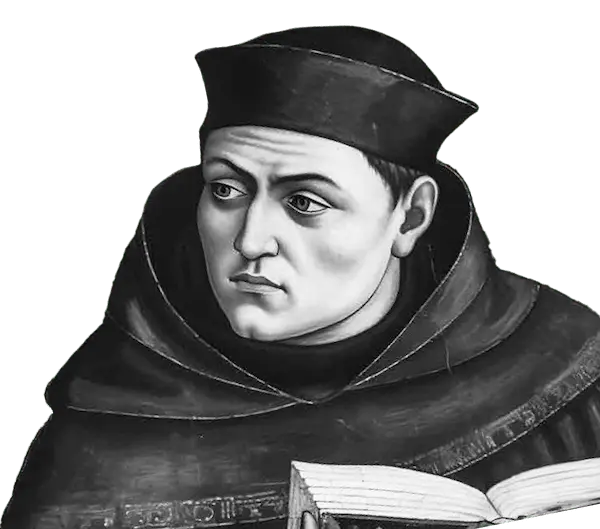
Thomas Aquinas Commentary
John 14
"Let not your heart be troubled: believe in God, believe also in me. In my Father`s house are many mansions; if it were not so, I would have told you; for I go to prepare a place for you. And if I go and prepare a place for you, I come again, and will receive you unto myself; that where I am, [there] ye may be also." — John 14:1-3 (ASV)
1. Above, our Lord taught His disciples by example; here He consoles them with His words. His words do two things:
- They encourage the disciples in many ways.
- They explain what He has said: “These things I have spoken to you, that you may not be caused to stumble” (John 16:1).
Concerning the first point, we should note that two things could trouble the disciples. One was near: that Christ would soon be leaving them. The second was in the future: the hardships they would undergo.
Christ consoles them regarding both. First, over His leaving; second, over their future hardships: “I am the true vine, and my Father is the vinedresser” (John 15:1).
Concerning His leaving, He does two things:
- He consoles them from their own point of view, as those who will be left: “I am the vine, you are the branches” (John 15:5).
- He consoles them from His own point of view, as the one leaving: “Let not your heart be troubled, nor let it be afraid” (John 14:27).
Concerning this consolation, He does three things:
- He says that He is going to the Father.
- He promises them the gift of the Holy Spirit: “If you love me, keep my commandments” (John 14:15).
- He promises that He will also be with them: “I will not leave you orphans; I will come to you” (John 14:18).
Concerning His going to the Father, He does two things:
- He mentions that He is going to the Father.
- He brings in the way He would go: “And where I go you know, and the way you know” (John 14:4).
Concerning this, He does three things:
- He expels their anxieties.
- He refers to His power: “You believe in God, believe also in me.”
- He adds a promise: “In my Father’s house there are many mansions.”
2. In regard to the first point, note that the disciples could have been disturbed by what our Lord said about the betrayal of Judas, Peter’s denial, and His own departure. Indeed, each of these did trouble them and make them sad: “You have made the land to quake,” that is, the hearts of the disciples, “you have rent it open” (Psalms 60:2). Therefore our Lord, wishing to soothe their sorrow, said: “Let not your heart be troubled.”
3. In Acts we read: “Jesus began to do and teach” (Acts 1:1). Yet above it says that Jesus “was troubled in spirit” (John 13:21). How can He tell His disciples not to be troubled when He Himself was troubled?
I answer that He did not teach the opposite of what He did. It was stated above that He was troubled in spirit, not that His spirit was troubled. Here He is not forbidding them to be troubled in spirit, but He is forbidding that their hearts—that is, their spirits—be troubled. For there is a troubled state which arises from reason; this is to be praised and is not forbidden: “For godly grief produces a repentance that leads to salvation” (2 Corinthians 7:10). Yet there is a different grief or troubled state of the reason itself; this is not praiseworthy because it draws the reason from its proper course. This is forbidden: “The just person will not be troubled, for the Lord puts his hand under him” (Psalms 37:24). For one who always possesses God cannot be disturbed.
p>4. Accordingly, our Lord refers to the power of His divinity, saying, “You believe in God, believe also in me.” Here He presupposes one thing and commands another.He presupposes their faith in God, saying, “You believe in God.” He had already taught them about this: “For whoever would draw near to God must believe that he exists” (Hebrews 11:6).
What He commands is that they believe in Him, saying, “Believe also in me.” For if you believe in God, and since I am God, then you should believe in me. This follows whether the word ‘God’ stands for the divine essence, since the Son is God, or whether it stands for the person of the Father. For no one can believe in the Father unless he believes in the Son: “He who does not honor the Son does not honor the Father who sent him” (John 5:23).
The fact that He says, “Believe also in me,” indicates that He is truly God; for although we are allowed to believe a human being or a creature, we ought to believe in God alone. Therefore, we must believe in Christ as we believe in God. “We are in him who is true, in his Son Jesus Christ. This is the true God and eternal life” (1 John 5:20); “This is the work of God, that you believe in him whom he has sent” (John 6:29).
5. Then when He says, “In my Father’s house are many mansions,” He adds the promise that it is through Christ that they will approach and be brought to the Father. Now, a promise to others that they will gain entrance to some place involves two things: first, the place must be prepared; next, they have to be brought there. Our Lord makes these two promises here: one concerns the preparation of the place, and the other is about their being brought there. Yet the first is not necessary, for the place has already been prepared; but the second is necessary. Thus He does two things:
- He says the first promise is not necessary.
- He then makes His second promise: “And if I go and prepare a place for you, I will come again and will take you to myself” (John 14:3).
In regard to the first, He does two things:
- First, He indicates that it is not necessary to prepare the place.
- Second, He shows that He could prepare it if it were necessary: “If it were not so, I would have told you, because I go to prepare a place for you.”
6. He says, “In my Father’s house are many mansions.”
Anyone’s house is where he dwells, and so the house of God is where God dwells. Now God dwells in His saints: “Yet you, O Lord, are in the midst of us” (Jeremiah 14:9). In some of them He dwells by faith: “I will live in them and move among them” (2 Corinthians 6:16); while in others He dwells by perfect happiness: “that God may be everything to every one” (1 Corinthians 15:28). Accordingly, God has two houses. One is the Church militant, that is, the society of those who believe: “that you may know how one ought to behave in the household of God, which is the church of the living God” (1 Timothy 3:15). God dwells in this house by faith. “The dwelling of God is with men. He will dwell with them” (Revelation 21:3). The other is the Church triumphant, that is, the society of the saints in the glory of the Father: “We will be satisfied with the goodness of your house, your holy temple” (Psalms 65:4).
Yet the house of the Father is not only where He dwells, but He Himself is the house, for He exists in Himself. It is into this house that He gathers us. We see from 2 Corinthians that God Himself is the house: “We have a building from God, a house not made with hands, eternal in the heavens” (2 Corinthians 5:1). This house is the house of glory, which is God Himself: “A glorious throne set on high from the beginning is the place of our sanctification” (Jeremiah 17:12). We remain in this place, in God, with our will and affections by the joys of love: “He who abides in love abides in God, and God abides in him” (1 John 4:16). And we remain here with our minds by our knowledge of the truth: “Sanctify them in the truth” (John 17:17).
In this house, then, that is, in glory, which is God, “are many mansions,” that is, various participations in happiness. This is because one who knows more will have a greater place. Therefore, the different rooms are the various participations in the knowledge and enjoyment of God.
7. The question arises here whether one person can be happier than another. It seems not. For happiness is the end; and what is perfect and complete does not have degrees. Therefore, there cannot be different degrees of happiness.
I answer that a thing can be perfect in two ways: absolutely and in a qualified sense. The absolute perfection of happiness is found only in God. Only He knows and loves Himself to the extent that He is knowable and lovable, since He knows and loves His own infinite truth and goodness infinitely. From this point of view, the supreme good itself, which is the object and cause of happiness, cannot be greater or less, because there is only one supreme good. But in a qualified sense—that is, considering certain conditions of time, nature, and grace—one person can be happier than another depending on the possession of this good and the capacity of each. The greater the capacity a person has for this good, the more he shares in it; I mean he participates in it more, the better disposed and prepared he is to enjoy it. Now one is disposed for this good in two ways. Happiness consists in two things. The first is the vision of God, and one is disposed for this by purity. And so the more one has a heart that is raised above earthly matters, the more he will see God, and the more perfectly. Second, happiness consists in the delight of enjoying, and one is disposed for this by love. Thus, one who has a more burning love for God will find more delight in the enjoyment of God. We read about the first in Matthew: “Blessed are the pure in heart, for they will see God” (Matthew 5:8).
8. Another question arises from what Matthew says, that every laborer received one denarius (Matthew 20:10). This denarius is nothing but a room in the house of the Father. Therefore, there are not many rooms.
I answer that the reward of eternal life is both one and many. It is many based on the various capacities of those who share in it, and from this point of view there are different rooms in the Father’s house. Yet this reward is one, and this for three reasons. First, because there is one object, for it is the same object which all the blessed see and enjoy. Thus, there is one denarius. But it is seen and loved in various degrees: “Then you will delight yourself in the Almighty” (Job 22:26); “In that day the Lord of hosts will be a crown of glory, and a diadem of beauty, to the remnant of his people” (Isaiah 28:5). It is like a spring of water, available to all to take as much as they wish. One who has a larger cup will receive more, and one who has a smaller cup will receive less. Therefore, there is one fountain, considering it in itself, but not everyone receives the same portion. This is the opinion of Gregory, in his Morals XXII. Second, this reward is one, according to Augustine, because it is an eternal portion: each one will have an eternal happiness, for the just will go into eternal life, but there are differences in capacity. Third, this reward is one because of charity, which unites everything and makes the joy of each the joy of the rest, and vice versa: “Rejoice with those who rejoice” (Romans 12:15).
9. The Pelagians erred by misunderstanding this passage. They said that children who die without baptism will be saved in the house of God, but not in the kingdom of God, for we read, “Unless a man be born again of water and the Spirit, he cannot enter into the kingdom of God” (John 3:5).
Augustine answers this by saying that our Lord said that these rooms are in God’s house. Now in a kingdom there are nothing but houses, for a kingdom is made up of cities, and cities of neighborhoods, and neighborhoods of houses. Thus, if rooms are in a house, it is evident that they are in the kingdom.
10. Then when He says, “If not, I would have told you: because I go to prepare a place for you,” He shows He has the ability to prepare a place for them if necessary.
For one could say: “It is true that in His Father’s house many rooms have been prepared, but if not, He could not prepare them.” Our Lord excludes this by saying, “If not,” that is, if the rooms were not prepared, “I would have told you: because I go to prepare a place for you.”
Here we should consider what is meant by the phrase, “to prepare a place for you.” A place is prepared in two ways. In one way, when something is done to the place itself, as when it is cleaned or enlarged: “Enlarge the place of your tent” (Isaiah 54:2). In another way, when someone is given the means to enter it; and so the Psalmist prays: “Be to me a rock of refuge, a strong fortress to save me” (Psalms 71:3), which is like saying: “May I always have the means to enter here.” With this in mind, the text can be understood in two ways. If this place had some defect or was something created, it would be subject to my power to perfect it, for every creature is subject to the power of the Word: “All things were made by him” (John 1:3). So, if it had some defect, “I would have told you: because I go to prepare a place for you.” But this place, in itself, is prepared, for this place is God Himself, as was said, in whom is the abundance of all perfections. But perhaps you do not have the means to enter it; and so, “if not,” that is, if it were not so that you had the means to enter here and were not predestined to this place, “I would have told you: I go to prepare a place for you,” for it is in my power to predestine you to this place. For He, with the Father and the Holy Spirit, has predestined them to eternal life: “He chose us in him” (Ephesians 1:4).
11. Our Lord said above: “Where I am going, you cannot follow me now” (John 13:36). And then here, to keep them from believing that they would be absolutely separated from Him, He adds, “And if I go and prepare a place for you, I will come again and will take you to myself.” This is the second promise, that they will be brought into the kingdom.
This seems to conflict with His earlier statement, for He had said: “If not, I would have told you: because I go to prepare a place for you.” This implies that He is not going to prepare a place for them. Yet here we read: “If I go and prepare a place for you,” which suggests that He is going to prepare a place for them.
One reply would be that these two sentences can be understood as connected. Then the meaning would be this: “If not,” that is, if places were not prepared and I had to go to prepare them, “I would have told you: because I go to prepare a place for you.” And then again, “If I go and prepare a place for you.”
According to Augustine, however, these are distinct sentences and are not read together. Our Lord prepared places both by eternal predestination and by carrying out this predestination. He also prepared these places by His departure. Thus, what our Lord said first, that rooms were prepared, is understood as referring to the first preparation from all eternity. Then when He says, “If I go and prepare a place for you,” this is understood as referring to the carrying out of the eternal predestination.
12. Our Lord prepared a place for us by His departure in five ways.
- He made room for faith. Since faith concerns things not seen, when the disciples saw Christ in person, they did not need faith for this. Thus He left them, so that the one they had possessed by His bodily presence and seen with their bodily eyes, they could still possess in His spiritual presence and see with the eyes of their mind. This is to possess Him by faith.
- His leaving prepared a place by showing them the way to go to that place: “He who opens the breach will go before them” (Micah 2:13).
- By His prayers for them: “He is able for all time to save those who draw near to God through him” (Hebrews 7:25); “He rides through the heavens to your help” (Deuteronomy 33:26).
- By attracting them to what is above: “Draw me after you” (Song of Solomon 1:4); “If then you have been raised with Christ, seek the things that are above” (Colossians 3:1).
- By sending them the Holy Spirit: “For the Spirit was not yet given, because Jesus was not yet glorified” (John 7:39).
13. The glorification of Christ was completed by His ascension. And so as soon as He ascended, He sent the Holy Spirit to His disciples. He told them ahead of time that He would physically leave them, saying, “If I go and prepare a place for you.” And then He promised them a spiritual return, saying, “I will come again.” I will come at the end of the world: “This Jesus... will come in the same way as you saw him go into heaven” (Acts 1:11). “And will take you,” glorified in soul and body, “to myself”: “We will be caught up together with them in the clouds to meet the Lord in the air” (1 Thessalonians 4:17).
14. Will Christ wait until the end of the world before He takes the spirits of the apostles?
It is the opinion of the Greeks that the saints will not go to paradise until the day of judgment.
But if this were true, the Apostle’s desire to be with Christ (Philippians 1:23) would be futile. Therefore, one should say that immediately after the house where we dwell here is overthrown, our souls are with Christ. And so the statement, “I will come again, and will take you to myself,” can be understood as that spiritual coming with which Christ always visits the Church of the faithful and gives life to each of the faithful at death. Then the meaning is: “I will come again,” to the Church, spiritually and continuously, “and will take you to myself,” that is, I will strengthen you in faith and love for me. “My beloved has gone down to his garden, to the beds of spices,” that is, to the community of the saints, “to feed in the garden,” that is, to delight in their virtues, “and to gather lilies,” to draw pure souls to Himself when He gives life to the saints at death (Song of Solomon 6:2).
15. Then He mentions the result of this, saying, “That where I am, you may be also,” so that the members may be with their head, and the disciples may be with their Teacher: “Wherever the body is, there the eagles will be gathered together” (Matthew 24:28); “Where I am, there will my servant be also” (John 12:26).
"And whither I go, ye know the way. Thomas saith unto him, Lord, we know not whither thou goest; how know we the way? Jesus saith unto him, I am the way, and the truth, and the life: no one cometh unto the Father, but by me. If ye had known me, ye would have known my Father also: from henceforth ye know him, and have seen him." — John 14:4-7 (ASV)
Previously, our Lord consoled His disciples about His departure, promising them that they could come to the Father. Now He mentions the way by which they are to approach the Father. But one does not know a way unless he also knows his destination; and so He also considers the destination.
First, He mentions the way and its destination as known to them.
Second, He explains this in response to Thomas, who said to Him, Lord, we do not know where you are going; and how can we know the way?
Regarding the first point, note that our Lord had said, if I go and prepare a place for you, I will come again (John 14:3). The disciples could have asked Him where He was going, just as Peter did before: Lord, where are you going? (John 13:36). Our Lord knew this and so said to them, where I am going you know, and the way you know. For I am going to the Father, whom you know, since I have revealed Him to you: I have manifested your name to the men whom you have given me (John 17:6). And I myself am the way through which I go, and you know me: we saw his glory (John 1:14). He spoke truly, therefore, when He said, where I am going you know, and the way you know, because they knew the Father through Christ, and they knew Christ by living with Him.
Next, when He says, Thomas said to him, Lord, we do not know where you are going, we see first, the occasion for this explanation, and second, the explanation itself: Jesus said to him, I am the way, and the truth, and the life.
The occasion for this explanation was the hesitation expressed in Thomas’s question: Lord, we do not know where you are going; how can we know the way? Here Thomas denies the two things that our Lord affirmed. For our Lord said that they knew both the way and its destination, but Thomas denied that he knew either. Yet both statements are true, for it is true that they knew, yet they did not know that they knew.
They knew many things about the Father and the Son which they had learned from Christ. Yet, they did not realize that the Father was the destination to which Christ was going, or that the Son Himself was the way. For it is difficult to go to the Father. This lack of knowledge is not surprising. Although they clearly knew that Christ was a human being, they only imperfectly recognized His divinity. As the scripture says, that path no bird of prey knows (Job 28:7).
Thomas says, how can we know the way? Knowledge of the way depends on knowledge of the destination. And so, because we do not know the destination—He dwells in unapproachable light, whom no man has ever seen or can see (1 Timothy 6:16)—we cannot discover the way: how unsearchable are his ways! (Romans 11:33).
Then when He says, Jesus said to him, I am the way, and the truth, and the life, He answers the question. Our Lord had to answer two things: first, about the way and its destination; second, about their knowledge of both.
First, therefore, He reveals the answer to the first point.
Second, He addresses their knowledge with the words, if you had known me, you would without a doubt have known my Father also.
Regarding the first point, He does two things:
First, He states what the way is.
Second, He states what the destination is, with the words, no one comes to the Father, but by me.
The way, as has been said, is Christ Himself; so He says, I am the way. This is indeed true, for, as stated in Romans 5:2, it is through Him that we have access to the Father. This answer was also able to settle the uncertainty of the wavering disciple.
Because this way is not separated from its destination but united to it, He adds, and the truth, and the life. So Christ is at once both the way and the destination. He is the way in His human nature and the destination in His divine nature. Therefore, as human, He says, I am the way; as God, He adds, and the truth, and the life. These last two appropriately indicate the destination of the way.
For the destination of this way is the end of human desire. Now, human beings especially desire two things: first, a knowledge of the truth, which is characteristic of them; second, that they continue to exist, which is common to all things. In fact, Christ is the way to arrive at the knowledge of the truth, while still being the truth itself: Teach me your way, O LORD, that I may walk in your truth (Psalms 85:11). Christ is also the way to arrive at life, while still being life itself: You will show me the path of life (Psalms 16:11). And so He indicated the destination of this way as truth and life. These two were already applied to Christ: first, He is life, in him was life (John 1:4); then, He is truth, because the life was the light of men (John 1:4), and light is truth.
Note that both truth and life belong properly and essentially to Christ. Truth belongs essentially to Him because He is the Word. Now, truth is the conformity of a thing to the intellect, and this results when the intellect conceives the thing as it is. Therefore, the truth of our intellect belongs to our word, which is its conception. Although our word is true, it is not truth itself, since it is not true of itself but only because it conforms to the thing conceived.
Therefore, the truth of the divine intellect belongs to the Word of God. But the Word of God is true of itself, since it is not measured by things; rather, things are true to the degree that they are similar to the Word. Therefore, the Word of God is truth itself. Because no one can know the truth without adhering to the truth, anyone who desires to know the truth must adhere to this Word.
Life also belongs properly to Christ, for everything which has some activity from itself is said to be living, while non-living things do not have motion from themselves. Among the activities of life, the chief are the intellectual activities. Thus, the intellect itself is said to be living, and its activities are a certain kind of life. Now in God, the activity of understanding and the intellect itself are the same. Thus, it is clear that the Son, who is the Word of the Father's intellect, is His own life.
This is why Christ referred to Himself as the way united to its destination: because He is the destination, containing in Himself whatever can be desired—namely, existing truth and life.
If, then, you ask which way to go, accept Christ, for He is the way: This is the way, walk in it (Isaiah 30:21). And Augustine says: Walk like this human being and you will come to God. It is better to limp along on the way than to walk briskly off the way. For one who limps on the way, even though he makes just a little progress, is approaching his destination; but if one walks off the way, the faster he goes the further he gets from his destination.
If you ask where to go, cling to Christ, for He is the truth which we desire to reach: My mouth will utter truth (Proverbs 8:7).
If you ask where to remain, remain in Christ because He is the life: He who finds me finds life and will have salvation from the LORD (Proverbs 8:35).
Therefore, cling to Christ if you wish to be secure, for you cannot get off the road, because He is the way. And those who hold on to Him are not walking off the road but on the right road: I have taught you the way of wisdom (Proverbs 4:11). But some are just the opposite: they did not find the way of truth to dwell in (Psalms 107:4). Again, they cannot be deceived, because He is the truth and teaches all truth: for this I was born, and for this I came into the world, that I should give testimony to the truth (John 18:37). Further, they cannot be troubled, because He is the life and the giver of life: I have come that they may have life, and have it more abundantly (John 10:10). Augustine says that when our Lord said I am the way, and the truth, and the life, He was saying in effect: How do you want to go? I am the way. Where do you want to go? I am the truth. Where do you want to remain? I am the life. As Hilary says, He who is the way does not lead us on erratic paths; He who is the truth does not deceive us with falsehoods; and He who is the life does not abandon us to death.
Here is another interpretation. In human beings, holiness involves three things: action, contemplation, and one’s intention. These are brought to perfection by Christ. Christ is the way for those in the active life; He is the truth for those who stand firm in the contemplative life. And He directs the intention of both those in the active and contemplative life to life, eternal life. For He teaches us to go and preach for the sake of the age to come. So, the Lord is our way by which we go to Him, and through Him to the Father.
But when He, who is the way, goes to the Father, is He the way for Himself? As Augustine says, He is the way, the one who walks on the way, and how one goes on the way; hence, He goes through Himself to Himself. For He, in His human nature, is the way. Thus, He came through His flesh, yet remained where He was; and He went through His flesh, without leaving where He had come from. Also, through the flesh He returned to Himself, the truth and the life. For God had come, through His flesh, to us—the truth to liars, the life to mortals: God is truthful, and every human is a liar (Romans 3:4). And when He left us and took His flesh up to that place where there are no liars, this very Word who was made flesh returned, through His flesh, to the truth, which is Himself. For example: when I speak to others, my mind goes out to them, yet it does not leave me; and when I am silent, in a certain sense I return to myself, yet still remain with those to whom I spoke. And so Christ, who is our way, became the way even for Himself, so that His flesh could go to the truth and the life.
Then when He says, no one comes to the Father, but by me, He answers the question about the destination of the way. The way, which is Christ, leads to the Father. Yet, because the Father and the Son are one, this way leads also to Himself. And so Christ says that He is the terminus of the way: no one comes to the Father, but by me.
Note that the Apostle says, For what person knows a man’s thoughts except the spirit of the man which is in him? (1 Corinthians 2:11), provided one does not choose to reveal his own thoughts. A person reveals what is hidden within by his words, and it is only by the words of a person that we can know what is hidden within. Now, no one comprehends the thoughts of God except the Spirit of God (1 Corinthians 2:11). Therefore, no one can acquire a knowledge of the Father except by His Word, which is His Son: no one knows the Father except the Son (Matthew 11:27). And just as one of us who wants to be known by others, by revealing to them the words in his heart, clothes these words with letters or sounds, so God, wanting to be known by us, took His Word, conceived from eternity, and clothed it with flesh in time. And so no one can arrive at a knowledge of the Father except through the Son. Thus He says: I am the door. If anyone enters by me, he will be saved (John 10:9).
Note, with Chrysostom, that our Lord had said, No one can come to me unless the Father who sent me draws him (John 6:44). But here He says, no one comes to the Father, but by me. This indicates that the Son is equal to the Father.
It is now clear what the way is, namely, Christ, and what the destination is, namely, the Father.
Then when He says, if you had known me, you would without a doubt have known my Father also, He shows that the disciples knew both where He was going and the way.
First, He shows this.
Second, He resolves a coming difficulty, when Philip said to him, Lord, show us the Father (John 14:8).
He does two things about the first point:
First, He shows that knowledge of the Son is also knowledge of the Father.
Second, He states the disciples’ knowledge of the Father: and from now on you will know him.
He had said: I have said that I am the way, and that you know the way, that is, me. Therefore, you also know where I am going, because you cannot know me without knowing the Father. This is what He says: if you had known me, you would without a doubt have known my Father also.
Yet He had said to the Jews before, If you did know me, perhaps you would also know my Father (John 8:19). Why does He say here, without a doubt, while before He said perhaps? It seems that before He had some doubts about what He says here.
We should answer that in the first instance He was speaking to the Jews, whom He was reprimanding. And so He added perhaps not out of doubt, but as a rebuke to them. But here He is speaking to His disciples, whom He is teaching. Thus, He simply states the truth to them: if you had known me, you would without a doubt have known my Father also. This is like saying: If you knew my grace and dignity, you would without a doubt also know that of the Father. For there is no better way to know something than through its word or image, and the Son is the Word of the Father: In the beginning was the Word, and the Word was with God (John 1:1); and the Word was made flesh and dwelt among us, and we saw his glory, the glory as it were of the only-begotten of the Father, full of grace and truth (John 1:14). The Son is also the Image of the Father: He is the image of the invisible God (Colossians 1:15); He reflects the glory of God and bears the very stamp of his nature (Hebrews 1:3). Therefore, the Father is known in the Son as in His Word and proper Image.
Note that to the extent that something approaches a likeness of the Word of the Father, to that extent the Father is known in it, and to that extent it is in the image of the Father. Now since every created word is some likeness of that Word, and some likeness, though imperfect, of the divinity is found in every thing, either as an image or a trace, it follows that what God is cannot be known perfectly through any creature or by any thought or concept of a created intellect. It is the Word alone, the only-begotten Word, which is a perfect word and the perfect Image of the Father, that knows and comprehends the Father.
Therefore, according to Hilary, this statement can be put in another context. Our Lord said, no one comes to the Father, but by me. If you ask Arius how one goes to the Father through the Son, he answers that it is by recalling what the Son taught, because the Son taught us about the Father: I have manifested your name to the men whom you have given me (John 17:6). But our Lord rejected this by saying, if you had known me, you would without a doubt have known my Father also. This is like saying: Arius, or anyone else can indeed speak about the Father, but no human being is such that by knowing him the Father is known. This is true of the Son alone, who has the same nature as the Father.
Next, with the words and from now on you will know him, our Lord shows the knowledge the disciples had of the Father. Our Lord had already told the disciples that they knew the Father when He said, where I am going you know. Yet Thomas denied this: we do not know where you are going. Thus our Lord shows here that in a certain way they did know the Father, so that His statement was true; and in another sense they did not know the Father, so that what Thomas said was true. To do this, He mentions a twofold knowledge of the Father: one which will be in the future, and the other which was in the past.
He says, from now on you will know him. He says from now on because knowledge of the Father is of two kinds. One is perfect and is by an immediate vision of Him; this will be in our heavenly homeland: when he appears we shall be like him (1 John 3:2). The other is imperfect, by reflections, and is obscure; we have this by faith: for now we see in a mirror dimly (1 Corinthians 13:12). Thus, this phrase can be understood of each kind of knowledge. From now on you will know him, with perfect knowledge in your homeland: I will show you plainly of the Father (John 16:25). This is like saying: It is true that you do not know Him with perfect knowledge, but from now on you will know him, after the mystery of my passion has been accomplished. Or, in the other way, from now on, after my resurrection and ascension and after I have sent the Holy Spirit, you will know him with the perfect knowledge of faith, for when the Spirit, the Paraclete, comes, he will teach you all things, and bring all things to your mind, whatever I have said to you (John 14:26). Afterward he was seen upon earth and conversed with men . For they saw Christ, according to His assumed flesh, in whom there was the Word, and in the Word, the Father; and so in Him they saw the Father, because I am from him and he has sent me (John 7:29).
Note that the Father was not in the flesh in such a way that it was joined to Him to constitute one person, but He was in the Incarnate Word because they had one and the same nature, and the Father was seen in the incarnate Christ: we saw his glory, the glory as it were of the only-begotten of the Father (John 1:14).
"Philip saith unto him, Lord, show us the Father, and it sufficeth us. Jesus saith unto him, Have I been so long time with you, and dost thou not know me, Philip? he that hath seen me hath seen the Father; how sayest thou, Show us the Father? Believest thou not that I am in the Father, and the Father in me? the words that I say unto you I speak not from myself: but the Father abiding in me doeth his works. Believe me that I am in the Father, and the Father in me: or else believe me for the very works` sake. Verily, verily, I say unto you, he that believeth on me, the works that I do shall he do also; and greater [works] than these shall he do; because I go unto the Father. And whatsoever ye shall ask in my name, that will I do, that the Father may be glorified in the Son. If ye shall ask anything in my name, that will I do." — John 14:8-14 (ASV)
Here our Lord clears up a confusion in one of the disciples:
First, we see what the confusion was.
Second, it is resolved: Jesus said to him: have I been so long a time with you.
In regard to the first point, recall that our Lord had mentioned two things above. He promised something for the future—namely, a perfect knowledge of God—when he said, from henceforth you will know him (John 14:7). He also mentioned something about the past: that they had seen him. When Philip heard this, he believed that he had seen the Father. But now he asks to know him, saying, Lord, show us the Father (not asking for a vision but for knowledge), and it is enough for us.
This is not surprising, since that vision of the Father is the end of all our desires and actions, and nothing else is necessary: you will fill me with joy by your face, that is, by the vision of your face (Psalms 16:11); he satisfies your desire with good things (Psalms 103:5).
Next, the confusion is cleared up.
First, we see it resolved.
Second, this is explained further: the words that I speak to you, I speak not of myself.
Regarding the first point:
Our Lord rebukes Philip for his slowness.
He states the truth: Philip, he who sees me sees the Father also.
Christ objects to the very request: how can you say, show us the Father?
He says, have I been so long a time with you, and yet you do not know me, Philip? He is saying, in effect: “You should know me, considering how long I have been living with you and talking with you. And if you had known me, you would surely have known the Father also.” Therefore, since you do not know the Father, you indicate that you do not know me. You can be rebuked for your slowness: are you also still without understanding? (Matthew 15:16); for though by this time you ought to be teachers, you need someone to teach you again (Hebrews 5:12).
This gives rise to a question. Previously, our Lord told the disciples that they knew him when he said, and the way you know (John 14:4), while here he seems to say the opposite: if you had known me, you would surely have known my Father also (John 14:7).
Augustine answers this by saying that among the disciples, some knew Christ as the Word of God. One of these was Peter, when he said, you are the Christ, the Son of the living God (Matthew 16:16). Others did not truly know him, and Philip was one of these. It is to the first group that our Lord says, where I go you know, and the way you know (John 14:4); it is to the second group that he says, if you had known me, you would surely have known the Father also (John 14:7).
As another explanation, Christ could be known in a twofold way. He could be known in his human nature, and everyone knew him this way. With this in mind, he says, where I go you know, and the way you know (John 14:4). He could also be known as being of a divine nature, but they did not yet perfectly know him in this way. In reference to this, he says, if you had known me, you would surely have known my Father also (John 14:7). This is clear from the fact that he adds, Philip, he who sees me sees the Father also. He is saying, in effect: “If you knew me, you would know the Father; and then you would not be saying, show us the Father, because you would have already seen him by seeing me.” (Compare to John 8:19: if you did know me, perhaps you would also know my Father).
Sabellius made this statement the basis of his error. He asked what the meaning of he who sees me sees the Father also could be, except that the Father and the Son are the same person.
Hilary answers this by saying that if this were so, our Lord would have said, he who sees me sees the Father, without adding the word also. Because he adds also, saying, sees the Father also, he shows there is a distinction. Augustine says that we use the same way of speaking when we talk about two people who are very much alike; we say that if you saw one, you saw the other. Now, the most perfect likeness of the Father is in the Son. Therefore, he says, he who sees me sees the Father also.
In fact, there is a greater likeness in the Son than there is among mere human beings. Among humans, there can never be a likeness based on the very same numerical form or quality, but only a likeness in species. In the Son, however, there is the same numerical nature as in the Father. Thus, in seeing the Son, the Father is better seen than another human is seen by seeing a person who is merely alike, no matter how similar they are.
Note that this statement excludes the error of Arius on two points. First, it rejects his denial of consubstantiality. For it is impossible to see the uncreated substance by seeing some created substance, just as by knowing a substance of one genus, one cannot know a substance of another genus. It is evident, therefore, that the Son is not a created substance but is consubstantial with the Father. Otherwise, one who sees the Son would not see the Father.
The other error excluded is their interpretation of to the King of ages, immortal, invisible, the only God (1 Timothy 1:17) as meaning that only the Father is invisible, but the Son was often seen in his nature. But if this were so, it would follow that the Father was also frequently seen, because one who sees the Son sees the Father also. So since the Father is invisible as to his nature, it is impossible that the Father was seen in his nature.
Someone might question why our Lord rebuked Philip for asking to see the Father after he had seen the Son, since when one sees a picture he should not be rebuked for wanting to see the thing pictured.
Chrysostom answers this by saying that after hearing about knowing and seeing the Father, Philip wanted to see the Father with his bodily eyes, just as he thought he had seen the Son. This is what our Lord rebuked, pointing out to him that he did not even see the Son in his nature with his bodily eyes. Augustine, however, says that the Lord does not disapprove of the petition, but the grasping soul. For Philip says, Lord, show us the Father, and it is enough for us, as if to say, “We know you, but this is not sufficient.” Thus he believed that knowledge of the Son was not completely sufficient, but only knowledge of the Father. From this, it seems that the Son was thought to be less than the Father. And this the Lord rebuked, showing that knowledge of the Son is sufficient and the same as the knowledge of the Father, saying, he who sees me sees the Father also.
Then when he says, how can you say, show us the Father? he shows his disapproval of the request and of the basis for the request.
He disapproves of the petition when he says, how can you say, show us the Father? since the Father is seen in the Son. Indeed, Philip was able to say, as in Job, what can I answer, who has spoken rashly? I will lay my hand upon my mouth (Job 39:34).
He disapproves of the root of the request when he says, do you not believe that I am in the Father and the Father in me? This is like saying: “You want to possess the Father, believing that you will have sufficiency in him. But if you believe that, do you not believe that I am in the Father and the Father in me? For if you believed the latter, you would expect to find in me all the sufficiency which is in the Father.”
He says, I am in the Father and the Father in me, because they are one in essence. This was spoken of before: I and the Father are one (John 10:30).
Note that, in the divinity, essence is not related to person as it is in human beings. Among human beings, the essence of Socrates is not Socrates, because Socrates is a composite. But in the divinity, essence is the same as the person in reality, and so the essence of the Father is the Father, and the essence of the Son is the Son. Therefore, wherever the essence of the Father is, there the Father is; and wherever the essence of the Son is, there the Son is. Now the essence of the Father is in the Son, and the essence of the Son is in the Father. Therefore, the Son is in the Father, and the Father in the Son. This is how Hilary explains it.
Now our Lord clarifies his answer:
First, by the works he does himself.
Second, by the works he will do through the disciples: amen, amen I say to you, he who believes in me, the works that I do, he also will do.
So he first mentions the works he does himself; second, he infers a tenet of the faith: do you not believe that I am in the Father, and the Father in me?
The belief that Christ was God could be known from two things: from his teaching and from his miracles. Our Lord mentions these: if I had not done among them the works that no other man has done, they would not have sin (John 15:24). Referring to his teaching he says, if I had not come, and spoken to them, they would not have sin (John 15:22). We also read: never has a man spoken like this man (John 7:46). The blind man, referring to his works, said: from the beginning of the world it has not been heard that any man has opened the eyes of one born blind (John 9:32).
Our Lord shows his divinity by these two things. Referring to his teaching, he says, the words that I say to you, by the instrument of my human nature, I speak not of myself, but from him who is in me, that is, the Father: the things I have heard from him are the same I speak to the world (John 8:26). The Father, therefore, who speaks in me, is in me. Now whatever a human being says must come from the first Word. And this first Word, the Word of God, is from the Father. Therefore, all the words we speak must be from God. So when anyone speaks words he has from the Father, the Father is in him.
Referring to his works, he says, the Father who dwells in me, he does the works, because no one could do the works that I do: the Son cannot do anything of himself (John 5:19).
Chrysostom wonders how Christ can start by referring to his words, and then bring in his works, for Christ says, the words that I speak to you, I speak not of myself . . . he does the works.
There are two answers to this. Chrysostom says that Christ was referring to his teaching the first time, and then referring to his miracles. For Augustine, our Lord is referring to his words as his works: this is the work of God, that you believe in him whom he has sent (John 6:29). So when the Lord says, he does the works, we should understand that these works are words.
Two heresies were based on the above texts. When our Lord said, I am in the Father, Sabellius understood this to mean that the Father and the Son are the same. And from the statement, I speak not of myself, Arius inferred that the Son is inferior to the Father. Yet these very texts refute these heresies. For if the Father and Son were the same, as Sabellius speculated, the Son would not have said, the words that I speak to you, I speak not of myself. And if the Son were inferior to the Father, as Arius blasphemed, he would not have said, the Father who dwells in me, he does the works.
Since our belief in the Trinity is shown by the above two statements, our Lord concludes to this belief, saying, do you not believe that I am in the Father and the Father in me? It was explained above how this is to be understood. In Greek, the text reads: believe, that is, believe me, that I am in the Father and the Father in me. Or, it is surprising that you do not believe that I am in the Father and the Father in me.
Note that before, our Lord was speaking only to Philip—Jesus said to him: have I been so long a time with you; and have you not know me? Philip, he who sees me sees the Father also—but from the point where he says, the words that I speak to you, he is speaking to all the apostles together. “But if what I say to you is not enough to show my consubstantiality, otherwise believe for the very works’ sake.” As said above: for the works that the Father has given to me that I might perform them, the works themselves, which I do, give testimony about me, that the Father has sent me (John 5:36); even though you do not want to believe me, believe the works (John 10:38).
After clarifying what he had said by appealing to the works he did by himself, our Lord now clarifies these things by the works he would do through the disciples.
First, he mentions the works of the disciples.
Second, he mentions how they would do them: whatever you will ask the Father in my name, that will I do.
As to the first point:
He first mentions the works of the disciples.
Second, he states the reason for what he said: because I go to the Father.
He says, amen, amen, I say to you, and so forth. He is saying, in effect: “The works that I do are so great that they are a sufficient sign of my divinity; but if these are not enough for you, then look at the works I will do through others.”
For the strongest sign of great power is when a person does extraordinary things not only by himself but also through others. So he says, he who believes in me, the works that I do, he also will do. These words not only show the power of the divinity in Christ, but also the power of faith, and the union of Christ with those who believe. For just as the Son acts because the Father dwells in him by a unity of nature, so also those who believe act because Christ dwells in them by faith: that Christ may dwell in your hearts through faith (Ephesians 3:17). Now the works which Christ accomplished and the disciples do by the power of Christ are the miracles: and these signs will accompany those who believe: in my name they will cast out demons; they will speak in new tongues; they will pick up serpents (Mark 16:17).
What is remarkable is that he adds, and greater works than these will he do. We could say that in a certain sense our Lord does more things and greater things through his apostles than by himself. Among the miracles of Christ, the greatest was when a sick person was healed by touching the fringe of his garment (Matthew 9:20). But, as we read in Acts, the sick were healed by the shadow of Peter (Acts 5:15). And it is greater to heal by one’s shadow than by the fringe of one’s garment. In another way, we could say that Christ did more by the words of his disciples than by his own. As Augustine says, our Lord is speaking here of works accomplished by words, when the fruit of these words was faith. We see in Matthew that a young man was not persuaded by Christ to sell his possessions and follow him, for when Christ said to the youth, go, sell what you possess and give to the poor, we read that he went away sorrowful (Matthew 19:21). Yet we read that at the preaching of Peter and the other apostles, people sold their possessions and all that they owned and brought the money and laid it at the feet of the apostles (Acts 4:34).
Someone might find fault with this, because our Lord did not say that the apostles would do greater things, but he who believes in me. Should we say, then, that those who do not do greater things than Christ are not to be counted among those who believe in him? Of course not! That would be too harsh.
We should say that Christ works in two ways. In one way, he works without us, as in creating the heavens and the earth, raising the dead to life, and things like that. In another way, he works in us but not without us; the result of this is faith, by which the ungodly are brought to life. Our Lord is speaking here of what is found in all believers: this is the result which Christ produces in us, but not without us.
The reason for this is that whoever believes is producing the same result, since what is produced in me by God is also produced in me by myself—that is, by my free choice. Thus the Apostle says, it was not I—that is, I alone—but the grace of God which is with me (1 Corinthians 15:10). Christ is speaking of this when he says, the works that I do, he also will do; and greater works than these will he do, for it is a greater thing to justify the ungodly than to create the heavens and the earth.
For the justification of the ungodly, considered in itself, continues forever: righteousness is immortal and perpetual . But the heavens and the earth will pass away (Luke 21:33). Furthermore, physical effects are directed toward what is spiritual. The heavens and the earth are physical effects, but the justification of the ungodly is a spiritual effect.
This gives rise to a question. The creation of the holy angels is included in the creation of the heavens and the earth. Is it then a greater work to cooperate with Christ in one’s own justification than to create an angel?
Augustine does not settle this, but he does say: “Let him who can, judge whether it is greater to create the just angels than to justify ungodly men. Certainly, if each shows an equal power, the second shows greater mercy.” But if we carefully consider what works our Lord is talking about here, we are not setting the creation of the angels above the justification of the ungodly. When our Lord said, and greater works than these will he do, we need not understand this to mean all the works of Christ, but perhaps only those which he was then doing. But then he was working by the word of faith, and it is not as great to preach words of righteousness, which he did without us, as to justify sinners, which he does in us in such a way that we also do it.
Now he gives the reason why he said they will do greater works, which is because I go to the Father. This can be understood in three ways. First, according to Chrysostom: “I will work as long as I am in the world, but when I leave, you will take my place. And so, the things that I am doing you will do, and even greater things, because I go to the Father, and after that I will do nothing by myself, that is, by preaching.”
The second interpretation is this: the Jews think that if I am killed, faith in me will be eradicated. This is not true. Indeed, it will be approved even more, and you will do greater things because I go to the Father—that is, I will not perish, but continue in my own dignity in heaven: now is the Son of man glorified, and God is glorified in him (John 13:31).
A third interpretation: you will do greater things because I go to the Father. He is saying, in effect: “Since I will be glorified more, it is appropriate that I do greater things, and also give you the power to do greater things.” Thus, before Jesus was glorified, the Spirit was not given to the disciples in the fullness with which it was given after: for the Spirit was not yet given, because Jesus was not yet glorified (John 7:39).
Now he mentions how these things will be done:
First, the way.
Second, why they will be done: that the Father may be glorified in the Son.
As to the first, since our Lord said, and greater works than these will he do, in order that the greatness of the worker might be known from the greatness of the works, some might suppose that one who believes in the Son of God would be greater than the Son. Our Lord excludes this by the way the works are done. For the Son does these works by his own authority, while one who believes in him does it by asking. So he says, whatever you will ask the Father in my name, that I will do.
This eliminates the equality between believers and Christ in three ways. First, because as was said, believers do these works by asking, so he says, whatever you will ask. Every one who asks receives (Matthew 7:8). Second, because believers work by reason of the Son, so he says, in my name, that is, by reason of my name: there is no other name under heaven given among men by which we must be saved (Acts 4:12). For this name is above every name: not to us, O Lord, not to us, but to your name give glory (Psalms 115:1). Third, because the Son himself does all these works in them and through them, thus he says, that I will do. Note that the Father is asked and the Son does the work, the reason being that the works of the Father and the Son are inseparable: whatever he does, these the Son also does in like manner (John 5:19). For the Father does all things through the Son: all things were made by him (John 1:3).
How could he say, whatever you will ask . . . that I will do, since we see that his faithful ask and do not receive?
According to Augustine, we should consider here that he first says, in my name, and then adds, that I will do.
The name of Christ is the name of salvation: you shall call his name Jesus, for he will save his people from their sins (Matthew 1:21). Therefore, one who asks for something pertaining to salvation asks in the name of Christ. It does happen that someone asks for something which does not pertain to salvation. This happens for two reasons. First, because one has a corrupt affection: as when one asks for something to which he is attracted, but which, if he had it, would be an obstacle to his salvation. One who asks this way is not heard because he asks wrongly: you ask and do not receive, because you ask wrongly (James 4:3). For when someone, because of his corrupt affection, would badly use what he wants to receive, he does not receive it because of our Lord’s compassion. The reason is that our Lord does not just look at one’s desire, but rather at the helpfulness of what is desired. For the good Lord often denies what we ask in order to give us what we should prefer.
The second reason we may ask for something which does not pertain to our salvation is our ignorance. We sometimes ask for what we think is helpful, but really is not. But God takes care of us and does not do what we ask. Thus Paul, who labored more than all others, asked our Lord three times to take away a thorn in his flesh, but he did not receive what he asked because it was not useful for him (2 Corinthians 12:8). We do not know how to pray as we ought, but the Spirit himself intercedes for us with sighs too deep for words (Romans 8:26). You do not know what you are asking (Matthew 20:22). Thus it is clear that when we truly ask in his name, in the name of Jesus Christ, he will do it.
He says, that I will do, using the future tense, not the present tense, because he sometimes postpones doing what we ask so that our desire for it will increase and so that he can grant it at the right time: rain will fall on you when it should fall (Leviticus 26:4); in a day of salvation I have helped you (Isaiah 49:8). Again, it sometimes happens that we pray for people and are perhaps not heard, and this is because they put obstacles in the way. Do not pray for this people . . . for I do not hear you (Jeremiah 7:16); though Moses and Samuel stood before me, yet my heart would not turn toward this people (Jeremiah 15:1).
Then when he says, that the Father may be glorified in the Son, he gives the reason. Augustine punctuates this passage in the following way: Whatever you will ask the Father in my name, I will do it. Then a new sentence begins: that the Father may be glorified in the Son, if you will ask me any thing in my name, that I will do. This is like saying: “I will do what you ask in my name so that the Father may be glorified in the Son,” and everything that the Son does is directed to the glory of the Father: I do not seek my own glory (John 8:50). We also should direct all our works to the glory of God: do all to the glory of God (1 Corinthians 10:31).
"If ye love me, ye will keep my commandments. And I will pray the Father, and he shall give you another Comforter, that he may be with you for ever, [even] the Spirit of truth: whom the world cannot receive; for it beholdeth him not, neither knoweth him: ye know him; for he abideth with you, and shall be in you." — John 14:15-17 (ASV)
1. Previously, our Lord consoled His disciples about His departure by promising that they would be able to approach the Father (as seen in chapter 14). But because this might have seemed to be in the distant future, and in the meantime they would remain sorrowful without their Teacher, He now soothes their sorrow by promising them the Holy Spirit.
Here we see three things:
- The preparation needed to receive the Holy Spirit.
- The promise of the Holy Spirit: he will give you another Paraclete.
- The clarification of this promise: that he may abide with you forever.
Preparation for receiving the Holy Spirit was necessary for both the disciples and for Christ.
2. The disciples needed a twofold preparation: love in their hearts and obedience in their actions. Our Lord assumes they have the first, for He says, if you love me. It is clear that they do, because they are sad about His departure: you will give testimony, because you have been with me from the beginning (John 15:27). He commands the second for the future: keep my commandments. This is as if to say: "You express your love for me not with tears, but with obedience to my commands, for this is a clear sign of love," as stated in John 14:23: if anyone loves me, he will keep my word.
Thus, two things prepare a person to receive the Holy Spirit. Since the Holy Spirit is love, He is given only to those who love: I love those who love me (Proverbs 8:17). Likewise, He is given to the obedient: to this we are witnesses (Acts 3:15); I have put my Spirit upon him (Isaiah 42:1).
3. But is it true that the disciples' obedience and love for Christ prepare them for the Holy Spirit? It seems not, because the love by which we love God is from the Holy Spirit: God’s love has been poured into our hearts through the Holy Spirit who has been given to us (Romans 5:5). Furthermore, our obedience is from the Holy Spirit: for all who are led by the Spirit of God are sons of God (Romans 8:14); I have run in the way of your commandments when you enlarged my heart (Psalms 119:32).
One might answer that by loving the Son we merit receiving the Holy Spirit, and by having Him, we love the Father. But this is false, because our love for the Father and the Son is the same love.
Therefore, we should say that it is a characteristic of God's gifts that if a person makes good use of a gift granted to him, he merits receiving a greater gift and grace. Conversely, one who uses a gift badly has it taken from him. For we read in Matthew that the talent the lazy servant received from his master was taken from him because he did not use it well, and it was given to the one who had received five talents (Matthew 25:24). It is the same with the gift of the Holy Spirit. No one can love God unless he has the Holy Spirit, for we do not act before we receive God’s grace; rather, grace comes first: he loved us first (1 John 4:10). We should say, therefore, that the apostles first received the Holy Spirit so that they could love God and obey His commands. But it was necessary that they make good use of this first gift of the Holy Spirit—through their love and obedience—in order to receive the Spirit more fully. And so the meaning is: if you love me, by means of the Holy Spirit whom you have, and obey my commandments, you will receive the Holy Spirit whom you will then possess in greater fullness.
4. Another preparation was needed on Christ's part, and regarding this He says, and I will ask the Father, and so on. Note that our Lord Jesus Christ, as a human being, is the mediator between God and humanity (1 Timothy 2:5). As a man, He approaches God and asks for heavenly gifts for us; and by coming to us, He lifts us up and leads us to God. And so, because He had already come to us and, by giving us God's commandments, had led believers to God, He still had to return to the Father and ask for spiritual gifts. As Hebrews 7:25 says, by approaching God Himself, He is able to save forever. He does this by asking the Father, saying, I will ask the Father. As it is written: When he ascended on high he led a host of captives, and he gave gifts to men (Ephesians 4:8).
Note that it is the same person who asks for the Paraclete to be given and who gives the Paraclete. He asks as a man; He gives as God. He says, I will ask, in order to banish their sorrow over His departure, because His very departure is the reason they can now receive the Holy Spirit.
5. Now we see the promise of the Holy Spirit. The word "paraclete" is Greek and means "consoler." He says, he will give you another Paraclete, meaning the Father—though not without the Son—will give the Holy Spirit, who is the Consoler, since He is the Spirit of love. It is love that causes spiritual consolation and joy: the fruit of the Spirit is love, joy (Galatians 5:22). The Holy Spirit is also our advocate: we do not know how to pray as we ought, but the Spirit himself intercedes for us with sighs too deep for words (Romans 8:26).
The fact that He says, another, indicates a distinction of persons in God, in opposition to the heresy of Sabellius.
6. An objection might be raised that the word "paraclete" suggests an action of the Holy Spirit. Therefore, by saying another Paraclete, a difference in nature seems to be indicated, because different actions imply different natures. If so, the Holy Spirit would not have the same nature as the Son.
I reply that the Holy Spirit is a consoler and advocate, and so is the Son. John says that the Son is an advocate: we have an advocate with the Father, Jesus Christ (1 John 2:1). In Isaiah, we are told He is a consoler: the Spirit of the Lord has sent me to comfort those who mourn (Isaiah 61:1). Yet the Son and the Holy Spirit are not consolers and advocates in the same way, if we consider the appropriation of persons. Christ is called an advocate because as a man He intercedes for us with the Father; the Holy Spirit is an advocate because He moves us to ask. Again, the Holy Spirit is called a consoler because He is formally love, whereas the Son is a consoler because He is the Word. The Son is a consoler in two ways: through His teaching and because He gives the Holy Spirit and incites love in our hearts. Thus, the word another does not indicate a different nature in the Son and the Holy Spirit. Rather, it indicates the different way each is an advocate and a consoler.
7. Now the promise of the Holy Spirit is given. We see:
- How it is given.
- What the gift itself is.
- Those who receive it, for as it is written, if you know these things, you will be blessed if you do them (John 13:17).
8. The Spirit is truly given because He is given forever. Thus He says, that he may abide with you forever, the Spirit of truth. When something is given to a person only for a time, it is not a true gift; but there is a true gift when something is given to be kept forever. And so the Holy Spirit is truly given because He is to remain with them forever. He is with us forever: in this life, He enlightens and teaches us, bringing things to our minds; and in the next life, He brings us to see reality itself. And the Spirit of the Lord came mightily upon David from that day forward (1 Samuel 16:13). Although Judas had received Him, the Spirit did not remain with him forever, because he did not receive Him to remain forever, but only for a temporary state of righteousness.
According to Chrysostom, one could say that our Lord said these things to dispel a certain physical interpretation the disciples might have had.Commentary on Saint John 75. They could have imagined that this Paraclete, who was to be given to them, would also leave them after a while through some kind of suffering, like Christ. He rejects this when He says, that he may abide with you forever. This is as if to say, "The Spirit will not suffer death as I do, nor will He leave you."
9. We saw above that it was said to John the Baptist: he upon whom you see the Spirit descending and remaining, it is he who baptizes with the Holy Spirit (John 1:33). From this, it seems peculiar to Christ that the Holy Spirit remains with Him forever. However, this cannot be true if He also remains with the disciples forever.
According to Chrysostom, the solution is that the Holy Spirit is said to remain in us by His gifts.Commentary on Saint John 75. Certain gifts of the Holy Spirit are necessary for salvation; these are found in all the saints and always remain in us, such as charity, which never falleth away (1 Corinthians 13:8), since it will continue into the future. Other gifts are not necessary for salvation but are given to the faithful so they can manifest the Spirit: to each is given the manifestation of the Spirit for the common good (1 Corinthians 12:7). With this in mind, the Holy Spirit is with the disciples and the saints forever by the first type of gift. But it is unique to Christ that the Spirit is always with Him by the second type of gift, for Christ always has a plenitude of power to work miracles, to prophesy, and so on. This is not true of others, because, as Gregory says, the spirits of the prophets are not under the control of the prophets.Moralia in Job 2.56.90–92.
10. The Spirit is a most excellent gift because He is the Spirit of truth. He is called the Spirit to show the subtlety or immateriality of His nature, for the word "spirit" is used to indicate something imperceptible and invisible. The Holy Spirit is also imperceptible and invisible: The wind blows where it wishes, and you hear its sound, but you do not know where it comes from or where it goes (John 3:8). He is also called the Spirit to indicate His power, because He moves us to act and work well. The word "spirit" indicates a certain impulse, which is why it can also mean "wind": for all who are impelled by the Spirit of God are sons of God (Romans 8:14); let your good Spirit lead me on a level path! (Psalms 143:10).
He adds, of truth, because this Spirit proceeds from the Truth and speaks the truth, for the Holy Spirit is nothing other than Love. When a person is impelled to love earthly things and the world, he is impelled by the spirit of the world: Now we have received not the spirit of the world, but the Spirit who is from God (1 Corinthians 2:12). When one is impelled to works of the flesh, he is not impelled by the Holy Spirit: Woe to the foolish prophets who follow their own spirit (Ezekiel 13:3).
But the Holy Spirit leads to the knowledge of the truth, because He proceeds from the Truth, who says, I am the way, and the truth, and the life (John 14:6). In us, love of the truth arises when we have conceived and considered truth. So also in God, Love proceeds from conceived Truth, which is the Son. And just as Love proceeds from the Truth, so Love leads to knowledge of the truth: he will glorify me, because he will receive from what is mine and will show it to you (John 16:14). Therefore, Ambrose says that any truth, no matter who speaks it, is from the Holy Spirit.This quote, in fact, belongs to Ambrosiaster, Commentary on 1 Corinthians 12. No one can say: Jesus is Lord, except by the Holy Spirit (1 Corinthians 12:3); when the Paraclete comes, whom I will send you from the Father, the Spirit of truth (John 15:26). It is a characteristic of the Holy Spirit to reveal the truth because it is love that impels one to reveal his secrets: I have called you friends, because all things whatever I have heard from my Father, I have made known to you (John 15:15); he showed it—the truth—to his friend (Job 36:33).
11. The ones who receive the Holy Spirit are those who believe; He says, whom the world cannot receive.
First, He shows to whom the Spirit is not given; second, to whom He is given, you will know him.
First, He shows that He is not given to the world; second, He explains why, for if you know these things, you will be blessed if you do them (John 13:17).
12. As to the first, He says, whom the world cannot receive. Our Lord is here calling those who love the world, the world. As long as they love the world, they cannot receive the Holy Spirit, for He is the love of God. And no one can love, as his ultimate end, both God and the world: If anyone loves the world, the love of the Father is not in him (1 John 2:15). As Gregory says: "The Holy Spirit inflames everything he fills with a desire for invisible things. And because worldly hearts love only visible things, the world does not receive him, because it does not rise to the love of what is invisible. For worldly minds, the more they widen themselves with their desires, the more they narrow the core of their hearts to the Spirit."Moralia in Job 5.28.50. The Holy Spirit of discipline will flee from the deceitful .
13. Regarding the second point, why He is not given to the world, He says, because it sees him not, nor knows him. Spiritual gifts are not received unless they are desired: she, divine Wisdom, hastens to make herself known to those who desire her .
Now, there are two reasons why they are not known. First, because one does not want to know them; and second, because one is not capable of such knowledge. These two reasons apply to the worldly. In the first place, they do not desire this, and regarding this He says, because it sees him not, that is, does not want to know Him: they have fixed their eyes on the ground (Psalms 16:11). Furthermore, they are not capable of knowing Him, and regarding this He says, nor knows him. As Augustine says: "Worldly love does not have invisible eyes, which alone can see the invisible Holy Spirit."Tractates on the Gospel of John 74.4. As is written: the sensual person does not perceive those things pertaining to the Spirit of God (1 Corinthians 2:14). Just as a tainted tongue does not taste sweet flavors, so a soul tainted by the corruption of the world does not taste the sweetness of heavenly things.
Here is the interpretation of Chrysostom.Commentary on Saint John 75. I say that he will give you another Paraclete... the Spirit of truth, but He will not assume flesh, because the world sees him not, nor knows him; that is, the world will not receive Him, but only you will.
14. Now He mentions, first, to whom the Spirit is given, and second, He gives the reason.
The Holy Spirit is given to believers. He says, you, who are moved by the Holy Spirit, will know him. Now we have received not the spirit of the world, but the Spirit who is from God (1 Corinthians 2:12). This is because you scorn the world: we look not to the things that are seen but to the things that are unseen (2 Corinthians 4:18).
The reason for this is, for he will abide with you. Note, first, the familiarity of the Holy Spirit with the apostles: for he will abide with you, that is, for your benefit. Let your good Spirit lead me on a level path! (Psalms 143:10); O, how good is your Spirit, O Lord, in all things . Second, note how intimate His indwelling is: and will be in you, that is, in the depths of your heart. I will put a new spirit within them (Ezekiel 11:19).
"I will not leave you desolate: I come unto you. Yet a little while, and the world beholdeth me no more; but ye behold me: because I live, ye shall live also. In that day ye shall know that I am in my Father, and ye in me, and I in you. He that hath my commandments, and keepeth them, he it is that loveth me: and he that loveth me shall be loved of my Father, and I will love him, and will manifest myself unto him." — John 14:18-21 (ASV)
-
Above, our Lord promised that the Holy Spirit would be our Comforter. But because the apostles had not risen very high in their knowledge of the Holy Spirit, and their attention was absorbed by Christ's presence, this comfort seemed small to them. Thus, in this section, our Lord promises two things:
- First, that He will return.
- Second, His own gifts: these things have I spoken to you, abiding with you (John 14:25).
Concerning the first point, His return, He does three things:
- He promises that He will return.
- He gives the reason: he who has my commandments, and keeps them; he it is who loves me.
- He answers a question from one of the disciples: Judas said to him, not the Iscariot (John 14:22).
Concerning the first of these points—that He promises to return—three aspects are presented:
- He shows that He will return.
- He describes the way He will return: yet a little while: and the world will see me no more.
- He foretells the fruit of His return: in that day you will know.
Concerning the first of these aspects—that He shows He will return—two things are noted:
- He shows why He needs to return.
- He promises to return: I will come to you.
-
The reason our Lord has to return is so that the disciples would not remain orphans; He says, I will not leave you orphans. The word ‘orphans’ comes from the Greek and indicates little children who do not have a father: we have become orphans, fatherless; our mothers are like widows (Lamentations 5:3).
Consider that we can have three fathers. One father gives us existence: we have had earthly fathers, literally, fathers of our flesh (Hebrews 12:9). A second father would be one whose evil example we follow: you are of your father the devil (John 8:44). A third father would be one who graciously adopts us: you have received the Spirit of adoption of sons (Romans 8:15). Now God does not adopt as His children those who imitate their father, the devil, for what fellowship has light with darkness? (2 Corinthians 6:14). And He does not adopt those who are too attached, in a worldly way, to their parents: he who loves father or mother more than me is not worthy of me (Matthew 10:37). But God does adopt as His children those who have become orphans by being stripped of their affection for sin and by abandoning a worldly love for their parents. For my father and my mother have forsaken me, but the Lord will take me up (Psalms 27:10); but much more one who has left them: forget your people and your father’s house; and the king will desire your beauty (Psalms 45:10).
Note that Christ presents Himself to His disciples as a father. Now although the word ‘father’, if taken to indicate a person, is unique to the Father, if it is taken to indicate an essence, it is appropriate for the entire Trinity. So our Lord said above: little children, yet a little while I am with you (John 13:33).
-
Christ promises to come when He says, I will come to you. But He had already come to them by taking on flesh: Christ Jesus came into the world (1 Timothy 1:15). Still, He will come in three more ways. Two of these ways are bodily or physical. One is after the resurrection and before His ascension, when He leaves them by death and comes to them after the resurrection and stands among His disciples, as is stated below (John 20:19). The other bodily coming will be at the end of the world: this Jesus, who was taken up from you into heaven, will come in the same way as you saw him go into heaven (Acts 1:11); and then they will see the Son of man coming in a cloud with power and great glory (Luke 21:27). His third coming is spiritual and invisible, that is, when He comes to His faithful by grace, either in life or in death: if he comes to me I will not see him (Job 9:11).
He says, therefore, I will come to you, after the resurrection (and this is the first way of coming mentioned above) and I will see you again (John 16:22). Again, I will come to you at the end of the world: the Lord will come to judge (Isaiah 3:14). And again I will come at your death to take you to myself: I will come again and will take you to myself (John 14:3). And again, I will come to you, visiting you in a spiritual way: we will come to him and make our abode with him (John 14:23).
-
Here He explains how He will return and shows that His return to the apostles will be in a special way. Since they might think that He would return to them as still subject to death, He excludes this, saying: yet a little while, and the world will see me no more. If we explain this as referring to His return after the resurrection, the meaning is this: yet a little while, that is, I will be with you only for a short time in this mortal flesh, and then I will be crucified; but after that, the world will see me no more. This is because after the resurrection He did not show Himself to all, but only to witnesses pre-ordained by God, that is, to His disciples (Acts 1:3). Thus He says, but you see me, that is, in my glorified and immortal body.
He gives the reason for this when He says, because I live and you will live. This clears up a difficulty. The disciples could have wondered how they would see Him, since He would be dead, and they with Him. So He says that this will not be the case, because I live, that is, I will live after the resurrection: I died, and behold I am alive for evermore (Revelation 1:18), and you will live, because you will not be killed with me: if then you seek me, let these go their way (John 18:8). Or another interpretation is that: I live, by my resurrection, and you will live, that is, you will rejoice over this, since the disciples therefore were glad, when they saw the Lord (John 20:20). Here, to live means to rejoice, and it is used in this sense: when Jacob heard that Joseph was ruling in Egypt his spirit began to live again, with joy (Genesis 45:26).
-
Augustine finds fault with this interpretation because our Lord said, yet a little while, and the world will see me no more. This means that the worldly will never see Him again. Yet they will see Him at the judgment, according to: every eye will see him (Revelation 1:7). Regarding this, it can be said that it is true that men of the world, after a little while, will not see Him in mortal flesh. For this reason Augustine explains this little while as including the second coming, when Christ comes to judge.
This time is described as little in comparison to eternity: for a thousand years in your sight are but as yesterday when it is past (Psalms 90:4). The Apostle, in Hebrews, also refers to this time as a little while when he is explaining the statement: in a little while, I will shake the heavens and the earth and the sea and the dry land (Haggai 2:7; Hebrews 12:26). And the world will see me no more, because after the judgment those who love the world and the wicked will not see Him, since they are going into eternal fire. As we read in another version of Isaiah: remove the wicked so they do not see the glory of God (Isaiah 26:10). But you, who have followed me and stayed with me in my trials, will see me, in an everlasting eternity: your eyes will see the king in his beauty (Isaiah 33:17); we will always be with the Lord (1 Thessalonians 4:17). You will see me because I live and you will live also. This is like saying: just as I have a glorified life in my soul and in my body, so will you; Christ will change our lowly body to be like his glorious body (Philippians 3:21). He says this because our glorified life is produced by the glorified life of Christ: for as in Adam all die, so also in Christ will all be made alive (1 Corinthians 15:22). Christ speaks of Himself in the present tense, I live, because His resurrection would be immediately after His death, and there would be no delay; according to: I will rise at dawn (Psalms 108:2), because you will not let your holy one undergo corruption (Psalms 16:10). When referring to the disciples He uses the future, you will live, because the resurrection of their bodies was to be postponed until the end of the world: your dead will live, their bodies will rise (Isaiah 26:19).
-
Now we see the fruit of His return, which is the knowledge of those things which the apostles did not know. As we saw, Peter did not know where Christ was going, and so he asked: Lord, where are you going? (John 13:36); and Thomas did not know this, nor the way He would go: Lord, we do not know where you are going; how can we know the way? (John 14:5). Philip did not know the Father, and so he asked: Lord, show us the Father, and it is enough for us (John 14:8). All these questions arose from ignorance of one thing: they did not know how the Father is in the Son and the Son is in the Father. Thus Christ said to Philip: do you not believe that I am in the Father, and the Father in me? (John 14:10). And so our Lord promises them that they will know this, saying, in that day you will know, that I am in my Father, and so on. This will dispel all confusion from the hearts of the disciples.
-
This sentence can be explained as referring to His coming at the time of the resurrection, and His coming at the judgment.
We have two kinds of knowledge of the mysteries of the divinity. One is imperfect, and we have this by faith; the other is perfect, and comes by vision. These two kinds of knowledge are mentioned in, for now we see in a mirror dimly, by the first kind of knowledge, but then face to face, referring to the second kind of knowledge (1 Corinthians 13:12).
He says, in that day, after my resurrection, you will know, that I am in my Father: and they will know this by the knowledge of faith, because then having seen that He has arisen and is among them, they will have a most certain faith about Him, especially those who would receive the Holy Spirit, who would teach them all things. Or, on the other hand, in that day, of the final resurrection at the judgment, you will know, that is, clearly and by vision: then I will understand fully, even as I have been fully understood (1 Corinthians 13:12).
-
But what will they know? The two things He mentioned above. First, the Father who abides in me, he does the works (John 14:10). Referring to this He says, that I am in my Father, that is, by a consubstantiality of nature. The other thing they will know is what He said about doing works through the disciples, when He said, he who believes in me, the works that I do, he also will do (John 14:12). And referring to this He says, and you in me, and I in you.
-
Here our Lord seems to say that the relation between Himself and the Father is like the relation of the disciples to Himself. For this reason the Arians maintained that just as the disciples are inferior to Christ and not consubstantial with Him, so the Son is inferior to the Father and distinct from Him in substance.
One should answer this by saying that when Christ says, I am in my Father, He means by a consubstantiality of nature: I and the Father are one (John 10:30); and the Word was with God (John 1:1).
-
The statement, and you in me, means that the disciples are in Christ. For what is protected or shielded by something is said to be in that thing, like something contained in its container. In this way the affairs of a kingdom are said to be in the hands of the king. And with this meaning it is said that in him we live and move and have our being (Acts 17:28). And I in you, remaining within you, and acting and indwelling within you by grace: that Christ may dwell in your hearts through faith (Ephesians 3:17); you desire proof that Christ is speaking in me (2 Corinthians 13:3).
Hilary gives another exposition. And you in me, that is, you will be in me through your nature, which I have taken on: for in taking on our nature He took us all on: he did not take hold of the angels, but he did take hold of the seed of Abraham (Hebrews 2:16). And I in you, that is, I will be in you when you receive my sacrament, for when one receives the body of Christ, Christ is in him: he who eats my flesh and drinks my blood abides in me, and I in him (John 6:56).
Another interpretation: and you in me, and I in you, that is, by our mutual love, for we read: God is love, and he who abides in love abides in God, and God abides in him (1 John 4:16). And you did not know these things, but you will know them in that day.
-
Now the reason for His return is given, and our Lord mentions two reasons why He is seen by the faithful and not by the world.
- Their true love for God.
- God’s love for them: and he who loves me, will be loved by my Father.
-
Regarding the first, He says, he who has my commandments and keeps them, he it is who loves me. Note that true love is love which appears and proves itself by actions, for love is revealed by its actions. Since to love someone is to will that person good and to desire what this person wants, one does not seem to truly love a person if he does not accomplish the will of the beloved or do what he knows this person wants. And so one who does not do the will of God does not seem to truly love Him. Thus He says, he who has my commandments and keeps them, he it is who loves me, that is, with a true love for me.
-
Some have these commandments of God in their heart, by remembering them and continually meditating on them: I have laid up your word in my heart, that I might not sin against you (Psalms 119:11). But this is not enough unless they are kept in one’s actions: a good understanding have all those who practice it (Psalms 111:10). Others have these commandments on their lips, by preaching and exhorting: how sweet are your words to my taste (Psalms 119:103). They also should follow them in their actions, because he who does them and teaches them will be called great in the kingdom of heaven (Matthew 5:19). Thus in Matthew, God reprimands those who speak but do not act (Matthew 23). Others have them by hearing them, gladly and earnestly listening to them: he who is of God hears the words of God (John 8:47). Yet this is not enough unless they keep them in their actions, for it is not the hearers of the law who are righteous before God, but the doers of the law who will be justified (Romans 2:13); do not labor for the food that perishes, but for that which endures to eternal life (John 6:27).
Therefore, those who have the commandments do keep them to a certain extent; but they still have to persist in keeping them. For this reason Augustine says: the person who keeps the commandments in his memory and keeps them in his life, who has them in his speech and keeps them in his conduct, who has them by hearing them and keeps them by doing them, who has them by doing and persisting in doing them, this is one who loves me.
-
Regarding the second reason why He will be seen by the faithful, He says, he who loves me, will be loved by my Father.
But this is seen at first glance to be absurd. For surely the Lord does not love us because we love Him? God forbid! It is said, not as though we had first loved God, but because he has first loved us (1 John 4:10). Therefore, we should understand this statement in the light of what was said before, he who has my commandments and keeps them, he it is who loves me. This does not mean that one keeps the commandments and as a result of this loves. But rather, one loves, and as a result of this, keeps the commandments. In the same way, we should say here that one is loved by the Father, and as a result he loves Christ, and not that one is loved because he loves. Therefore, we love the Son because the Father loves us. For it is a characteristic of true love that it draws the one loved to love the one who loves him: I have loved you with an everlasting love, and therefore I have drawn you, having compassion on you (Jeremiah 31:3).
-
Because the Father’s love is not without the Son’s love, since it is the same love in each—whatever he does, these the Son also does in like manner (John 5:19)—He adds, and I will love him.
Why does He say, I will love, using the future, since the Father and the Son love all things from eternity?
We should answer that love, considered as being in the divine will, is eternal; but considered as manifested in the accomplishment of some work and effect, is temporal. So the meaning is: and I will love him, that is, I will show the effect of my love, because I will manifest myself to him: for I love in order to manifest myself.
-
Note that one’s love for another is sometimes qualified and sometimes absolute. It is qualified when one wills some particular good for the other; but it is absolute when one wills all good for the other. Now God loves every created thing in a qualified sense, because He wills some good for every creature, even for the demons, for example, that they live and understand and exist. These are particular goods. But God loves absolutely those to whom He wills all good, that is, that they have God Himself. And to have God is to have truth, for God is truth. But truth is possessed when it is known. So God, who is truth, truly and absolutely loves those to whom He manifests Himself. This is what He says, and will manifest myself to him, that is, in the future, by glory, which is the ultimate effect of future beatitude: he showed it to his friend (Job 36:33); she hastens to make herself known to those who desire her .
-
Someone might ask: Will the Father not manifest Himself? Yes, both the Father and the Son. For the Son manifests Himself and the Father at the same time, because the Son is the Word of the Father: no one knows the Father except the Son (Matthew 11:27). If in the meantime the Son manifests Himself to anyone in some way, this is a sign of God’s love. And this can be a reason why the world will not see Him, because He will not manifest Himself to it because it does not love Him.
Jump to: