
Thomas Aquinas Commentary Matthew 1
Thomas Aquinas Commentary
Matthew 1
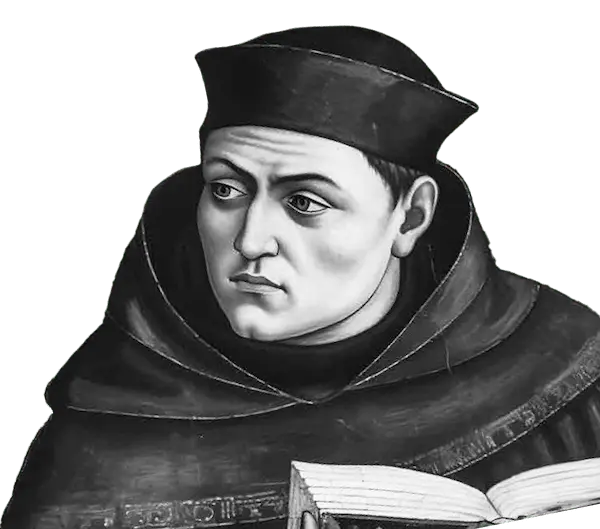
Thomas Aquinas Commentary
Matthew 1
"The book of the generation of Jesus Christ, the son of David, the son of Abraham." — Matthew 1:1 (ASV)
Among the Evangelists, Matthew is especially concerned with Christ’s humanity; for this reason, according to Gregory, He is represented by a man in the figure of the four animals. By means of His humanity, Christ entered into the world, He proceeded, and departed.
And therefore, the whole Gospel is divided into three parts. The Evangelist first deals with the entrance of Christ’s humanity into the world; secondly, with His course of life; and thirdly, with His departure. The second part begins at Matthew 3:1, where it is said, And in those days cometh John the Baptist preaching in the desert of Judea.
The third part begins at Matthew 21:1, where it is said, And when they drew nigh to Jerusalem and were come to Bethphage, unto mount Olivet. In the first part he does two things:
- Christ’s generation is described.
- The manifestation of His generation is added, where it is said, When Jesus therefore was born in Bethlehem of Juda, in the days of king Herod (Matthew 2).
In the first part he does three things:
- A sort of title of the whole book is placed at the beginning, when it is said, The book of the generation of Jesus Christ.
- The lineage of His ancestors is traced, Abraham begot Isaac.
- Christ’s generation is described in particular, when it is said, Now the generation of Christ was in this wise.
Now the title which is presented at the beginning is the following: The book of the generation of Jesus Christ.
However, this seems to be an incomplete sentence. For the title is in the nominative case without a verb; but it is not an incomplete sentence. For Matthew wrote the Gospel in Hebrew, and for that reason, in his writing he maintained the style of the Jews. Now it was customary for the Hebrews to speak in this way, just as when it is said, The vision of Isaiah the son of Amos, it is understood, ‘This is’; and it is not necessary to add these words. So here, when it is said, The book of the generation, it is understood, ‘This is.’ And this manner of speaking is also customary for us; for if we wish to title a book, it is called Priscianus Major and Priscianus Minor, and it is not necessary to add, ‘This is,’ or ‘Begins.’
Likewise, it is asked, since a small portion of this book is about Christ’s generation, why he gave his book this title.
And it should be understood that Matthew, who wrote for the Hebrews, in his writing maintained the custom of the Hebrews. Now it was customary for the Hebrews to title their books from their beginning, just as Genesis is so called because it deals with Generation or Creation; hence: This is the book of the generation of Adam (Genesis 5:1). And the book of Exodus is so called because in the first part it deals with the exodus of the children of Israel from Egypt.
But it is asked, why is of Jesus Christ added? And it should be understood that, according to the Apostle, As in Adam all die, so also in Christ all shall be made alive (1 Corinthians 15:22). Now Matthew had seen the first book of the Old Testament, in which it is said in chapter 5: This is the book of the generation of Adam. Therefore, in order that the New Testament, which deals with regeneration and restoration, might correspond to it by contrast, he says, The book of the generation of Jesus Christ, to show that the Author of both is the same.
Here, however, the question arises concerning what is said here: The book of the generation of Jesus Christ. For the contrary is found in Isaiah 53:8, where it is said, Who shall declare his generation?
But the sense is, according to Jerome, that in Christ there is a twofold generation. Specifically, there is the divine generation, which cannot be declared because even if in some way we describe the Begotten Son, nevertheless, the manner in which He is begotten, neither man nor angel can comprehend.
The other, however, is the human generation, which is discussed in this Gospel. But, nevertheless, even in this generation, there are many difficult things. And for that reason, according to Remigius, there are very few who can declare it.
Likewise, it is also asked why he says, Generation, since many generations are traced here. But it should be said that although many generations are enumerated, nevertheless, all are presented for the sake of the one, namely, Christ’s generation, concerning which it is said below: The generation of Christ was in this wise (Matthew 1).
Now He, whose generation is traced, is described in three ways:
- By His name, when it is said, Jesus.
- From His office, when it is said, Christ.
- From His origin, when it is said, The son of David, the son of Abraham.
Although there have been others who were also called “Jesus,” such as Jesus the son of Nave, about whom it is written, Valiant in war was Jesus the son of Nave, who was successor of Moses among the prophets ; and another lived about the time of the building of the Temple, about whom it is written in Zechariah 3.
These men were Jesus nominally and figuratively, insofar as they prefigured Him. The first Jesus led the people of Israel into the promised land; but this Jesus, who is our Savior, did not lead us into an earthly land, but into a heavenly land: For we have the author and finisher in His Blood, etc. (Hebrews 12:2).
And He is rightly called Jesus, because the name agrees with Him according to both natures, namely, the divine and the human. Indeed, according to His human nature, He suffered in His flesh and completed the mystery of our redemption. Since that suffering would not have efficacy except by virtue of the divine nature joined to it, for this reason it is said below: His name shall be called Jesus: for he shall save his people from their sins (Matthew 1).
But it is asked why he says, Christ. Was not Jesus sufficient? The reply is that this was done because, as it has been said, others also were called Jesus.
Now he describes Him when he says, Christ, that is ‘anointed.’ Observe, however, that there were three anointings in the Old Testament Law. For Aaron was anointed as a priest (Leviticus 8). Saul was anointed by Samuel as a king in 1 Kings 10. And David was so-anointed in 1 Kings 16. Elisha was anointed as a prophet in 1 Kings 19. Therefore, because Christ was a true priest, as it is said in Psalm 109:4: Thou art a priest for ever according to the order of Melchizedek, etc., and a king and a prophet, for this reason He is rightly called Christ, on account of the three offices which He exercised.
The son of David, the son of Abraham. Here a twofold question arises, namely, concerning their number and order.
As to the first question, why he named these two, this was done for the reason stated in the prologue: namely, because Abraham was a prophet. In Genesis 20:7 the Lord said to Abimelech, the king of Gerara: Restore the man his wife, for he is a prophet. Likewise, Abraham was a priest (Genesis 15:9), since he fulfilled the office of a priest, namely, by offering a victim to the Lord; Take me, He said, a cow of three years old, etc. And David was a prophet, as it is evident in Acts 2:20. He was also a king, as it is evident in 2 Samuel 2:4.
Because, therefore, Christ was a king, a prophet, and a priest, for this reason, it is rightly said that He was the Son of these men. For if he had named only Abraham, it would not be signified that Christ was a king. Likewise, if he had named only David, the priestly dignity in Christ would not be denoted; and therefore he wrote both.
As to the second question, namely, why he wrote the names in such an order, it should be said that, according to Jerome, David is put first, and the order is interchanged on account of the necessity of tracing the genealogy. For if he were to say first, The son of Abraham, and secondly, The son of David, he would need to repeat Abraham a second time so that the order of the genealogy might be preserved.
According to Ambrose, however, it should be said that David is put first by reason of dignity; for to David was made the promise about the Head Himself, when it is said: Of the fruit of thy womb I will set upon thy throne (Psalms 131:11). But to Abraham was made the promise about the members, namely, of the Church; hence: In thy seed shall all the nations of the earth be blessed (Genesis 22:11).
Here it should be observed that there were many errors concerning Christ. For some erred about His divinity, such as Paul of Samosata, Photinus, and Sabellius; some erred about His humanity; and some erred about both. Others, however, erred about His person.
Regarding His humanity, the first to err was Manes, who said that Christ did not have a true body but had received an imaginary one. Against this is what the Lord says: Handle, and see: for a spirit hath not flesh and bones, as you see me to have (Luke 24:39).
After him, secondly, Valentine erred. He said Christ brought a heavenly body down with Him and did not assume a body from the Virgin, but passed through her like water through a channel. Now, this error is contrary to what is said: Who was made to him of the seed of David, according to the flesh (Romans 1:3).
The third error was that of Apollinaris, who said Christ only took a body and not a soul, but had the divinity in place of the soul. This is contrary to what is frequently said in Scripture: Now is my soul troubled (John 12:27).
Because of this passage, this same man changed his opinion and said Christ had a vegetative and sensible soul, yet not a rational soul, but the divinity in its place. But then an unfitting consequence would follow: that Christ was no more a man than an animal.
The Evangelists, however, divided these errors among themselves as though by a kind of casting of lots. For Mark and John chiefly destroyed those errors which are about His divinity. Thus, John said immediately at the beginning of his Gospel: In the beginning was the Word (John 1:1). And Mark began his Gospel this way: The beginning of the gospel of Jesus Christ, the Son of God (Mark 1:1), and he did not say, ‘The son of Abraham.’
Matthew and Luke, however, destroyed in the beginning of their Gospels those errors that are about His humanity. Therefore, observe that in what is said, The son of David, the son of Abraham, all the errors concerning Christ’s humanity are excluded.
For someone is not said to be the son of another unless through univocal generation, which is according to a similarity of species. For no matter how much something is generated by a human, unless it shares the same specific nature, it is never called a son, as is evident with things like lice.
If, therefore, Christ is the son of David and of Abraham, it is necessary that He have the same nature by reason of the same species. However, He would not have the same nature by reason of the same species if He did not have a true and natural body, nor if He had brought it from heaven, nor also if He lacked a sensitive or rational soul. Hence, the exclusion of every error is evident.
"Abraham begat Isaac; and Isaac begat Jacob; and Jacob begat Judah and his brethren; and Judah begat Perez and Zerah of Tamar; and Perez begat Hezron; and Hezron begat Ram; and Ram begat Amminadab; and Amminadab begat Nahshon; and Nahshon begat Salmon; and Salmon begat Boaz of Rahab; and Boaz begat Obed of Ruth; and Obed begat Jesse; and Jesse begat David the king. And David begat Solomon of her [that had been the wife] of Uriah;" — Matthew 1:2-6 (ASV)
Having presented the title, His genealogical lineage is traced here. It is divided into three parts, according to the three series of fourteen by which this genealogical lineage is traced.
The first series of fourteen is from Abraham to David, proceeding through the Patriarchs. The second series proceeds from David to the Babylonian Captivity, proceeding through the kings. The third series is from the Babylonian Captivity to Christ, beginning with the leaders and proceeding through private persons.
The second series is where it is said, And David the king begot Solomon. The third is where it is said, And after the transmigration of Babylon, etc. The first series is divided into three parts:
- The ancestors who were before the entrance into Egypt are set forth.
- Those who were in the exodus itself and the entrance into the promised land are set forth.
- Those who were after the entrance into the promised land are set forth.
He says, therefore, first, Abraham begot Isaac.
Here it should be considered, before we proceed further, that two Evangelists, namely Luke and Matthew, describe Christ’s generation according to the flesh in detail; but they describe it differently. This difference is observed in five respects:
- They differ regarding the position.
- They differ regarding the order.
- They differ regarding the manner.
- They differ regarding the terminus.
- They differ regarding the persons enumerated.
First, I say that they differ regarding the position. Matthew begins to trace Christ’s generation at the start of his Gospel. Luke, however, begins to trace Christ’s generation not at the beginning, but after His baptism.
According to Augustine, the reason is that Matthew had the task of describing Christ’s carnal generation, and for that reason, he should put it immediately at the beginning. Luke, however, especially intended to praise the priestly person in Christ, and the expiation of sins pertains to the priest.
For that reason, Christ’s generation is appropriately placed by Luke after the baptism, in which the expiation of sins occurs. Second, Luke and Matthew differ regarding the order in tracing Christ’s genealogy. Matthew traces Christ’s generation by beginning from Abraham and descending all the way to Christ. Luke, however, begins from Christ and, by ascending, proceeds all the way to Abraham and even further.
The reason for this difference in order is that, according to the Apostle (Romans 4:25), in Christ there were two things: His humility in accepting the defects of our nature, and the power of His divinity and grace, through which He made atonement for us for these defects. As it is written, God sent his own Son in the likeness of sinful flesh (on account of the first), and of sin, hath condemned sin in the flesh (on account of the second) (Romans 8:3).
Matthew, therefore, who stressed Christ’s carnal generation, through which He descended even to the assumption of our infirmity, fittingly wrote His generation by descending. Luke, however, who commended the priestly dignity in Him, through which we are reconciled to God and united to Christ, fittingly proceeds by ascending.
Third, they differ regarding the manner. In the detailed exposition of the genealogy, Matthew uses the word begot, but Luke uses the word “was.” This is because Matthew, in his entire detailed exposition, gives the ancestors according only to the flesh, while Luke gives many ancestors according to the Law, or by adoption.
For it was commanded in the Law that if someone died without children, his brother was to take his wife and raise up sons for him. Therefore, those sons did not belong to him who fathered them biologically, but through a kind of adoption they were credited to the deceased. Consequently, Luke, who includes many sons accounted for through adoption, does not say begot, but “was,” because although their adoptive fathers had not biologically fathered them, the sons were nevertheless theirs through a kind of adoption. Matthew, however, who gives only the ancestors according to the flesh, says begot.
The reason for this, as was said, is that Matthew’s aim is chiefly directed towards Christ’s humanity. Because Christ was born from ancestors according to the flesh, for that reason, no one is included in Matthew’s genealogy who was not an ancestor according to the flesh. Luke, however, chiefly commends the priestly dignity in Christ, through which we are adopted as sons of God; therefore, he included not only the ancestors according to the flesh but also the legal ancestors.
Fourth, they differ regarding the terminus. Matthew starts his genealogy from Abraham, and it is continued to Christ. Luke, however, starts from Christ, and his genealogy is continued not only to Abraham but even to God.
The reason for this can be understood from the fact that Matthew wrote for the Hebrews, who took special pride in Abraham, saying, We are the seed of Abraham (John 8:33), for Abraham was the first principle of believing. Therefore, Matthew started from Abraham. Luke, however, wrote for the Greeks, who knew nothing about Abraham except in reference to Christ; for if Christ had not existed, they would never have known anything about Abraham. Therefore, Luke began from Christ and ended not only with Abraham but with God.
Fifth, they differ regarding the persons enumerated. In Luke’s entire genealogical lineage, there is absolutely no mention of a woman; in Matthew’s, however, some women are included. According to Ambrose, the reason for this is that Luke, as was said, especially commended the priestly dignity, and in a priest, purity is especially required. Matthew, however, traced His generation according to the flesh, and therefore some women are placed in it.
Nevertheless, it should be observed that in Matthew’s entire genealogy, only sinful women are included, or rather, women who were known to have been involved in some sin. Examples include Tamar, who committed fornication (Genesis 38); Ruth, who was an idolatress because she was a Gentile; and the wife of Uriah, who was an adulteress (2 Kings 11).
According to Jerome, this was to signify that He whose genealogy is traced came into this world for the sake of redeeming sinners. Ambrose mentions another reason: the sinful women were included so that the Church’s embarrassment might be removed. For if Christ was willing to be born of sinners, then unbelievers should not mock if sinners come into the Church.
Another reason can be given (I believe, according to Chrysostom): that the imperfection of the Law might be shown, and that Christ came to fulfill the Law. For by the fact that certain sinful women are mentioned in connection with men like David and Judah, it is indicated that even those who were greatest in relation to the Law were sinners. This, in turn, indicates the imperfection of the others.
For if these were sinners, much more so were others also: All have sinned and do need the glory of God (Romans 3:23). Therefore, these women are included in Christ’s generation to signify that He had fulfilled the Law.
Observe, nevertheless, that these women, although they all had been sinners, were not sinners at the time their genealogy is traced; they had by that time been cleansed by penance.
He says, therefore, Abraham begot Isaac. First, it should be noted that here there are two things to be considered according to the literal sense of the text:
- That Christ is signified by these ancestors.
- That these things are also recounted, and can be recounted, for our instruction.
He says, therefore, Abraham begot Isaac (this is recorded in Genesis 21). And Isaac begot Jacob (Genesis 25). And Jacob begot Juda and his brethren.
Here the question is raised: since Abraham had another son besides Isaac, namely Ishmael, and similarly Isaac had another son, why is no mention made of them, while it is said here, Juda and his brethren? Likewise, it is asked why Judah is given more prominence by being named rather than the others.
The reason is that Judah and his brothers remained in the worship of the one God, and for that reason, mention is made of them in Christ’s generation. This was not true for the other sets of brothers: Isaac and Ishmael, nor Jacob and Esau.
In answer to the second question, this was so that it could be shown that the prophecy of Jacob was fulfilled in Christ: The sceptre shall not be taken away from Juda, nor a ruler from his thigh, till he come that is to be sent, and he shall be the expectation of nations (Genesis 49:10); For it is evident that our Lord sprung out of Juda (Romans 7:14). Therefore, more mention is made of him than of the others.
And Juda begot Perez and Zara of Thamar. Here the question is raised: since the Lord was not born of Zara, but of Perez, why is Zara mentioned? Likewise, why is he mentioned by name? For previously the evangelist said, his brethren; why, therefore, did he mention the name of Zara?
It should be replied, according to Ambrose, that this was done according to a mystery. As proof of this, observe the historical account found in Genesis 38: in Thamar’s giving birth, Zara appeared first. The midwife tied a scarlet thread on his hand, saying: This shall come forth the first, and therefore she called his name Zara. But he drawing back his hand, the other came forth: and the woman said: Why is the partition divided for thee?
Now Zara, who appeared first, signifies the Jewish people. The scarlet thread the midwife tied on his hand signifies circumcision, which took place with a flow of blood. But as he drew back his hand, etc., the other came out, because blindness in part has happened in Israel, until the fullness of the Gentiles should come in (Romans 11:25). For in this way the divided Gentile nations entered into the light of the faith, emerging from the womb of ignorance and unbelief.
Second, it should be observed that Christ is signified by the ancestors listed in His generation, either by reason of their name, or of a deed, or of something else, as is apparent in each instance.
For Abraham is interpreted ‘the father of many nations,’ and he signifies Christ, of whom it is written: Who had brought many children into glory (Hebrews 2:10, referencing the idea, though the exact quote is closer to bringing "many sons to glory"). (Note: The original reference was Rom. 2:10, which is "Tribulation and anguish, upon every soul of man that doeth evil, of the Jew first, and also of the Gentile". Hebrews 2:10 KJV is "For it became him, for whom are all things, and by whom are all things, in bringing many sons unto glory, to make the captain of their salvation perfect through sufferings." The author's quote "Who had brought many children into glory" is a paraphrase. I will keep the author's reference Rom. 2:10 as per instructions, despite the mismatch.)Who had brought many children into glory (Romans 2:10). Likewise, Abraham, by the Lord’s command, went out from his own land (Genesis 12:1). And Christ is signified, who said, I have forsaken my house, I have left my inheritance, etc. (Jeremiah 12:7). Similarly, it is Abraham who laughed, saying, God hath made a laughter for me (Genesis 21:6). And Christ is signified, at whose birth a cause of joy is announced not only to one person, but to the whole world: Behold, I bring you good tidings of great joy that shall be to all the people: for, this day is born to you a Saviour, who is Christ the Lord (Luke 2:10–11). Similarly, He is signified by Jacob, both by reason of the meaning of his name, and by reason of his deed, as is evident in this, that he put a rock, that is, the hardness of the Cross, under his head. Similarly, He is signified by Judah, and also Perez, which means ‘division’: for He will divide the sheep from the goats (Matthew 25:32).
Morally, however, in these generations the state of our justification is denoted, according to the six things which are required for justification. Faith is denoted by Abraham who was justified by the righteousness of faith: That he might be the father of all them that believe, being uncircumcised (Romans 4:11). By Isaac, hope is denoted, because his name is interpreted ‘laughter’: Rejoicing in hope (Romans 12:12). Charity is denoted by Jacob, who married two wives, namely, Leah, which means ‘laboring,’ and Rachel. They denote the two lives which are in charity, according to the two precepts of charity: for the contemplative life is delighted in God, and it is the active life through which our neighbor is helped. By Judah, ‘confession’ is denoted, which is twofold: there is the confession of faith, With the heart, we believe unto justice: but, with the mouth, confession is made unto salvation (Romans 10:10); and there is the confession of one’s sins: Confess therefore your sins one to another (James 5:16). Now, from this follows a twofold effect: namely, the destruction of vices, which is denoted by Perez, and the beginning of the virtues, which is signified by Zara. And these things originate from Tamar, which means ‘bitterness’: I will recount to thee all my years in the bitterness of my soul (Isaiah 38:15).
And Perez begot Esron. Here is set forth the genealogical lineage of the ancestors who were born in Egypt, or in the exodus from there. For just as Christ is signified by Perez, which means ‘division’ (He shall separate the sheep from the goats, Matthew 25:32); so He is signified by Hezron, which means ‘arrow,’ or ‘courtyard.’ For He is called an arrow on account of the efficacy of His preaching, by which it penetrated the hearts of His listeners: Thy arrows are sharp: under thee shall people fall, into the hearts of the king’s enemies (Psalms 45:5, KJV has 45:6). (Note: KJV Ps 44:6 is "Thy throne, O God, is for ever and ever: the sceptre of thy kingdom is a right sceptre."Psalms 45:5 KJV is "Thine arrows are sharp in the heart of the king's enemies; whereby the people fall under thee." The author's quote is closer to Ps 45:5. I will keep the author's reference Ps. 44:6.)Thy arrows are sharp: under thee shall people fall, into the hearts of the king’s enemies (Psalms 44:6). Now He is a ‘courtyard’ on account of His breadth of charity, by which He loved not only His friends, but also His enemies: When we were enemies, we were reconciled to God by the death of his Son (Romans 5:10); He hath prayed for the transgressors (Isaiah 53:12). And again: Father, forgive them, for they know not what they do (Luke 23:34).
And Esron begot Aram. Now Aram (or Ram) is interpreted ‘elect’ or ‘elevated’: Behold my servant, He is elevated above all men (Isaiah 42:1, a paraphrase); He set him above all principality (Ephesians 1:20–21, a paraphrase).
And Aram begot Aminadab, which means ‘willing.’ It is He in whose person the Psalmist says: I will freely sacrifice to thee, and will give praise, O Lord, to thy name: because it is good (Psalms 54:6, KJV has 53:8); and He was offered because it was his own will, and he opened not his mouth (Isaiah 53:7); I came down from heaven, not to do my own will but the will of him that sent me (John 6:38).
And Aminadab begot Naasson, which means ‘augury’ or ‘like a serpent’: because Christ not only knew the present, but also the past and the future; All things are naked and open to his eyes (Hebrews 4:13). Likewise, He is ‘like a serpent’ on account of His prudence, for prudence is attributed to a serpent: Be ye wise as serpents (Matthew 10:16); He knoweth both the deceivers, and him that is deceived (Job 12:16). Note that this Nahshon lived in the time of Moses, went out with him from Egypt, and was a prince in the tribe of Judah in the desert, as it is stated in Numbers 1:7. But it should be observed that in Exodus 13:18, where our text reads: The children of Israel went up armed out of the land of Egypt, Aquila translated the word ‘armed’ as ‘equipped,’ on account of an equivocation; the Septuagint text, however, is better: “The children of Israel in the fifth generation went out of Egypt.”
But on the contrary, this Nahshon was not the fifth from Jacob, but the seventh, as is evident by counting Jacob, Judah, etc., down to Nahshon. Therefore, this happened not in the fifth, but in the seventh generation. But it is replied that one should not count through the tribe of Judah, but through the tribe of Levi, under whose leadership the children of Israel went out from Egypt: Thou hast conducted thy people like sheep, by the hand of Moses and Aaron (Psalms 77:20, KJV has 76:21). And it is clear that there were only five generations through the tribe of Levi. For Jacob begot Levi, and Levi begot Kohath, Kohath begot Amram, Amram begot Moses and Aaron, as is evident in Exodus 2 ; and under Moses they went out from Egypt.
Observe here that the tribe of Judah was the most numerous among all the tribes, because from it the kings were to come, who were obliged to fight. The least numerous among all the tribes was the tribe of Levi, because it had been preordained for divine service and the priesthood, for which fewer men sufficed. And, for that reason, God willed that by counting through the tribe of Judah, it would also be true what is said in Genesis 15:16: In the fourth generation they shall return hither. Therefore, Jerome says that what is said there ought to be understood by counting through the tribe of Levi; what is said here, however, ought to be understood by counting through the tribe of Judah.
For Perez himself entered Egypt with Jacob his father. And, for that reason, these generations are not to be counted from Jacob, but from Perez. Similarly, Levi himself entered Egypt with his father, Jacob. And for that reason, the generations are to be counted from Levi, and not from Jacob. Now it is clear that Moses was the fourth from Levi.
And Naasson begot Salmon. Salmon is interpreted ‘sensible’ (or ‘peaceable’): and he signifies Christ, in whom are hidden all the treasures of wisdom and knowledge.
Morally, here it should be noted that just as in the first set of generations the order of our justification is signified as regards the state of beginners, so in this second set of generations, which similarly contains five men, the progress of the advanced is signified. For the first thing which follows from the fact that a man is justified from sin is that he has a zeal for souls. And, for that reason, it is appropriate that Perez begot Hezron, which means ‘arrow’ on account of the efficacy of the preaching by which the hearts of the listeners are penetrated: He hath made me as a chosen arrow (Isaiah 49:2). And the other names apply in this way.
And Salmon begot Boaz, etc. Here are set forth the ancestors who were born after the entrance into the Promised Land. For Salmon was born in the desert, entered with Joshua into the Promised Land, and married Rahab the harlot, of whom he begot Boaz. Boaz is interpreted ‘strong’: O Lord, my might, and my strength (Jeremiah 16:19). Now Rahab is interpreted ‘hunger’ or ‘breadth’: and she signifies the Church, because to it pertains the beatitude: Blessed are they that hunger and thirst after justice: for they shall have their fill, etc. (Matthew 5:6). Her name is also interpreted ‘breadth,’ because the Church has been spread throughout the whole world: Enlarge the place of thy tent, and stretch out the skins of thy tabernacles, etc. (Isaiah 54:2). Likewise, her name is interpreted ‘might,’ because by the might of Christ’s preaching He converted kings and philosophers. Likewise, she signifies the Church by reason of her deed. Rahab let out a scarlet cord in a window, by which she was freed from the overthrow of Jericho (Joshua 2:21). Our window is our mouth: therefore, the cord in the window is the confession of Christ’s Passion, through which the Church was freed from death. Again, she signifies the Church by reason of her marriage, because just as Rahab was joined in matrimony to Salmon, who was the prince in the tribe of Judah, so Christ espoused Himself to the Church: I have espoused you to one husband, that I may present you as a chaste virgin to Christ (2 Corinthians 11:2).
But here it is asked: According to the passage, since Rahab was a harlot, how was she espoused to so great a prince, who was greater than the others?
And one should reply that Rahab did something very great, because, having despised her people and her native religion, she chose the worship of God. And, for that reason, she was given to the noblest prince as a very great honor.
And Boaz begot Obed of Ruth. This is stated in the last chapter of Ruth. Obed is interpreted ‘a servant’ or ‘servitude’ and he signifies Christ, concerning whom it is said by the prophet: Thou hast made me to serve with thy sins (Isaiah 43:24). Now Ruth signifies the Church born of the Gentiles by reason of her place of birth, for she was a Moabitess. Moab is interpreted ‘of his father’: You are of your father the devil (John 8:44); and again she signifies the Church by reason of her marriage, as is evident in the Gloss.
But it is asked why these women are named here, since they were sinners.18 Jerome points out the reason concerning Ruth, namely, it was so that she might fulfill the prophecy: Send forth, O Lord, the lamb, the ruler of the earth, from Petra of the desert (Isaiah 16:1). Petra of the desert is certainly an evil place, and by it Ruth the Moabitess is signified. Now Ambrose indicates the reason, saying: “For it was to come to pass that the Church would be gathered together from the infidel Gentiles; and for that reason she would have been ashamed and confounded, unless they saw that Christ also was born from sinners.” Hence, to take away their shame and confusion, they are named here.
But it is inquired: In Deuteronomy 23:3 it is said: The Ammonite and the Moabite shall not enter into the church; therefore, since Ruth was a Moabitess, how was she received into the Church?
But one should answer from the words of the Apostle in Galatians 5:18, that those who are led by the Spirit are not under the law. For the intention of the legislator ought to be better observed than the words of the law. For what was the reason why the Lord forbade that they enter the Church? It was because He found idolatry among them, and so He made this law lest they draw away the Jews into idolatry. Hence, this woman, who was already converted, was not an idolatress; and for that reason she was not subject to the prohibition.
And Obed begot Jesse (Ruth 4:17). Now Jesse is interpreted ‘sacrifice’ or ‘fire’; and he signifies Him who offered Himself as a victim to God in the odor of sweetness.
But it is asked, since this man is called by another name, Isai (Jesse), as is evidenced in 1 Kings in many places, and that name was more solemn, why did the Evangelist not name him thus?
And it should be said that this was so that it might be shown that what was said by the prophet Isaiah (Isaiah 11:1) was fulfilled in Christ: There shall come forth a rod out of the root of Jesse.
And Jesse begot David the king. David is interpreted ‘of a strong hand’ and ‘of a desirable appearance’; all these things are seemly to Christ, as is evident. For He is strong who conquered the devil: But if a stronger than he come upon him and overcome him, he will take away all his armor wherein he trusted and will distribute his spoils (Luke 11:22). Likewise, He is beautiful above the sons of men (Psalms 45:2, KJV has 44:3).
But here it is asked: since many others were kings, why only is he called ‘king’?
And it is replied that he was the first king in the tribe of Judah, from which the Lord descended; for although Saul was a king, nevertheless, he was of the tribe of Benjamin. A second reason is that the others reigned on account of the merits of David himself: And I will make his seed to endure for evermore: and his throne as the days of heaven (Psalms 89:29, KJV has 88:30). A third reason is to show the fulfillment of the prophecy in Jeremiah 23:5: I will raise up to David a just branch: and a king shall reign, and shall be wise: and shall execute judgment and justice in the earth; He shall sit upon the throne of David, and upon his kingdom (Isaiah 9:7).
Morally, however, in this generation, the fruit of the perfect is designated, just as in the other generations the fruit of the beginners and of the advanced are designated. For the first thing which is required in a perfect man is that he himself be strong in going against adversities, such that he is not retarded on account of some difficulty. This is signified by Boaz, for his name is interpreted ‘strong’: They that hope in the Lord shall renew their strength, they shall take wings as eagles, they shall run and not be weary, they shall walk and not faint (Isaiah 40:31); Who shall find a valiant woman? etc. (Proverbs 31:10). The second thing is the humility of a servant, so that the greater he actually is, so much the more he humbles himself in all things. This is signified by Obed, whose own name is interpreted ‘a servant’ or ‘servitude’: He that is the greater among you, let him become as he that serveth (Luke 22:26). The third thing is fervor of charity, which is signified by Jesse, which means ‘burnt’ or ‘fire’: Let my prayer be directed as incense in thy sight, etc. (Psalms 141:2, KJV has 140:2). And from this, one reaches the kingdom and glory, because Jesse begot David the king: He hath made us to our God a kingdom and priests to God His Father (Revelation 1:6, a paraphrase, closer to Rev 5:10); You are a chosen generation, a kingly priesthood, a holy nation, a purchased people (1 Peter 2:9).
"and Solomon begat Rehoboam; and Rehoboam begat Abijah; and Abijah begat Asa; and Asa begat Jehoshaphat; and Jehoshaphat begat Joram; and Joram begat Uzziah; and Uzziah begat Jotham; and Jotham begat Ahaz; and Ahaz begat Hezekiah; and Hezekiah begat Manasseh; and Manasseh begat Amon; and Amon begat Josiah; and Josiah begat Jechoniah and his brethren, at the time of the carrying away to Babylon." — Matthew 1:7-11 (ASV)
Having presented the genealogical lineage of the ancestors, which passed through the Patriarchs, here the Evangelist presents the lineage of the fathers, which continues through the kings, and it is divided into two parts. In the first part are presented the kings who were born of Israel without any mixture of foreign ancestry; in the second part are presented the kings who followed the introduction of foreign blood, where it is said, And Joram begot Uzziah.
Here a twofold question arises. For Luke, in calculating Christ’s genealogy, ascends through Nathan; Matthew, however, proceeds by descending from David to Christ through Solomon. Therefore, there seems to be some discrepancy.
But it should be answered, as has already been stated: Luke, in Christ’s genealogy, lists many ancestors who were not ancestors by physical descent through procreation, but through legal adoption. Matthew, however, lists no one who was not an ancestor by physical descent.
And it is true that, according to the flesh, the Lord descended from David through Solomon and not through Nathan. Nevertheless, according to Augustine, it is not without mystery that Matthew descends from David through Solomon to Christ, while Luke ascends from Christ to David through Nathan.
For Matthew had the task of describing Christ’s physical lineage, according to which Christ descended even to the likeness of sinful flesh. For that reason, Matthew rightly descends in His generation from David through Solomon, since David himself sinned with Christ’s foremother. Luke, however, who especially intended to highlight Christ’s priestly dignity, through which sins were atoned for, rightly ascends through Nathan, who was a holy man.
Note, however, that according to the same Augustine in his book, Retractions, one should not think that Nathan the prophet, who rebuked David, was the same as David's son whom he fathered; they merely had the same name.
Secondly, it is asked why Bathsheba is not mentioned by name, as were Tamar, Rahab, and Ruth.
And it should be said that the others, although they were sinners at one time, nevertheless, were later converted and penitent. This woman, however, sinned disgracefully through the crime of adultery and by consenting to homicide; thus, because of the shameful nature of these crimes, her name is not included.
Observe, however, that in Scripture the sins of great men are recounted, for example, those of David and others. This is because the devil overthrew not only small and lowly men, but also great men, for he is our adversary.
For that reason, their sins are recounted as a warning, so that whoever stands may take care not to fall. Another reason is lest anyone consider them to be more than human. For if someone were to consider only the perfection in them, he might be deceived into idolatry; but when he sees them to have fallen through sin, he does not imagine them to be anything more than human.
Note also, according to Gregory, that sometimes an actual deed is evil, but it signifies something good; however, sometimes a deed is good, and it signifies something evil.
For Uriah was a good and just man, and he was not rebuked in Scripture for anything; but, nevertheless, he signifies the devil. Bathsheba, however, was a sinful woman; and, nevertheless, she signifies a good thing, namely, the Church, as the Gloss on 2 Samuel 12 indicates, and as the Gloss, which interprets the figure allegorically, also indicates.
Uriah is interpreted as ‘God is my light,’ and he signifies the devil, who inordinately desired the light of divinity: I will be like the most High (Isaiah 14:14). Bathsheba is interpreted as ‘well of the seven’ or ‘well of the covenant,’ and she signifies the Church of the Gentiles, because of the sevenfold baptismal grace. The devil had espoused this Church to himself; but David, that is, Christ, took her away from him, joined her to Himself, and killed the devil.
Alternatively, Bathsheba signifies the Law, through whose ways the people were led, and signifies those who do not wish to enter the house through spiritual understanding; for that reason, it carries the sentence of its own death, because The letter killeth (2 Corinthians 3:6). But David, that is, Christ, took the Law away from the Jews when He taught that it, that is, the Law, is to be understood spiritually.
And Solomon begot Rehoboam, etc. Now, just as David is interpreted as ‘strong of hand’ and ‘of desirable appearance,’ so Solomon is interpreted as ‘peacemaker.’ This is fitting, because peace of conscience proceeds from the strength of good deeds: Much peace have they that love thy law (Psalms 119:165). Now it happens that from peace of conscience, a person desires others to come to what is good. Hence, Solomon begot Rehoboam, which means ‘might,’ because one who has peace of conscience is motivated to spread the name of Christ by the power of preaching, as it is read concerning the Apostles: When they shall rush in unto Jacob, Israel shall blossom and bud, and they shall fill the face of the world with seed (Isaiah 27:6). Now both signify Christ, because He is peace. Likewise, He is Rehoboam, who converted people by the power of preaching.
And Rehoboam begot Abijah, which means ‘God the Father.’ This is because when a person is zealous for the spiritual or physical benefit of others through works of mercy, he is made worthy of God’s fatherhood, as it is written: Do good to them that hate you, that you may be the children of your Father who is in heaven, etc. (Matthew 5:44). And in Luke 6:36 it is written: Be ye merciful (Luke 6:36). This pertains to Christ, of whom it is said: I will be to him a Father, and he shall be to me a Son (Hebrews 1:5).
And Abijah begot Asa, which means ‘lifting up.’ This is because sometimes a person, by virtue of being made a father or a superior to others, becomes guilty of a certain careless negligence. For that reason, Abijah begot Asa, namely, so that a person may be in continual advancement and may always lift himself up to greater things. This also pertains to Christ, who is called ‘lifting up,’ that is, growing: And the child grew (Luke 2:40). Or ‘lifting up,’ because He took away the sins of the world.
And Asa begot Jehoshaphat, which means ‘judging.’ This is because as the spiritual person grows, he is made one who judges: The spiritual man judgeth all things (1 Corinthians 2:15). And this pertains to Christ, because The Father hath given all judgment to the Son (John 5:22).
And Jehoshaphat begot Joram, which means ‘one dwelling on high.’ For he who is appointed a judge ought to dwell on high: He shall dwell on high (Isaiah 33:16). Now the Apostle says how this may be: Our conversation is in heaven (Philippians 3:20). And this pertains to Christ, because He is high above all nations (Psalms 113:4).
And Joram begot Uzziah. Here a literal question arises. For in 1 Chronicles 3:11, it is said that Joram begot Ahaziah. Ahaziah, however, begot Joash. And Joash begot Amaziah, who is also called Azariah. And Amaziah begot Uzziah. Therefore, it seems that the Evangelist erred in two points in his genealogy. Firstly, he erred because Joram did not beget Uzziah, but Amaziah did; and secondly, he erred because he omitted three generations.
And it should be said, regarding the first point, that to beget another person can be understood in two ways: mediately and immediately. Immediately, as, for instance, a biological father immediately begot a son; in this way Joram did not beget Uzziah. Alternatively, it may be understood mediately, as, for instance, we are said to be sons of Adam. In this way, a son can be said to be begotten by his grandfather or great-grandfather, because he descended from him through an intermediate generation.
Now, three reasons are given for why he omitted the three generations. The first is from Jerome, who says (just as it is written in Exodus 20:5): The Lord visits the iniquity of the fathers upon the children, unto the third and fourth generation, to those who are made imitators of the crimes of their fathers. Now Joram married the daughter of Jezebel, namely Athaliah, who drew him into idolatry. Ahaziah also was more given to idolatry than his father.
And, similarly, Joash imitated the crimes of his fathers, and, in addition to the crime of idolatry, also killed Zechariah, the son of Jehoiada. For that reason, these three men, as though unworthy, are excluded from Christ’s genealogy.
Chrysostom gives another reason. For the Lord commanded Jehu (2 Kings 9), the son of Nimshi, that he himself eradicate the house of Ahab. Jehu was diligent in carrying out the command and yet, nevertheless, did not withdraw from the worship of many gods, for he worshiped the molten calves. And because he diligently accomplished the Lord’s command by destroying the house of Ahab, it was said to him that his sons would sit upon the throne of the house of Israel to the fourth generation. Hence, just as Jehu earned the kingdom of Israel to the third or fourth generation, so, by contrast, Joram—who married Gentile women and transferred the iniquity of the house of Israel to the house of Judah—should lose the names of his descendants in Christ’s genealogy to the fourth generation, when atonement had been made.
Augustine, in his On Questions of the New and Old Testament, gives another reason. He says that some ancestors were good and had good parents, such as Isaac and Jacob. Some were evil and, nevertheless, had good parents, as, for instance, Solomon, who was a sinner and, nevertheless, had a just and holy man, David, for his father. Some ancestors were neither good nor had good parents, as were these three, as is evident from what was said previously.
Joram sinned, and his sin continued all the way to Uzziah, who did almost nothing evil, except that he burned incense; the continuation of sin is the cause and reason for destruction. And for that reason, these three, who persisted in the sin of idolatry, are excluded from Christ’s genealogy.
A mystical reason, however, is given because of the three series of fourteen generations by which Matthew intends to present Christ’s genealogy. Now Uzziah is interpreted as ‘the strong One of the Lord,’ and he signifies Christ, about whom it is written: The Lord is my strength and my praise: and he is become my salvation, etc. (Psalms 118:14). Mystically, however, Joram begot Uzziah, because those who dwell on high ought to perform deeds of strength.
Note that under this Uzziah, Isaiah prophesied, as appears in Isaiah 1. For because of the leading men—the kings and also the people—God had taken away prophecy and teaching; hence, under a good king, the outpouring of prophecy began again.
And Uzziah begot Jotham, which means ‘perfected,’ and he signifies Christ, through whom the Church grows daily in perfection. And so it is fitting that Uzziah begot Jotham because those who perform deeds of strength continually advance in perfection: They shall go from virtue to virtue (Psalms 84:7).
And Jotham begot Ahaz, which means ‘comprehending.’ This is because through continual growth in the perfection of the virtues, one comes to the knowledge of God: By thy commandments I have had understanding: therefore have I hated every way of iniquity (Psalms 119:104); They declared the works of God (by showing them forth in their works), and understood his doings (Psalms 64:9). Because of this, Paul wrote: I follow after, if I may by any means apprehend (comprehendam), wherein I am also apprehended by Christ Jesus (Philippians 3:12). And this pertains to Christ, who alone perfectly comprehends divinity: No one knoweth the Father but the Son (Luke 10:22).
And Ahaz begot Hezekiah, that is, ‘the strong Lord.’ This is because such a person has strength from God: The Lord is my courage, and my strength (2 Samuel 22:2). And this pertains to Christ, who is strong in battle.
And Hezekiah begot Manasseh, and his name is interpreted as ‘forgetfulness.’ This is because he who now perfectly knows God is forgetful of temporal things: Forget thy people and thy father’s house (Psalms 45:10); The Lord God hath made me to forget all my labours (Genesis 41:51). And this pertains to Christ, concerning whom it is said: If the wicked doeth penance for all his sins which he hath committed, I will not remember all his iniquities that he hath done (Ezekiel 18:21).
And Manasseh begot Amon, that is, ‘faithful’ and ‘fostering.’ He who despises temporal things is truly faithful. For, according to Gregory, deceit is the daughter of avarice; and for that reason, he who perfectly despises temporal things has no inclination to be unfaithful with the goods of others. Hence, it is rightly said that Manasseh begot Amon.
This name is also interpreted as ‘fostering,’ because he who despises temporal things ought from then on to foster the poor through mercy: If thou wilt be perfect, go sell what thou hast, behold the despising, and give to the poor, behold the fostering. Now this pertains to Christ, who is truly faithful: The Lord is faithful in all his words (Psalms 145:13). And again, He is a foster father: I who was a foster father to Ephraim, carried them in my arms: and they knew not that I healed them (Hosea 11:3); How often would I have gathered together thy children, as the hen doth gather her chickens under her wings, and thou wouldst not? (Matthew 23:37).
And Amon begot Josiah, which means ‘the salvation of the Lord,’ or ‘incense.’ This is because from this it follows that a person obtains salvation: that he is even now forgetful of temporal things and bestows or distributes them. Or it is interpreted as incense, and this pertains to Christ: He hath wrought salvation in the midst of the earth (Psalms 74:12); And He hath delivered himself a sacrifice to God for an odour of sweetness (Ephesians 5:2).
And Josiah begot Jechoniah and his brethren, which means ‘preparation of the Lord’ or ‘resurrection.’ And he signifies Christ, who prepared a place for us (John 14) and who says, I am the resurrection and the life (John 11:25); and by passing through this life we come to the resurrection.
Here, however, three literal questions arise. Firstly, it is asked how Josiah is said to have begotten Jechoniah, when, in fact, he did not beget him, but Jechoniah's father Jehoiakim begot him.
And there is a twofold answer to this. For, according to Chrysostom, with whom Augustine agrees, Jehoiakim’s name is completely omitted. This is because he did not reign by divine ordinance, but by Pharaoh’s power, who set him on the throne after imprisoning his brother Jehoahaz, who had reigned before him. In this respect, note the history in 2 Kings 23 and 2 Chronicles 36.
Josiah, in fact, had sons relevant to this discussion including Jehoahaz, Jehoiakim (who is also Eliakim), and Zedekiah. For if, as Augustine says, those three previously mentioned kings were excluded from the genealogy because they were corrupted by idolatry, how much more so Jehoiakim, who was set on the throne not by God, nor by a prophet, but by the appointment of a Gentile ruler?
It is the opinion (though not the exact words) of Jerome, with whom Ambrose concurs, that both the one placed at the end of the second series of fourteen generations and the one placed at the beginning of the third were called Jehoiakim, and, moreover, that Jechoniah and Jehoiakim are the same person.
Hence, it should be observed that Josiah had sons including Jehoiakim (also called Eliakim), Jehoahaz, and Zedekiah. Now when Josiah died, Jehoahaz reigned in his place. He was thereafter captured and imprisoned by Pharaoh, king of Egypt, who then appointed Jehoiakim (Josiah’s older son) as king, imposing tribute upon him. Afterwards, Nebuchadnezzar, king of Babylon, having conquered the king of Egypt, besieged Jerusalem and took Jehoiakim away, whom he then sent back to Jerusalem under tribute.
Later, however, when Jehoiakim, relying on help from the king of Egypt, wanted to rebel against the king of Babylon, Nebuchadnezzar went up to Jerusalem, captured it, and put Jehoiakim’s son, Jehoiachin, in his place, whom he also named Jechoniah.
After this was done, Nebuchadnezzar, fearing that this man (Jehoiachin, also called Jechoniah), remembering his father’s death, would ally with the King of Egypt, returned to Jerusalem and besieged it. And Jechoniah (also called Jehoiachin, the son of the previously mentioned Jehoiakim), by the counsel of Jeremiah, handed himself, his wife, and his children over to King Nebuchadnezzar.
And these persons are properly said to have been carried away in the deportation. But Nebuchadnezzar appointed Zedekiah (Jechoniah’s uncle, his father Jehoiakim's brother) as king in his place, and led Jehoiachin himself into Babylon. He is the one of whom it is said afterwards, And after the deportation.
But why is he named Jechoniah, since his given name was Jehoiachin (also called Coniah)? It should be answered that this name, Jechoniah, was significantly used by a prophet, namely Jeremiah: Thus saith the Lord, if Jechonias the son of Joakim the king of Judah were a ring on my right hand, I would pluck him thence (Jeremiah 22:24). And afterwards it is said, Is this man Jechonias an earthen and a broken vessel? (Jeremiah 22:28). And for that reason, he is preferably named this way in the genealogy to show that the Evangelist is in accord with the Prophet.
Note also that although the name is similar, it is written in different ways (referring to the underlying Hebrew). For the name of the first Jehoiakim is written with a letter corresponding to ‘k’ (Hebrew Qoph), and he is called Jehoiakim. But the name of the second, Jehoiachin (also Jechoniah), is written with the letter ‘ghimel,’ and hence is pronounced differently. For that reason, they have different interpretations: the first name is interpreted as ‘resurrection,’ while the second name is interpreted as ‘preparation of the Lord.’
Secondly, it is asked why it is said, Jechoniah and his brethren. For many of the kings had brothers, but their brothers are never mentioned in this way.
It should be answered, according to Ambrose, that wherever there is mention of brothers—as for instance when it is said, Judah and his brethren, and Perez and Zerah of Tamar—this signifies that they were equal in holiness or equal in wickedness. Now all these (Jechoniah and his brothers) were evil. Alternatively, it can be said it was because it is not certain which of these men reigned, as is clear from what has been said; this was not the case, however, regarding the brothers of the other kings.
Thirdly, the question is raised about the phrase in the deportation. This seems incorrect because Josiah was never carried away.
And the reply is that this should be understood according to Divine foreknowledge, by which it had been ordained that those whom Josiah begot would be carried away. Or the reply is that in the deportation means approximately ‘near the time of the deportation,’ or that it was then imminent.
"And after the carrying away to Babylon, Jechoniah begat Shealtiel; and Shealtiel begat Zerubbabel; and Zerubbabel begat Abiud; and Abiud begat Eliakim; and Eliakim begat Azor; and Azor begat Sadoc; and Sadoc begat Achim; and Achim begat Eliud; and Eliud begat Eleazar; and Eleazar begat Matthan; and Matthan begat Jacob; and Jacob begat Joseph the husband of Mary, of whom was born Jesus, who is called Christ. So all the generations from Abraham unto David are fourteen generations; and from David unto the carrying away to Babylon fourteen generations; and from the carrying away to Babylon unto the Christ fourteen generations. Now the birth of Jesus Christ was on this wise: When his mother Mary had been betrothed to Joseph, before they came together she was found with child of the Holy Spirit. And Joseph her husband, being a righteous man, and not willing to make her a public example, was minded to put her away privily. But when he thought on these things, behold, an angel of the Lord appeared unto him in a dream, saying, Joseph, thou son of David, fear not to take unto thee Mary thy wife: for that which is conceived in her is of the Holy Spirit. And she shall bring forth a son; and thou shalt call his name JESUS; for it is he that shall save his people from their sins." — Matthew 1:12-21 (ASV)
Here is related the third series of fourteen in Christ’s generation, which proceeds through private persons. Concerning this Jechonias, as was said above, there were two opinions. For Jerome and Ambrose held that one Jechonias was the one who is placed at the end of the first fourteen generations, and was called Joakim; but there was another Jechonias who was called Joachim. But according to Augustine, it was as was said above. For this transmigration of the children of Israel signifies the transfer of the faith to the Gentiles: To you it was necessary for us first to speak the word of God (Acts 13:46). In that transmigration, a sort of bending back of the Jews toward the Gentiles occurred. Therefore, what one might call a kind of corner was established; and, for this reason, this Jechonias signifies Christ, who was made the cornerstone, joining both the Jewish and Gentile peoples in Himself: The stone which the builders rejected; the same is become the head of the corner (Psalms 117:22).
But here a question is asked. In Jeremiah 22:30 it is said, Write this man (Sedecias) barren, a man that shall not prosper in his days: for there shall not be a man of his seed that shall sit upon the throne of David (Jeremiah 22:30). How, therefore, can it be said that Christ descended from David through Sedecias, since Isaiah wrote the following concerning Christ: He shall sit upon the throne of David, and upon his kingdom (Isaiah 9:7)?
And it is replied, according to Ambrose, that when Christ is said to sit upon a throne, it is understood as a spiritual and not a corporeal kingdom, except to the extent that David’s corporeal kingdom signifies a spiritual kingdom.
And Salathiel begot Zorobabel. Against this, it is said in 1 Chronicles 3 that the sons of Jechonias were Asir, Salathiel, Melchiram, and Phadaia. And Phadaia had sons, Zorobabel and Semei. Concerning Abiud, however, there is no mention of him there at all.
Therefore, it seems that the Evangelist spoke wrongly, saying that Salathiel begot Zorobabel, and that Zorobabel begot Abiud.
Regarding this, it is answered in three ways in the Gloss.
One answer is that, in the book of Chronicles, many things have been corrupted through the errors of transcribers, especially concerning those things that pertain to numbers and to names. Therefore, the Apostle forbids paying attention to these corrupted generations, which lead to more questions than real utility (1 Timothy 1:4).
Another answer is that Salathiel had two different names. For he is called Salathiel and Phadaia; and for this reason the book of Chronicles names Zorobabel the son of Phadaia, but the Evangelist names him the son of Salathiel. There is, therefore, no opposition.
A third answer, and it is truer, is that Salathiel and Phadaia were brothers, as the book of Chronicles relates. Phadaia, however, begot a son whom he called by the same name, namely, Zorobabel, and this man begot Abiud. Also, it should be said that the book of Chronicles recounts the genealogy of Phadaia himself; but the Evangelist recounts the generation of Salathiel, because Christ was born of him.
It should be observed, however, that regarding these men who were from Abiud all the way to Joseph, there is no mention of them in Sacred Scripture, but these things were taken from the annals of the Hebrews, which Herod, in large part, caused to be burned, so that the lowliness of his lineage might be hidden.
Note, therefore, that in this part of the genealogy three ranks are set forth. The first is the rank of the teachers, and it contains four generations: for before prayer preparation is required, according to what is said, Before prayer prepare your soul . And, for this reason, after Jechonias, which means ‘preparation of the Lord,’ follows Salathiel, which means ‘my petition’; and they signify Christ, who in all his prayers was heard for his reverence (Hebrews 5:7).
Now, prayer should precede teaching, according to that passage, Pray that speech may be given me in the opening of my mouth (Ephesians 6:19); and, for this reason, after Salathiel follows Zorobabel, that is, ‘the master of Babylon,’ which means ‘of confusion.’ This is because, through the teaching and preaching of the Apostles, the Gentiles were called back to the true God, and this led to the confusion of idolatry. And this pertains mainly to Christ, who says, You call me Master and Lord. And you say well (John 13:13).
Now, through teaching and preaching, a man acquires the dignity of a father; therefore, they are called the fathers of those who are spiritually instructed: For if you have ten thousand instructors in Christ, yet not many fathers. For in Christ Jesus, by the gospel, we are children (1 Corinthians 4:15). And, for this reason, there follows, And Zorobabel begot Abiud, which means ‘he is my father’; and this belongs to Christ: He shall cry out to me: You are my father (Psalms 88:27).
And Abiud begot Eliacim. Here is indicated the rank of the beginners, namely, the hearers. Now the first thing that occurs in the hearer through preaching, and which a preacher should intend, is that the hearer rise from his vices to the virtues, according to what is said, Rise, you that sleep (Ephesians 5:14). And, for this reason, Abiud begot Eliacim, which means ‘resurrection’; and this belongs to Christ who says, Every one that believes in me has eternal life (John 11:26).
Now one who rises cannot arrive at the state of justice except through God’s help. And, for this reason, after he has risen, a man needs God’s help, according to what is said, My help is from the Lord (Psalms 120:2). Therefore, it continues, And Eliacim begot Azor, which means ‘aided.’ This also belongs to Christ, of whom it is said in Psalm 26:9: Be thou my helper, O Lord.
Through this help one arrives at justice. Therefore, Azor begot Sadoc, which means ‘the just’: The justice of God, by faith of Jesus Christ, unto all, and upon all them that believe in him (Romans 3:22). Now the consummation or end of justice is charity: The end of justice is Christ, the end of the commandment is charity (1 Timothy 1:5). There are only two precepts, namely, the love of God and the love of neighbor: And this commandment we have from God, that he who loves God love also his brother (1 John 4:21).
And, for this reason, Sadoc is followed by Achim, and Achim is followed by Eliud. Achim is interpreted ‘my brother.’ Therefore, it signifies love of neighbor: Behold how good and how pleasant it is for brethren to dwell together in unity! (Psalms 132:1). This belongs to Christ, who is our flesh and our brother. And because love of neighbor cannot be without love of God, it continues: And Achim begot Eliud. Eliud is interpreted ‘my God’: You are my God (Psalms 30:15).
And Eliud begot Eleazar. Here is designated the rank of the advanced. Now one cannot advance without divine help; and, for this reason, Eliud is rightly followed by Eleazar, which means ‘God is my helper’: Blessed is the man whose help is from you (Psalms 83:6). But because God can help toward salvation in many ways, such as by removing obstacles and by giving opportunities, there is very powerful help through the gift of His grace: By the grace of God, I am what I am (1 Corinthians 15:10).
And, for this reason, Eleazar, that is to say, God’s help, is followed by Mathan, which means ‘gift,’ namely, of divine grace. This belongs to Christ, who is also one who gives: For God so loved the world, as to give his only begotten Son (John 3:16); He gave gifts to men (Hebrews 4:8).
But because a person might merely rely upon the gift of grace, falling into negligence by not cooperating with grace by his free will, therefore Jacob follows, which means ‘wrestler’; on account of this it is said: By the grace of God, I am what I am (1 Corinthians 15:10). And it continues, And his grace in me has not been void; We do exhort you that you receive not the grace of God in vain (2 Corinthians 6:1).
And now Joseph follows, meaning ‘increase,’ because through grace and the effort of free will a person comes to an increase: The path of the just, as a shining light, goes forwards, and increases even to perfect day (Proverbs 4:18). Therefore, Jacob begot Joseph the husband of Mary.
But here there are two questions. For first, it is asked about the contradiction which seems to exist between Luke and Matthew. For Luke says that Joseph was of Heli, who was of Mathat. Matthew, however, says that he was of Jacob. Therefore, there seems to be a contradiction between them.
But it should be said regarding this that the two were of the same stock but not of the same family, namely, Mathan and Mathat. For they were of the stock of David; but one descended from the stock of David through Solomon, namely, Mathan; the other descended from David through Nathan, namely, Mathat. Therefore Mathan took a wife by the name of Estha, from whom he begot Jacob. Now when Mathan died, because the Law did not forbid a widow to marry, she married his brother, Mathat, who begot Heli from her. Therefore, Jacob and Heli were brothers from the same mother, but not from the same father. Now Heli took a wife and died without children; from this, Jacob, to raise up seed for his brother, took the same wife and begot Joseph.
Therefore, Joseph was the son of Jacob according to the flesh, but the son of Heli according to adoption. And, for this reason, Matthew, who gives only Christ’s ancestors according to the flesh, says that Joseph was the son of Jacob; Luke, however, who gives many ancestors who were not ancestors according to the flesh, says he was the son of Heli. The reason for this diversity was stated above.
It should be observed, however, that when a brother took his brother’s wife to raise up his name, it should not be understood that the son who was begotten was called by the name of the deceased brother. For Boaz, who took Ruth to raise up seed for Elimelech, begot a son whom he did not call Elimelech, but Obed; but in this sense he is said to raise up his name, because that son was ascribed to him according to the Law. Nor is this unfitting, because, as it is said in ecclesiastical history, the Apostles and the Evangelists themselves were instructed by Christ’s closer ancestors about Christ’s genealogy, who were keeping this in their hearts partly by memory and partly from the aforementioned books of Chronicles.
There is a second question. Matthew intends to write Christ’s generation. Since, therefore, Christ was not the son of Joseph, only of Mary, why was it necessary to trace Christ’s generation from Abraham to Joseph?
To this it is responded that it was the custom of the Jews, and is still so to this day, to take a wife from one’s own tribe. Therefore, in Numbers 36:7, it is said that every man should take a wife from his tribe and kindred. And though this was not necessarily observed, nevertheless, the custom was observed. Therefore, Joseph took Mary for his wife, as she was very closely related to him. And, for this reason, since they were of the same tribe, by the fact that Joseph is shown to have descended from David, it is also shown that Mary and Christ were of the seed of David. But from where can it be held that Joseph and Mary were of the same family? It is evident from what is stated in Luke 2:4, that when a census was due to occur, Joseph and Mary themselves went up to the city of David, which is Bethlehem. Therefore, by the fact that he brought her with him, it is evident that they were of the same family.
But it is asked why he does not show Christ’s generation from David through Mary. It is replied that it was not the custom among the Hebrews, nor even among the Gentiles, to trace a genealogy through women. Therefore, Christ, who had come for the salvation of humankind, willed to be imitated in this, namely, to observe human customs; and so His genealogy is not traced through women, particularly since His genealogy could be known through men without danger to the truth.
The husband of Mary. Jerome says, “When you hear this word ‘husband,’ do not let the suspicion of wedlock arise.”
On the contrary, was there not a true marriage? It is replied that it was indeed, because the three goods of matrimony were present: offspring, namely, God Himself; faith, since there was no adultery; and sacrament, since it was an indivisible union of minds. What, therefore, is to be said? This denial by Jerome must be understood with respect to the consummation of marriage, which is through carnal intercourse. Now, for this reason, as Augustine says, he is called Mary’s husband, so that it might be shown that the marriage was between spouses equally bound by a vow of continence.
But how was this a marriage? For a vow impedes contracting marriage and annuls the contract. Therefore, since the Blessed Virgin vowed her virginity, it seems there was no marriage. Furthermore, she would have agreed to carnal intercourse if it was a marriage.
But it should be replied that the Blessed Virgin was constrained between two things: for on one side, she was constrained by the curse of the Law, to which a sterile person was subject; on the other side, she was constrained on account of her intention to observe chastity. And, for this reason, she resolved to practice virginity, unless the Lord would ordain otherwise. As to what is asserted, that she consented to carnal intercourse, it should be replied that she did not. She did, in fact, consent directly to marriage; however, she would have consented somewhat implicitly to carnal intercourse, if God had willed this.
Of whom was born Jesus, who is called Christ. Here a twofold error is excluded. One error asserts that Christ was the son of Joseph. And this is excluded by what is said, De qua. For if He were the son of Joseph, the Evangelist would have said, De quo; or at least he would have said, De quibus. Another error is excluded, namely, that of Valentinus, who says that Christ did not take a body from the Blessed Virgin; instead, He brought it from heaven and passed through the Blessed Virgin as through a channel. What is said, Of whom, is opposed to this. For if it were as he says, the Evangelist would not have said, Of whom, but instead ‘through whom,’ or ‘by whom,’ or ‘from whom,’ or something similar.
For this preposition of always indicates consubstantiality; the preposition ‘from,’ however, does not. Therefore, it can be said: ‘From morning comes the day,’ and ‘The chest comes from the craftsman.’ But it is never said, ‘The chest is made out of the craftsman.’ Therefore, by the fact that he says of, he indicates that Christ’s body was formed from the body of the Blessed Virgin: God sent his Son, made of a woman, made under the law (Galatians 4:4).
Here the error of Nestorius, who asserted that there were two persons in Christ, is guarded against; and, for this reason, he did not admit that God was born or suffered. Nor would he attribute to a man other things that belong to God, such as to exist from eternity, or to have created the stars. Therefore, in some of his letters he interpreted this passage as a confirmation of his error: Of whom was born Jesus; he does not say God, but Jesus, which is the name of a man, as is also Christ. But according to this, there would not have been any union in Christ, nor could Christ be said to be one.
Therefore, observe that in Christ, because a union of the two natures occurs in one Person, a communication of idioms occurs, such that those things which belong to God may be attributed to a human being, and vice versa. And an example can be given of two accidents in one substance, as, for instance, an apple is said to be white and savory. And insofar as it is savory, it is said to be white, because the apple is white, and vice versa.
Who is called Christ. Note: He is simply called Christ without any additional name, to indicate that He was anointed with invisible oil, unlike the kings and prophets in the Law who were anointed with material oil: Your God, has anointed you with the oil of gladness above your fellows (Psalms 44:8).
So all the generations. Having recounted Christ’s generation, here he concludes the number of generations. And he divides them into three series of fourteen. The first series of fourteen is from Abraham to David inclusively, i.e., such that David is named in that first series of fourteen: So all the generations. The second series of fourteen extends from David exclusively, such that David is not numbered, but rather it starts from Solomon and ends at the Babylonian Captivity: And from David to the transmigration of Babylon, are fourteen generations. The third begins from the Babylonian Captivity and ends at Christ, such that Christ is the fourteenth generation.
Chrysostom assigns the reason: that, in these three series of fourteen, some change for the people of Israel always occurred. For in the first fourteen they were under the leaders; in the second, they were under the kings; and in the third, they were under the priests. And Christ was a leader, king, and priest: The Lord is our judge, the Lord is our lawgiver, the Lord is our king (Isaiah 33:22). And about His priesthood it is said, You are a priest forever according to the order of Melchizedek (Psalms 109:4).
He assigns another reason, namely, that the necessity of Christ’s coming might be shown. For in the first fourteen they asked for a king against God’s will, and they transgressed the Law. Now in the second, they were led into captivity on account of their sins. But in the third, we are freed from all guilt, misery, and spiritual slavery of sin.
Jerome assigns a third reason, namely, that by these men are signified the three periods in which the lives of all humankind are led. For by the first fourteen is signified the time before the Law, because in it are listed some fathers who were before the Law. By the second, the time under the Law is signified, because all those fathers who are listed were under the Law.
Now by the third, the time of grace is signified, because it ends at Christ, i.e., by whom grace and truth came (John 1:17). This division also corresponds to a mystery, because fourteen is a number composed of four and ten. By ten, therefore, the Old Testament is understood, which was given in ten Commandments. By four, however, the Gospel is understood, because it is divided into four books. Now the three groups of fourteen designate faith in the Trinity. Therefore, by the fact that Matthew divides the genealogy into three groups of fourteen, it is indicated that through the New and Old Testament, in faith of the Trinity, one comes to Christ.
Now, concerning the number of generations, there are two opinions. For according to Jerome, who says that because there is a different Jechonias at the end of the first fourteen and at the beginning of the second, there are forty-two generations, as they make a total of three series of fourteen. But according to Augustine, there are only forty-one; and by the fact that Christ is the last one, this also corresponds to a mystery. For the number forty is the product of four and ten, or conversely.
According to the Platonists, four is the number of bodies (for a body is composed of the four elements), while ten is the number which is the sum of the lineal numbers (for one, two, three, and four make ten). And because Matthew intends to declare how Christ descended lineally to us, for this reason Christ came to us by forty generations. Luke, however, who intends to commend in Christ His priestly dignity, to which belongs the expiation of sins (I say not to you, until seven times; but until seventy times seven times, etc. (Matthew 18:22)), lists seventy-seven generations.
For this number is the product of seven and eleven, as seven times eleven are seventy-seven. By eleven, therefore, the transgression of the Decalogue is understood; by seven, however, is understood the sevenfold grace, through which sins are forgiven. Now because, according to Jerome, there are forty-two generations, this is also not without a mystery, because by those two are understood the two precepts of charity, or the two Testaments are understood, the New and the Old.
Now the generation of Christ was in this wise. Having set forth Christ’s generation in general, here His generation is described in detail; and it is divided into three parts.
First, he sets forth a kind of title;
Second, the Evangelist describes the mode of generation, where it is said, When as his mother Mary was espoused to Joseph;
And third, he proves the mode of generation, where it is said, Whereupon Joseph her husband.
He says, therefore, Now the generation of Christ. This can be read in two ways: for according to Chrysostom it is a kind of prologue to the things to be said; but according to Remigius it is a type of epilogue to the things which were said. It is read in the first way as follows: Thus, it has been said concerning Christ’s genealogy, how Abraham begot Isaac, etc., through carnal admixture.
But the generation of Christ was in this wise; supply the words, ‘as it will be said in what follows.’ In the second way it is read thus, as though it were an epilogue to what preceded: as it is said, Abraham, etc., to Christ.
Now the generation of Christ was in this wise; supply the words, ‘namely, that it extended from Abraham through David and the others to Christ.’ Afterwards, he describes the mode of the generation:
First, he describes the person generating, when he says, When as his mother Mary was espoused;
Second, he describes the actual generating of Christ, when he says, Before they came together, she was found with child;
Third, he describes the author of the generation, when he says, of the Holy Ghost.
He describes the person generating by three things.
First, he describes her by her condition, when he says, espoused to Joseph;
Second, he describes her by her dignity, when he says, His mother;
And third, he describes her by her proper name, when he says, Mary.
He says, therefore, When as Mary the mother of Jesus was espoused to Joseph.
But here a question immediately arises. Since Christ willed to be born of a virgin, why did He will that His mother be espoused?
A threefold reason, according to Jerome, is assigned.
The first is so that the testimony of her virginity would be more credible: for if she had not been espoused, and said she was a virgin when she was with child, it would seem that she asserted this for no other reason than to hide the crime of adultery. But since she had been espoused, she had no need to lie. And, for this reason, she would have been believed more easily: Your testimonies have become exceedingly credible (Psalms 92:5).
Another reason is so that she would have a man’s protection, either when she fled to Egypt, or when she returned from there.
The third reason was so that His birth might be hidden from the devil, lest, namely, if he knew, he might impede His Passion, and the fruit of our redemption: For if they had known it, they would never have crucified the Lord of glory (1 Corinthians 2:8); and this is explained concerning the devil, meaning the devil would not have permitted Him to have been crucified.
But it seems it was the contrary. Did the devil never learn that she was a virgin? For her virginity was in her uncorrupted flesh. Therefore, the devil could have known that she was a virgin.
But it should be replied, according to Ambrose, who also assigns this reason, that devils can know some things by some subtlety of their nature; nevertheless, there are certain things which they cannot know except by divine permission. Therefore, the devil might have known her virginity if he had not been divinely prevented from making a careful investigation.
Three reasons are assigned by Ambrose.
The first is that it was for the sake of preserving the honor of the mother of the Lord: “The Lord preferred people to doubt His origin, rather than His mother’s purity.” And, for this reason, He willed that she be espoused, so that the suspicion of adultery might be taken away: for He had come to fulfill the Law, not to destroy it: I have not come to destroy, but to fulfill (Matthew 5:17); Honor your father and your mother (Exodus 20:12).
Another reason is that an excuse for virgins’ ill repute for adultery might be taken away: for if the mother of the Lord had not been espoused, and nevertheless was with child, they might excuse themselves through her: Incline not my heart to evil words; to make excuses in sins (Psalms 140:4).
The third reason is that Christ espoused Himself to the Church, which is a virgin: For I have espoused you (2 Corinthians 11:2). And, for this reason, He willed to be born of an espoused virgin as a sign that He espoused Himself to the Church.
When as his mother Mary was espoused. But to whom? To Joseph. According to Chrysostom, Joseph was a carpenter; and he signifies Christ, who through the wood of the Cross restored all things heavenly, and so on. His mother, that is, God’s mother. Here, her dignity is shown: for this was not granted to any other creature, neither man nor angel, to have been the father or mother of God; on the contrary, this was a unique grace, that she would become the mother not of a mere man but of God. For that reason, it is said in Revelation, A woman clothed with the sun (Revelation 12:1), as though she were completely filled with the divinity. This is what Nestorius denied, saying that the divinity was not received by the Virgin.
Against whom Ignatius Martyr uses a beautiful example to show that she was the Mother of God. “It is clear,” he says, “that in the generation of men in general, a woman is called one’s mother; and, nevertheless, the woman does not give the rational soul, which is from God, but provides the substance for the formation of the body.
In this way, therefore, a woman is called the mother of the whole man, because that which is taken from her is united to a rational soul. Similarly, when Christ’s humanity was taken from the blessed Virgin, on account of the union with the divinity she is called not only the mother of a man, but also the Mother of God, although the divinity was not taken from her, just as in other men the soul is not taken from the mother.”
Mary, her proper name, is interpreted ‘Star of the sea,’ or ‘Enlightener,’ or in her own language it is interpreted, ‘Mistress’: hence, in Revelation 12:1 she is described with the moon under her feet. Before they came together.
Here Helvidius objects: If it is said before they came together, therefore, at some time, they came together. Hence, he denied the virginity of Christ’s mother—not before the birth, nor during the birth, but after the birth, he says that she was known by man.
Jerome responds that, without a doubt, this word that is said, Before, always implies a relationship to the future. But this can be in two ways: either according to reason, or according to the understanding of the intellect. For if it is said, ‘Before I ate in the port of Rome, I sailed to Africa,’ it must not be understood that I ate after I sailed to Africa. It is understood that I had intended to eat, and, having been prevented by the voyage, I did not eat. So it is here: it is not to be understood that afterwards they really came together, as that impious man says. Rather, it is understood from the very fact that she had become betrothed that, according to common opinion, it was lawful for them to come together at some time, although they never actually did.
Remigius explains this differently: it may be understood concerning the solemn celebration of the nuptials. For the betrothal was beforehand, and the betrothal lasted for some days, and, meanwhile, the betrothed woman was under the guardianship of her husband. Afterwards, however, the solemn celebration took place, and then she was led to the husband’s house.
The Evangelist speaks of these betrothals here. And, according to this, Helvidius’s objection has no basis. Note the appropriateness of the word: for something is properly said to be ‘found’ when it was neither hoped for nor thought of. Joseph had such a high opinion of Mary’s purity that it was beyond his expectation to find her with child.
She was found with child—supply the words ‘by Joseph himself,’ who, as Jerome says, “was investigating nearly all her secrets as her betrothed husband.” Of the Holy Ghost. Here the agent of the conception is discussed. This, however, is to be read separately from what preceded, for it is not to be read or understood that Joseph found her with child by the Holy Ghost, but only that he found her with child. And lest the suspicion of adultery might arise in the meantime for the hearers, the Evangelist added, Of the Holy Ghost—that is, by the power of the Holy Ghost, not from His substance, lest He be believed to be the Son of the Holy Ghost. The Holy Ghost shall come upon you, and the power of the Highest shall overshadow you (Luke 1:35).
However, according to Augustine, the works of the Trinity are indivisible. Therefore, that conception was worked not only by the Holy Ghost but also by the Father and Son. Nevertheless, by a certain appropriation, it is attributed to the Holy Ghost, and this is for three reasons.
The first reason is because the Holy Ghost is love. And this was the sign of the greatest love, that God willed His Son to become incarnate: God so loved the world, as to give His only begotten Son (John 3:16).
The second reason is that grace is attributed to the Holy Ghost: There are diversities of graces, but the same Spirit (1 Corinthians 12:4); and this was the greatest grace.
The third reason is assigned in the acts of the Council of Nicaea: that in us there is a twofold word—the word of the heart and the word of the voice. The word of the heart is that conception of the intellect, which is hidden from men, except insofar as it is expressed by the voice, or the word of the voice. The eternal Word before the Incarnation, when He was with the Father and hidden from us, is compared to the word of the heart. But the Incarnate Word, who has now appeared to us and is manifest, is compared to the word of the voice. But the word of the heart is not joined to the voice except by means of breath. Thus, rightly, the Incarnation of the Word, through which He visibly appeared to us, was made by means of the Holy Ghost.
Note here the four reasons why Christ willed to be born of a virgin:
- Original sin is contracted in offspring from the marital union. Therefore, if Christ had been born of sexual intercourse, He would have contracted original sin. But this was not fitting, since He came into the world to take away our sins. Hence, He ought not to have been infected with the contagion of sin.
- Christ was the chief teacher of chastity. Scripture says, There are eunuchs, who have made themselves eunuchs for the kingdom of heaven (Matthew 19:12).
- It was for the sake of purity and cleanliness. As it is written, Wisdom will not enter into a malicious soul . Therefore, it was fitting that His mother’s womb not be polluted by any corruption.
- It was on account of the characteristic of a word: namely, that as a word comes forth from the heart without corrupting the heart, so Christ willed and ought to have been born without corrupting the Virgin.
Whereupon Joseph her husband being a just man. After describing the manner of the generation, here he confirms it by testimony. For since the Evangelist said above that the mother of Jesus was found with child, and that this was of the Holy Ghost, someone might believe that the Evangelist states this because of his devotion to the Master. Therefore, the Evangelist here confirms the aforementioned manner of generation. This is confirmed first by the angelic revelation, where it is said, And Joseph rising, and second, by the prophetic prediction, Now this was done.
In the first part (the angelic revelation), there are three elements:
- First, the person to whom the revelation was made is introduced.
- Second, the one revealing is introduced, where it is said, But while he thought upon these things, behold the angel of the Lord appeared.
- Third, the words of the revelation are set forth, where it is said, Joseph, son of David.
Now, the person to whom the revelation was made is shown to be a credible witness by two things: first, that he is just, and thus would not lie; and second, that he is her spouse, or husband. The jealousy and rage of the husband will not spare in the day of revenge (Proverbs 6:34). Therefore, it reads thus: She was found by Joseph with child. Whereupon Joseph her husband, being a just man, and not willing publicly to expose her. Here there are two opinions of the Saints, namely, of Ambrose and Augustine. For Augustine holds that Joseph, who was not present when the angelic annunciation was made, upon returning and finding her with child, suspected adultery.
But then the question immediately arises: How was he just if he was not willing to expose—that is, to make public—the crime of her whom he suspected of adultery? For in this he would seem to be consenting to the sin, as it says in Romans 1:32 that not only they that do them, but they also that consent to them that do them are worthy of death.
But to this there is a threefold response:
- According to John Chrysostom, justice is twofold. One is the justice that is the cardinal virtue, called special justice; the other is legal justice, which includes every virtue: piety, clemency, and the like. Therefore, when it is said that Joseph was just, it is to be understood as general justice, just as justice may be taken for piety. Therefore, because he was just—that is to say, pious—he was not willing to expose her.
- According to Augustine, sin is twofold: namely, hidden sin and manifest sin. For a hidden sin is not to be publicly accused; rather, a remedy is to be applied to it in a different way. Therefore, the suspicion of adultery, which Joseph had, was the suspicion of a hidden sin, and not of a manifest one, because he alone knew of it. And, therefore, if others knew her to be with child, they could only think that it was his; and thus her crime ought not to have been made public.
- According to Rabanus, Joseph was indeed just and pious. For in that he was pious, he wished not to make her crime public; but in that he willed to put her away, he appeared just. For he knew that, as Proverbs 18:22 says, He that keepeth an adulteress, is foolish and wicked.
But, according to Jerome and Origen, he did not suspect adultery, for Joseph knew Mary’s chastity. He had read in Scripture that a virgin would conceive: And there shall come forth a rod (virga) out of the root of Jesse, and a flower shall rise up out of his root (Isaiah 7:14, Isaiah 11:1). He also knew that Mary had descended from the line of David. Hence, he more easily believed this to be fulfilled in her than that she had been violated. And therefore, considering himself unworthy to dwell with one of so great holiness, he wanted to put her away privately, as Peter said, Depart from me, O Lord, for I am a sinful man (Luke 5:8). Therefore, he was not willing to take her—that is, to lead her home to himself and accept her as a spouse—thinking himself unworthy. Or, according to the opinion of others, being unaware of the divine purpose, he did so lest he be held guilty if he concealed the matter and kept her with him.
But while he thought upon these things. Here the one revealing is introduced, and three things are mentioned: First, the time is mentioned. Second, the one revealing is introduced: Behold the angel. Third, the manner of revelation is expressed: Appeared to Joseph in his sleep. Therefore, he says, But while he thought upon these things—that is, while he was turning these things over in his mind—behold the angel of the Lord appeared.
Note that two things are here commended about Joseph: his wisdom and clemency. His wisdom, indeed, in that before he acted, he deliberated: Let your eyelids go before your steps (Proverbs 4:25)—that is, do nothing without judgment and thoughtful deliberation. Likewise, his clemency or piety, in that he did not manifest or make public her deed, unlike many men who immediately want to publicize externally what they have in their heart: As a city that lies open and is not compassed with walls, so is a man that cannot refrain his own spirit in speaking (Proverbs 25:28).
And thus, he merited to be instructed, or consoled. Thus it follows: Behold the angel of the Lord appeared, as if to say, the help of God was at hand: A helper in due time in tribulation (Psalms 53:6); For behold God is my helper: and the Lord is the protector of my soul (Psalms 9:10). The angel of the Lord: nothing indeed is better able to free from blame than he who was aware of her preserved virginity. Hence, it is believed that the same angel who was sent to Mary (Luke 1) was sent to Joseph—The angel of the Lord shall encamp round about them that fear him (Psalms 23:8)—actually, to Mary and Joseph, that he might deliver her from disgrace and not leave Joseph in confusion.
But here the question is asked: why was the revelation not made to Joseph in the beginning, before he was troubled? Likewise, why did Mary not make known to him the angelic annunciation which was made to her?
Now, to the first question, the answer is that the angel did this so that Joseph’s testimony might be more believable. For just as the Lord permitted the Apostle Thomas to doubt His Resurrection, so that by doubting he would touch His wounds, and by touching he might believe, and by believing he might remove the wound of unbelief in us, so also the Lord permitted Joseph to doubt Mary’s chastity, so that by doubting he might receive the angelic revelation, and by receiving it, he might believe more firmly. To the second question, it may be answered that if Mary had told him, he would not have believed.
Appeared to him in his sleep: this is the manner of revelation. Note that, strictly speaking, to ‘appear’ is a characteristic of those things which by their nature are invisible, yet they possess the power to become visible, such as God or an angel. For those things which are already visible by their nature are not properly said to ‘appear.’ Therefore, it is called a divine or angelic apparition. Hence, it is properly said, Appeared to him in his sleep.
But here it is asked, why in his sleep? The reason given in the Gloss is that Joseph was in some way doubting, and therefore he was in some way sleeping. Thus, it is rightly said that the angel appeared to him in his sleep. A better reason can be assigned. For as the Apostle says in 1 Corinthians 14:22, Prophecy is given to believers, but signs to unbelievers. And a revelation, which is called prophetic, properly occurs in sleep: If there be among you a prophet of the Lord, I will appear to him in a vision, or I will speak to him in a dream (Numbers 12:6). And so, because Joseph was just and faithful, it was fitting for him, as a faithful man, to have an apparition suitable for believers—namely, a somewhat prophetic revelation. However, because a corporeal apparition is miraculous, such a type of apparition was not fitting for him, since he believed and was faithful.
But then it is asked why a visible apparition was made to Mary, since she was most faithful?
And it must be said that the mystery of the Incarnation was revealed to Mary at the beginning, when it was more difficult to believe. Therefore, it was fitting that a visible apparition be made to her. But to Joseph it was not revealed at the beginning, but instead when it was already largely manifest, since he already saw her womb enlarged, and therefore he was more easily able to believe. And thus, the apparition that occurred in his sleep was sufficient for him.
Joseph, son of David. Here the words of the revelation are related, and they are divided into three parts according to the three things the angel did:
- First, he prohibits a divorce for Mary and Joseph.
- Second, he makes known the mystery of the Incarnation when he says, That which is conceived in her, is of the Holy Ghost.
- Third, he foretells the future service of Joseph, which in fact he would show to the Child, where it is said, And she shall bring forth a son.
And so he says, Joseph. He calls him to make him attentive to listening and to subject him to himself. This is common in Scripture: namely, when an apparition of a superior being is first bestowed, some lifting of the mind and attention is required in the hearer. Son of man, stand upon your feet, and I will speak to you (Ezekiel 2:1). And further, O son of man, hear all that I say to you: and do not provoke me (Ezekiel 2:8). I will stand upon my watch (Habakkuk 2:1).
Son of David; thus his lineage is expressed to draw attention to what is said in Isaiah 7:13: Hear you therefore, O house of David: Is it a small thing for you to be grievous to men, that you are grievous to my God also? For this sign was not given to one person but to the whole tribe or house. Hence, because the angel was obliged to instruct Joseph about this, he is prompted by the expression of his lineage to recall the Prophet’s prediction.
Fear not. Every apparition inspires some fear, whether it be of a good or bad angel. This is because such an apparition is unfamiliar and somewhat strange to human nature, and so it makes a man somewhat disturbed. But there is this difference: the apparition of a bad angel incites terror and leaves a man in this terror, so that he might more easily lure the man, thus put out of himself, into sin. But the apparition of a good angel, although it inspires some terror, nevertheless this terror is immediately lessened and followed by consolation, so that the man might return to himself and heed what is said to him. Therefore, in Luke 1, where it is said that an angel appeared to Zechariah, the words immediately follow (Luke 1:13): Fear not, Zechariah, and likewise in the same chapter (Luke 1, verse 80): Fear not, Mary. Hence, after the apparition occurred, consolation is immediately bestowed upon Joseph.
He had a twofold fear: namely, of God and also of sin, lest he should sin by dwelling with Mary as one conscious of a sin. And so, Fear not is added—namely, from fear of sin—to take Mary for your wife. Note that she is called his wife, not on account of their matrimony, but on account of their betrothal. For it is the custom of Scripture to call betrothed individuals spouses, and spouses betrothed.
But it is asked, why does the angel command him to take her, when he had not yet put her away? And it is to be said that although he had not put her away physically, nevertheless he did put her away in thought, and so he is commanded to take her. Or, fear not to take refers to the solemnization or celebration of the nuptials.
For that which is conceived in her, is of the Holy Ghost. Here he makes plain the mystery of the Incarnation. Note that although there were three elements on that occasion—namely, the Virgin herself conceiving, the Son of God conceived, and the active power of the Holy Ghost—the angel indicates two of them well: namely, the one conceiving and the author of the conception. But the third, the very one conceived—the Son of God—is not indicated except vaguely: For that which, he said, is born in her. And this is to show that He is ineffable and incomprehensible, not only to humans but also to angels. For that which, he says, is born in her (he does not say of her, because to be conceived of a mother is to go forth into the light; to be born in a mother is the same as to be conceived) is of the Holy Ghost. This, therefore, is the angelic testimony, which the Evangelist cites to prove what he said above: She was found with child, of the Holy Ghost.
Note that in the conception of other women, in human seed there is a formative power, which resides in the seed, and by this power the fetus is formed and nourished in the woman’s body. But the power of the Holy Ghost fulfilled this function. And thus it is sometimes found to have been said by the Saints that the Holy Ghost was there as the seed; yet, at other times it is said that there was no seed there. This is because in human seed there are two things: namely, the corruptible substance itself, which descends from a man’s body, and the formative power itself. Therefore, it must be said that the Holy Ghost was there as the seed with respect to the formative power, but He was not there as the seed with respect to its corporeal substance, because neither the body of Christ nor His conception was made from the substance of the Holy Ghost. And so it is clear that the Holy Ghost cannot be called the father of Christ, neither according to His divine nature nor according to His human nature.
Indeed, not according to His divine nature, because although Christ shares the same glory with the Holy Ghost, nevertheless the Son according to His divine nature receives nothing from the Holy Ghost; and so He cannot be called His Son, for a son receives something from his father.
Likewise, neither according to His human nature, because a father and a son ought to share the same substance. But Christ, although He was conceived by the power of the Holy Ghost, yet He was not from the substance of the Holy Ghost.
But on the contrary, this, which is said, Of the Holy Ghost, is what is said in Proverbs 9:1: Wisdom hath built herself a house. Therefore, it seems that divine Wisdom Itself—that is, the Son of God—united a human nature to Himself, and so it was not done by the power of the Holy Ghost.
But according to Augustine, there is a twofold response:
- The expression written in Proverbs 9 is to be understood as referring to the Church, which Christ founded by His Blood.
- The operations of the Trinity are indivisible, and so what the Son does, the Holy Ghost also does. But nevertheless, by a certain appropriation, it is attributed to the Holy Ghost, for the reason mentioned above.
And she shall bring forth a son. Here he foretells the service that Joseph will show to the child soon to be born. He also does three things:
- First, he foretells the offspring of the Virgin.
- Second, he makes known the service to be shown to the child by Joseph himself, when he says, And you shall call his name.
- Third, he reveals the name imposed upon that child, when he says, Jesus.
He says, therefore: She shall bring forth. Thus, she indeed conceived of the Holy Ghost first, but she shall bring forth a son. He does not say, ‘To you,’ because Joseph did not beget the child. In Luke 1:13 it is said to Zechariah: Your wife shall bear you a son, because Zechariah begot him.
Or, therefore, he does not say, ‘To you,’ so that it might be shown that He was born for all people—not only for you, nor for herself does she bring forth her son, but for the whole world. Behold, I bring you good tidings of great joy, (that shall be to all the people): for this day, is born to you a Saviour, who is Christ the Lord, in the city of David (Luke 2:10–11).
But because Joseph might have said, ‘She conceived of the Holy Ghost and will bring forth a son; what, therefore, is this to me? In what way am I necessary for him?’ And so, he adds Joseph’s own service: And you shall call his name. It was the custom among the Hebrews, and still is today, that on the eighth day they circumcise the child and then give him his name. This was done by Joseph; therefore, in this work, he was the minister. Therefore, it is said to him, You shall call. He does not say, ‘You shall impose,’ because the name was already imposed upon him: You shall be called by a new name, which the mouth of the Lord shall name (Isaiah 62:2).
Jesus—this is the name imposed by God. And he gives the reason: For he shall save his people—His people, whom He acquired for Himself by His blood. In Daniel 9:26 it is said: The people that shall deny him shall not be his. Therefore, to be the people of the Lord is through faith: You are a chosen generation, a kingly priesthood, a purchased people (1 Peter 2:9).
From their sins. In the book of Judges it is frequently said that such-and-such a one saved Israel. But from whom? It was from their carnal enemies. But here it is from their sins, by remitting sins, which belongs to God alone to do: But that you may know that the Son of man hath power on earth to remit sins (Luke 5:24).
Note that here Nestorius is confounded, who said that the things which belong to God—such as being from eternity, being omnipotent, or the like—do not fittingly belong to this man. Behold, it is this very same man, who was born of the Virgin, who is called Jesus. He shall save his people from their sins. Therefore, since no one is able to remit sins but God alone, one is correct in saying that this man is God, and that those things which belong to God most truly apply to him.
"Now all this is come to pass, that it might be fulfilled which was spoken by the Lord through the prophet, saying, Behold, the virgin shall be with child, and shall bring forth a son, And they shall call his name Immanuel; which is, being interpreted, God with us." — Matthew 1:22-23 (ASV)
The Evangelist had said before that the mother of God was found to be with child by the Holy Spirit, and he proved this above by the angelic revelation; here he proves this by the prediction of the prophet. From this, he says, All this was done that it might be fulfilled which the Lord spoke by the prophet. It should be realized that this small passage can be introduced in two different ways. For Chrysostom favors the view that the angel said all this, and thus introduced the prophecy. The reason is that, so that what he announced might not appear to be a new thing, he immediately wished to show that it was foretold long ago: Who now has done what was to come to pass, (Isaiah 48:3) according to another translation.
Others say, and I believe more correctly, that this phrase, namely, All this was done, and so on, are the words of the Evangelist, for the words of the angel are completed where it is said, For he shall save his people, and so on. The Evangelist introduces those words for three reasons:
- So that he might show that the Old Testament pertains to Christ: To him all the prophets give testimony, that by his name all receive remission of sins, who believe in him (Acts 10:43).
- So that they might more easily believe in Christ: For if you did believe Moses, you would perhaps believe me also; for he wrote of me (John 5:46).
- To show the conformity of the Old and New Testaments: Which are a shadow of things to come, but the body is of Christ (Colossians 2:17).
But, to know what is contained in this prophecy, one needs to understand that the angel announces three things. First he says, That which is conceived in her, and so on; second, She shall bring forth a son; third, You shall call his name Jesus. These are contained in the prophecy in this order. And he proves the first when he says, Behold a virgin; second, And she shall bring forth; and third, And he shall be called.
Therefore, He was of the Holy Spirit, because He was conceived through virginity. And this is what is said in the prophecy, Behold a virgin shall be with child. It shall bud forth and blossom, and shall rejoice with joy and praise, and so on, (Isaiah 35:2). Likewise, A virgin shall be with child, because in giving birth, her virginity was in no way harmed: And there shall come forth a rod out of the root of Jesse, and a flower shall rise up out of his root (Isaiah 11:1). Indeed, Christ is the flower. Therefore, her virginity is in no way harmed.
It follows, And his name shall be called Emmanuel. But the question arises, why does this not agree with the words of the angel, who said, And He shall be called Jesus?
It should be pointed out that this promise was made to the Jews, who were to receive salvation from the coming of Christ. And Jesus is interpreted as ‘Savior,’ which has the same meaning as ‘Emmanuel,’ or God with us. For God is with us in four ways:
- By the assumption of our nature: The Word was made flesh (John 1:14).
- By the conformity of nature, because He is similar to us in all things: In the likeness of men, and habit found as a man (Philippians 2:7).
- By His corporeal presence: Afterwards he was seen upon earth, and conversed with men .
- And by His spiritual presence: Behold I am with you all days, even to the consummation of the world (Matthew 28:20).
Yet, regarding the literal sense, the question is asked: why did the Evangelist not use the same words as the prophet, but instead use the name Jesus?
But it should be pointed out that it was spoken by the same Spirit. Nevertheless, Jerome says the reason the Evangelist spoke thus, She shall be with child, is because he was speaking of what was already accomplished.
Likewise, it is asked why in Isaiah it is said, And he will be called (Isaiah 7:14); but here it is said, And they will call. To this Jerome says that here it is said They will call, because what the angel first called by announcing (Luke 2) afterwards the Apostles called by preaching and magnifying, That in the name of Jesus every knee should bow, and so on, (Philippians 2:10).
Which being interpreted is, God with us. But it is asked, who added this interpretation of the prophecy, God with us—the prophet or the Evangelist? And it seems that it was not the Evangelist, because this was not needed, since he wrote in Hebrew.
But one reply can be that Emmanuel is a compound name, and so the Evangelist also interpreted it in Hebrew. Or it can be said that the one who first translated the Gospel from Hebrew interpreted it.
And it is to be noted that in the Gloss there are three types of prophecy—namely, of predestination, of foreknowledge, and of threatening—and these differ. For a prophecy is called a foretelling of things that are far off, that is, of future events. Now, certain future events are things that only God does. Certain other things, however, even if God does them, nevertheless happen through us and also through other creatures. And there are certain things that God in no way does, such as evil things.
The foretelling of those things that only God does is called a prophecy of predestination, such as the conception of the Virgin. Therefore, the prophecy in Isaiah 7:14, Behold a virgin shall conceive, is a prophecy of predestination. But those things that occur from secondary causes can be considered in two ways. First, insofar as they are in the foreknowledge of God—for example, concerning Lazarus. If someone considered the natural causes, he might say that Lazarus would never rise, and he would be saying a true thing, although, nevertheless, Lazarus was to be brought back to life according to the order of divine foreknowledge.
Therefore, when a prophecy is a prediction according to its being in the divine foreknowledge, it is always fulfilled; but when it is according to the order of inferior causes, it is not always fulfilled, as appears in Isaiah 38:1, when Isaiah said to Hezekiah: Take order with your house, for you shall die, and not live.
But does a prophecy never impose a necessity upon His foreknowledge? And I reply that it does not, because a prophecy is what one might call a sign of the divine foreknowledge, which does not impose a necessity upon the foreknown things, because it considers future events as present. For whatever is done is present to God, because His gaze does not impose a necessity, just as when I see someone sit down. And it is in this way that we understand these prophecies, which are cited in this book.
For it is to be considered that there were three errors. One was that of the Manichaeans, who said that no prophecy concerning Christ is found in the whole Old Testament, and that whatever is cited in the New Testament from the Old Testament is all from a corruption of the text.
Opposed to this is the passage: Paul, a servant of Jesus Christ, called to be an apostle, separate unto the gospel of God, which he had promised before, by his prophets, and so on, (Romans 1:1). And what may be said of the Jewish prophets is said further on: Whose are the fathers, and of whom is Christ, according to the flesh, and so on, (Romans 9:5).
Another error was Theodore’s, who said that none of those passages cited from the Old Testament literally concern Christ, but are adapted to Him. It is as when they cite that saying of Virgil, ‘Remembering he was considering such things, and immovable he persists in his opinions’; for this was adapted to Christ. And then that saying, That it might be fulfilled, ought to be explained thus: it is as if the Evangelist said, ‘And this can be adapted to Christ.’ Opposed to this is Luke 24:44: All things must needs be fulfilled, which are written in the law of Moses, and in the prophets, and in the psalms, concerning me. And if anyone asserts a different literal sense, he is a heretic, and his heresy is condemned.
But because not only the words of the Old Testament, but also the deeds signify something concerning Christ, sometimes certain things are said of certain other things in their literal sense. However, they refer to Christ insofar as they bear the figure of Christ, as concerning Solomon it is said: And he shall rule from sea to sea, and so on, (Psalms 71:8); for this was not fulfilled in him. The third error was that of the Jews.
And it is to be known that the Jews especially object to this passage, because in Hebrew there is not the word “Virgin” but “Alma,” which means ‘a young maiden.’ Therefore, these things are not literally said about Christ, but about Emmanuel, or about some son of Isaiah, according to others.
But Jerome points out, in opposition to these things, that this word cannot be said to refer to the son of Isaiah, as is proved by the fact that he was already born when this was said. Likewise, no famous person can be found to have lived at that time who was called Emmanuel. Again, it is not a sign that a maiden gives birth. Hence, Jerome says that “Alma” is equivocal: it sometimes signifies a period of life, and at other times signifies a girl who has been hidden, and then it means a carefully preserved virgin; and such is its meaning here.
Again, the Jews object that the expression was to be a sign (Isaiah 7:3 and following): two kings would come against Ahaz, and the prophet promised that they would be delivered from these things by the giving of this sign to Ahaz.
But it is to be replied that he gave this sign not only to Ahaz, but also to the house of David, because he says, Hear you, therefore, O house of David. It is as though the prophet were to say: The Lord will help you against this king, because He will do far greater things, for there will not only be a liberation for him, but for the whole world. But let us return to the text itself: Now all this was done.
But it is to be stated in one way, according to Rabanus, that All this was done, and so on, refers to the things done in the past—that the angel appeared to the Virgin, and said these words, All this was done, for the preservation of the Virgin—so that the word that may be taken causatively.
Or it refers to those things that he had foretold, and it can be said that all this was done by means of a prophecy of predestination. Or it can be said that the Evangelist was writing when all was accomplished, and thus he refers to it. Therefore, the word that is taken consequently, because God did not will to take flesh so that the prophecy might be fulfilled (as if the Old Testament were worthier than the New), but the fact that Christ became incarnate happened according to the prophecy.
Jump to: