
Thomas Aquinas Commentary Matthew 14
Thomas Aquinas Commentary
Matthew 14
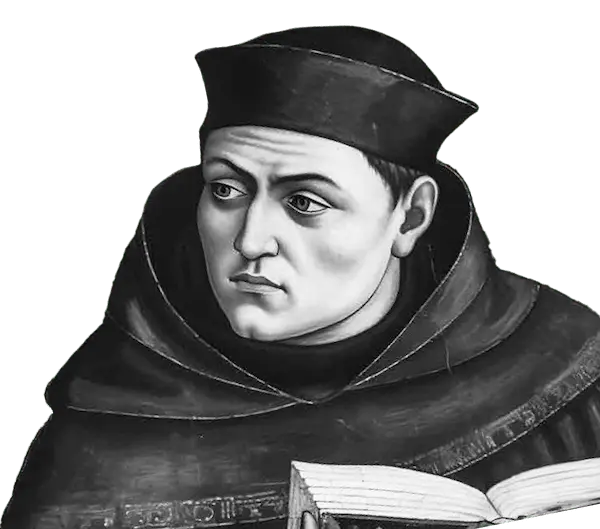
Thomas Aquinas Commentary
Matthew 14
"At that season Herod the tetrarch heard the report concerning Jesus, and said unto his servants, This is John the Baptist; he is risen from the dead; and therefore do these powers work in him. For Herod had laid hold on John, and bound him, and put him in prison for the sake of Herodias, his brother Philip`s wife. For John said unto him, It is not lawful for thee to have her. And when he would have put him to death, he feared the multitude, because they counted him as a prophet. But when Herod`s birthday came, the daughter of Herodias danced in the midst, and pleased Herod. Whereupon he promised with an oath to give her whatsoever she should ask. And she, being put forward by her mother, saith, Give me here on a platter the head of John the Baptist. And the king was grieved; but for the sake of his oaths, and of them that sat at meat with him, he commanded it to be given; and he sent and beheaded John in the prison. And his head was brought on a platter, and given to the damsel: and she brought it to her mother. And his disciples came, and took up the corpse, and buried him; and they went and told Jesus. Now when Jesus heard [it], he withdrew from thence in a boat, to a desert place apart: and when the multitudes heard [thereof,] they followed him on foot from the cities. And he came forth, and saw a great multitude, and he had compassion on them, and healed their sick." — Matthew 14:1-14 (ASV)
Above, the Lord showed the power of the Gospel teaching by way of some parables; here, He shows its power by deeds. And He does three things:
- He shows to what effects it extends itself through an allegory of deeds;
- He shows the sufficiency of the Gospel teaching; and
- He shows how it may be preserved in its purity.
The second point is found in chapter 15, and the third is in chapter 16. Regarding the first point:
- A false opinion is related;
- Its occasion is related; and
- The opinion is disproved.
The second part is where it is said, Herod had apprehended John, etc.; the third part is where it is said, Which when Jesus had heard, he retired from there.
He says, therefore, At that time Herod the Tetrarch heard the fame of Jesus. And it should not be referred to that day, but to a time in general, because Mark and Luke do not recount this in the same order, for they recount this event after the sending of the disciples, as is found in Mark 6.
Hence, it is uncertain which Evangelist is keeping the historical order. Nevertheless, what is said, At that time, is said so that Herod’s negligence may be indicated, because Herod had heard of the fame of Jesus only after the miracles. For this desire is frequently found among the rich: they do not care about small matters.
Charge the rich of this world not to be high-minded nor to trust in the uncertainty of riches, etc. (1 Timothy 6:17). He says, Herod the Tetrarch, to differentiate him from King Herod, under whom Christ was born, as is stated above in chapter 2.
Hence, when that Herod died, Christ returned from Egypt. This Herod was his son and was a tetrarch. His father was made a king by the Romans and had six sons, two of whom he killed during his lifetime. At the time of his own death, he killed another firstborn son, although he had already appointed him to be made king while his father was still living. After the same Herod died, Archelaus took the kingdom to himself and, following his father’s malice, could not be tolerated by the Jews. They then approached the Romans, and the kingdom was divided into four parts: two parts were delivered to Archelaus, another was delivered to Herod, and another part was delivered to Philip. Hence, this Herod was a tetrarch and the ruler over a fourth part of the kingdom.
Heard the fame of Jesus. On account of this, he was reprehensible, because Christ had already been living for so long a time and had performed miracles, and, nevertheless, he then heard for the first time. Thus is fulfilled what is written: Destruction and death have said: With our ears we have heard his fame (Job 28:22).
And he said to his servants: This is John the Baptist, etc. Some have said that he held the error of the transmigration of souls, for Plato and Pythagoras affirmed that when the soul leaves one body, it enters into another body. Herod, holding this opinion, as they say, believed that John’s soul passed into Christ’s body. But this cannot be, because he had killed him shortly before; now Jesus was thirty years old. Therefore, he did not believe this.
Moreover, Christ had already performed miracles before John’s beheading and imprisonment, as is stated in John 3. Nevertheless, Herod should be praised because he believed in the resurrection, about which it is written: Shall man that is dead, thinkest thou, live again? (Job 14:14).
Likewise, he had another good quality, namely, that he believed that the resurrection may bring about a better state of existence. For that reason, he believed that John might then work miracles which he had not performed before his resurrection. Therefore, he says, And therefore mighty works shew forth themselves in him, because he had reached a higher state of existence. Hence, men will rise again in a better state of existence. Therefore, the Apostle says: It is sown in weakness: it shall rise in power (1 Corinthians 15:43).
But here there is a question, because Luke 9:7 says that Herod heard and doubted. Therefore, he said, John I have beheaded. Here, he speaks without hesitation when he says, This is John.
Augustine solves this question, saying that he was not saying what he believed, but what he heard from others. Therefore, when he first heard, he doubted, but when His fame spread, he consented. So, Luke relates his first view, but Matthew relates his second view. Or, it can be said differently, that Matthew is also mentioning Herod’s doubting, so that it may be read interrogatively: Is this John?
For Herod had apprehended John. This was done previously; therefore, he is not following the order of events but is giving the reason for John’s death from a past incident.
But there is a question: Why are the Evangelists giving the reason for John’s death? And it is Chrysostom who asks this. He answers this, however, saying they are principally concerned with Christ’s deeds, but also other deeds insofar as they relate to Christ.
Therefore, he here gives the reason for John’s death from what follows. First, he gives the reason for his imprisonment; second, he gives the reason for his death, where it is said, But on Herod’s birthday, etc. Regarding the first (the imprisonment), he does three things:
- He relates the imprisonment;
- He relates its cause;
- He relates the beheading.
For Herod had apprehended John and bound him, and put him into prison. He mentions the order of events, namely, that Herod first apprehended him, bound him, and then imprisoned him; now the order of events concerning Christ was the same. He mentions the cause of the events when he says, because of Herodias, his brother’s wife. Herod and Philip were brothers. Philip married Herodias, the daughter of Aretas, king of the Arabs.
He had enmity with that king of the Arabs, and also with his brother Herod, so that the king of the Arabs, in hatred of Philip, took his daughter and gave her to Herod.
Concerning this John, you should realize that he was a man of great virtue; therefore, it is said of him: He shall come in the spirit of Elias (Luke 1:17). Likewise, you should observe that he is also called a martyr, because he died on account of defending the faith, since he died for the truth; and Christ is truth.
For John said to him: It is not lawful for thee to have her. It should be known that Antipater, the grandfather of King Herod, was a foreigner, but he was a proselyte; therefore, his children were Jews. But it was commanded in the Law that while a brother was still alive, another brother could not marry the brother’s wife. For this reason, John, as if Herod were a zealous follower of the Law, was saying, It is not lawful for thee to have her.
And having a mind to put him to death, he feared the people. It sometimes happens that when someone is unwilling to avoid a sin, he falls into a greater one. Killing, and theft, and adultery, have overflowed, and blood hath touched blood (Hosea 4:2). Therefore, because he did not wish to avoid adultery, he committed murder. And though he wanted to commit murder, he feared the people.
A disturbance of the people is to be greatly feared; Of three things my heart hath been afraid: the accusation of a city, and the gathering together of the people, and a false calumny . Likewise, fear of the Lord takes away an evil will, but fear of man does not, although it may make one delay. Therefore, because he could not kill him on account of his fear of the people, he delayed.
But on Herod’s birthday, etc. Here he does three things concerning the killing of John, because he was unable to kill him on account of his fear of the people:
- The events preceding the killing are related;
- The killing itself is related; and
- The events subsequent to the killing are related.
About the first, three preceding events are related, namely, the dancing, the promise, and the request.
He says, therefore, But on Herod’s birthday, etc. It was a custom among the ancients that they would celebrate the day of one’s birth, contrary to what is written: The day of death than the day of one’s birth (Ecclesiastes 7:2). It is not recorded that anyone celebrated the day of his birth except this man and Pharaoh, the king of Egypt. Therefore, on Herod’s birthday, the daughter of Herodias (so she was called) danced before them, that is, in the dining room (and in this he is rendered blameworthy, because in his lasciviousness he forgot his royal court, in which the occurrence of these things was inappropriate), and pleased Herod, contrary to what is written: Use not much the company of her that is a dancer .
And he continues, Whereupon he promised with an oath, etc. Behold the thoughtless promise and the rash oath. Let not thy mouth be accustomed to swearing: for in it there are many falls . And she being instructed before by her mother, said: Give me here in a dish the head of John the Baptist. Here the woman’s request is related.
Women are sometimes pious and have a changeable disposition; therefore, when they are pious, they are very pious, but when they are cruel, they are very cruel: There is no head worse than the head of a serpent; and there is no anger above the anger of a woman . And it is said in the same place: All malice is short to the malice of a woman . For a man would hardly ever think what an evil-minded woman thinks. Her mother, therefore, sought to satisfy her anger. Likewise, she feared that Herod might at some time be converted on account of John’s words and put her away.
And the king was struck sad because of his oath. Here it is specified how he was killed. Chrysostom says, "An example is here given that honor is respected even by the wicked," as it is stated in Wisdom 5:1 and following.
Jerome says that he is now sad who, before, wanted to kill him, but he feared the people. Why, therefore, does he say that he was sad? He solves the question thus: It is the custom of men to relate what is seen by men. For instance, they were saying that Christ was the son of Joseph, because they supposed this to be true, as is stated in Luke 3. Therefore, he says, He was struck sad, because he seemed to be so to men.
The execution follows. And first, the command is set forth; and second, the execution is set forth. Because of his oath, and for them that sat with him at table. In this he was foolish, because an oath concerning something dishonorable should not be respected, because by the very fact that I swear to something dishonorable, I have broken the oath: Thou shalt swear in truth, and in judgment (meaning with discretion), and in justice (Jeremiah 4:2). Similarly, if he had sworn that he himself would do something, it should have been understood to be in relation to honorable things: Love not a false oath (Zechariah 8:17).
He says, And for them that sat with him at table, to make them all accomplices of the homicide, for they all were asking him to heed the girl’s request, he commanded it to be given, and he sent, and beheaded John. Here his execution is related. In this is fulfilled what John had said: He must increase: but I must decrease (John 3:30), because Christ was stretched upon the Cross, and he was beheaded. Likewise, the beheading of John was a sign that, by the authority of the Law, they would lose Christ and the Law.
Afterwards, the events subsequent to the killing are related. And first, the fulfillment of the thing promised is related; and second, the burial is related. He says, therefore, And his head was brought in a dish. And in this, Herod was reprehensible because he used cruelty amidst pleasures. Therefore, it is said that a certain official loved a certain mistress, and when she was sitting on his lap, she said that she had never seen a man killed. And when he was at dinner, he had some man brought forth who deserved death and had him killed in front of her. The Romans knew what he did, and so he was exiled from Rome. So also this Herod was sent into exile. And his disciples came and took the body, and buried it.
Here, John’s burial is discussed, and burial of the dead is numbered among the works of mercy. And, nevertheless, it seems that mercy does not pertain to the dead, because if it did pertain to them, it seems that what the Lord says would not be true: Fear him that can destroy both soul and body in hell (Matthew 10:28).
Why, therefore, is it numbered among the works of mercy? It should be answered that even if it is not of use to him according to the effect, which it now has, it is, nevertheless, of use to him according to the affection that a person now has towards the dead. Therefore, they took the body, and buried it; it is said that they buried it in Sebastia, since it was nearby.
Afterwards, Julian the Apostate, seeing many men coming to John’s relics, had him burned, except for his head. And they came and told Jesus. Therefore, John’s disciples, who at first were slandering Jesus, returned to Him when John died and were His companions. In this way, some men are converted to Christ in time of tribulation: In their affliction they will rise early to me (Hosea 6:1).
Which when Jesus had heard, he retired from there by a boat, into a desert place apart. Above, Herod’s opinion about Christ was related, and, occasioned by this, the story of John was introduced. Now, however, Herod’s opinion is shown to be false. He had said two things: namely, that Christ was John whom he had killed, and likewise, that John, now risen, was working miracles. He says, therefore: Which when Jesus had heard, he retired from there by a boat, etc.
Why did He retire? Jerome gives four reasons:
- So that He might spare His enemies, lest they fall headlong from one murder to another murder: Blood hath touched blood (Hosea 4:2).
- So that He might defer His Passion; therefore, He Himself says: My time is not yet come (John 7:6).
- So that He might give an example to us, lest we bring torments upon ourselves, for it is not a virtue but presumption to bring torments upon ourselves. Therefore, it is said above: If they shall persecute you in one city, flee into another (Matthew 10:23).
- So that He might show with what great devotion the multitude was hearing the word of God: The Lord your God tries you, that it may appear whether you love him (Deuteronomy 13:3).
Likewise, it should be observed that the Evangelist relates four things which should have deterred the multitude from following Christ:
- He retired into a boat;
- He retired into the desert;
- There were no woods there because it was a desert; and
- He did not retire along a road on which men readily travel, but, on the contrary, He retired apart.
Now He did this so that the multitude’s devotion would be commended more. Likewise, Chrysostom says that He retired so that He might commend a man; for that reason, He was unwilling to retire until John’s death had been announced.
He continues, And the multitudes having heard, etc. Here, His miracles are discussed. And first, the multitude’s devotion is mentioned; and second, the miracles are mentioned. He says, therefore: And the multitudes having heard of it, followed him on foot out of the cities. It is this passage in which the devotion of the multitudes and of the poor is discussed, who follow the Lord because of their devotion: In their affliction they will rise early to me (Hosea 6:1).
And he coming forth saw a great multitude, etc. Here he mentions the miracles which the Lord worked coming from the desert, and it was appropriate, because when He was in heaven, the multitudes were not seeking Him: I came forth from the Father and am come into the world (John 16:28).
Therefore, He is moved to compassion; therefore it follows, And He had compassion on them. Therefore, He immediately showed compassion on them: Thou, O Lord, art a God of compassion, and merciful, patient, and of much mercy, and true (Psalms 85:15).
The effect of this compassion follows, And He healed their sick, that is, gratuitously and not having been asked: He sent his word, and healed them (Psalms 106:20).
"And when even was come, the disciples came to him, saying, The place is desert, and the time is already past; send the multitudes away, that they may go into the villages, and buy themselves food. But Jesus said unto them, They have no need to go away; give ye them to eat. And they say unto him, We have here but five loaves, and two fishes. And he said, Bring them hither to me. And he commanded the multitudes to sit down on the grass; and he took the five loaves, and the two fishes, and looking up to heaven, he blessed, and brake and gave the loaves to the disciples, and the disciples to the multitudes. And they all ate, and were filled: and they took up that which remained over of the broken pieces, twelve baskets full. And they that did eat were about five thousand men, besides women and children. And straightway he constrained the disciples to enter into the boat, and to go before him unto the other side, till he should send the multitudes away. And after he had sent the multitudes away, he went up into the mountain apart to pray: and when even was come, he was there alone. But the boat was now in the midst of the sea, distressed by the waves; for the wind was contrary. And in the fourth watch of the night he came unto them, walking upon the sea. And when the disciples saw him walking on the sea, they were troubled, saying, It is a ghost; and they cried out for fear. But straightway Jesus spake unto them, saying Be of good cheer; it is I; be not afraid. And Peter answered him and said, Lord, if it be thou, bid me come unto the upon the waters. And he said, Come. And Peter went down from the boat, and walked upon the waters to come to Jesus. But when he saw the wind, he was afraid; and beginning to sink, he cried out, saying, Lord, save me. And immediately Jesus stretched forth his hand, and took hold of him, and saith unto him, O thou of little faith, wherefore didst thou doubt? And when they were gone up into the boat, the wind ceased. And they that were in the boat worshipped him, saying, Of a truth thou art the Son of God. And when they had crossed over, they came to the land, unto Gennesaret. And when the men of that place knew him, they sent into all that region round about, and brought unto him all that were sick, and they besought him that they might only touch the border of his garment: and as many as touched were made whole." — Matthew 14:15-36 (ASV)
After having excluded Herod’s opinion, here the Evangelist mentions the power of Christ’s doctrine. For its power is threefold: it feeds, it rescues, and it heals the sick. And so its first power is shown in that He feeds the multitudes; the second is shown in that He rescues the disciples from the perils of the sea; and the third power is shown in that He heals many men. The second is where it is said, And forthwith Jesus obliged his disciples to go up into the boat; and the third is where it is said, And having passed the water, etc. About the first, he does three things:
- His decision to feed the multitudes is related;
- The distribution of food is related;
- And the abundance of the food is related.
The second thing is where it is said, But Jesus said to them, etc. The third thing is where it is said, And they did all eat, etc.
He says, therefore, And when it was evening, that is to say, at sunset, by which Christ’s death is signified, because it was at that time that He delivered His body as food. Hence, it is said: This do for the commemoration of me (1 Corinthians 11:24). And, You shall shew the death of the Lord, until he come (1 Corinthians 11:26).
Then the disciples show the need of feeding the multitudes from the nature of the place, where they say, This is a desert place. Here that same question comes up which is found in Psalm 77:19, namely, how could the Lord furnish a table in the wilderness? Similarly, if the place were near a town, one could suppose that He had food from there, but it was a desert place.
Again, the need is set forth from the hour, for they say, And the hour is now passed, in which the multitudes could get food for themselves. Send away the multitudes. From this, it seems that the disciples were so intent upon the sweetness of Christ’s words that they were finding more pleasure in hearing Christ than in procuring provisions for themselves; hence, they cared little for bodily refreshment. For it is stated in Luke 21:37: And in the daytime, he was teaching in the temple: but at night going out, he abode in the mount.
Again, there was another reason to feed them, namely, that it was nightfall. Concerning this hunger, it is stated: I will send forth a famine into the land: not a famine of bread, nor a thirst of water, but of hearing the word of the Lord (Amos 8:11). And in this, the multitude’s devotion is indicated, as well as their love and respect for Christ, because they did not depart from him, although it was nightfall.
But here there is a literal question, namely, that it is stated in John that Jesus questioned Philip; here, however, it is stated that the disciples questioned Christ.
Augustine resolves the matter. This is not incongruous, because what one Evangelist leaves out, another may say. Hence, they firstly spoke to Christ; and secondly, Jesus lifting up His eyes asked the disciples.
But Jesus said to them. Here he relates the distribution of the food, and about this he does three things:
- Christ’s command is related;
- The quantity of the food is related;
- And the manner and order of distributing the food is related.
The second part is where it is said, They answered him, etc.; the third part is where it is said, Bring them hither to me, etc. They had said two things. Firstly, they had said that He should send away the multitudes; likewise, they had said that they should seek food for themselves: and Christ responds to these two things as follows.
“You say, ‘Send away the multitudes,’ but They have no need to go; He is here who giveth food to all flesh (Psalms 135:25). Again, you say that they should look for food, but it is not necessary, because you can give them heavenly food.” Hence, He says, Give you them to eat. Thus, an example is given that spiritual food ought to be preferred to bodily food.
The quantity of the food follows where it is said, They answered him: We have not here, but five loaves, and two fishes. From this, we ought to observe that the Apostles were so devoted to the word of God that they did not even care about looking for food. Make not provision for the flesh (Romans 13:14).
Mystically, the teaching of the Law is signified by the five loaves; With the bread of life and understanding, she shall feed him . By the two fishes, the teaching of the Psalms and the Prophets is implied. Or, according to Hilary, the teaching of the Prophets and of John the Baptist are signified by the two fishes, just as there were two outstanding personages in the Law, namely, the royal and the priestly personages.
Who said: Bring them hither to me. Here, the manner of distribution is related:
- The presentation is related;
- The arrangement of the multitudes is related;
- The prayer is related;
- And the distribution is related.
Hence, he says, Who said. He, who was omnipotent, was able to create new loaves; but He willed to feed them from existing loaves.
But what is the reason? The literal reason, according to Chrysostom, is that it was to refute the heresy of the Manichaeans who said that these creatures were made by the devil, contrary to that which is written: Every creature of God is good (1 Timothy 4:4). Hence, if they were from the devil, Christ would not have performed such great miracles with them.
Likewise, it was to show that He is the Lord of the land and of the sea. For He, who in Genesis 1:11, said: Let the earth bring forth green herb, and who said: Let the waters bring forth the creeping creature having life, etc. (Genesis 1:20), is the very same Person who multiplied the loaves.
Similarly, this was to indicate that He did not reject the Old Law, but converted it into the New Law. For that reason, He says, Bring them hither to me, because the things which were written in the Old Law ought to be referred to the New Law. Hence, He said: If you did believe Moses, you would perhaps believe me also: for he wrote of me (John 5:46).
And when he had commanded the multitude to sit down upon the grass, etc. Here the arrangement of the men is related, namely, that He made them sit on the grass; All flesh is grass (Isaiah 40:6). Therefore, to sit upon the grass is nothing other than to mortify the flesh. Mortify therefore your members which are upon the earth (Colossians 3:5). Similarly, by the grass, the Law is signified. Because these men were Jews, and they were elevated by the Law, for that reason, He did not want them to sit upon the soil.
He took the five loaves and the two fishes, etc. It ought to be observed that when the Lord performs miracles, He sometimes prays, and sometimes does not pray. Sometimes He prays, as He does here, to show that He is a man; sometimes He performs even greater miracles and He does not pray, to show that He is God.
And looking up to heaven, he blessed. He looks up to heaven, more precisely, to His Father. I have lifted up my eyes to the mountains, from whence help shall come to me (Psalms 120:1). He blessed, because all things are blessed by God’s word. Note that our act of blessing is not productive, but symbolic; God’s act of blessing, however, is productive. Hence, a blessing pertains to an increase by God’s multiplication; thus, it is written: He blessed them, saying: Increase and multiply, and fill the earth (Genesis 1:22).
Afterwards, the distribution is discussed: He brake, and gave the loaves to his disciples. In these words it is indicated that the first distribution was made to the disciples by the head of the disciples, Christ; The head of every man is Christ (1 Corinthians 11:3). But He broke the bread that He might make known His own distribution of bread. Deal thy bread to the hungry (Isaiah 58:7). He gave the loaves to his disciples, as it were, to mediators. Take ye and eat (Matthew 26:26); And let a man prove himself, so that he may eat of that bread and drink of the chalice, etc. (1 Corinthians 11:28). And the disciples gave to the multitudes, as His distributors.
But how were the loaves multiplied? It ought to be said that the fragments were multiplied. Some men say that this can occur naturally: just as matter could have any form whatever, so it could have any quantity. But this is foolish to say that matter could have any material quantity, for this cannot happen except through rarefaction, and this rarefaction is determined in natural things.
Certain others say that it multiplies just as from a few grains much grain is produced; but in that example it happens through nature, here, however, it happens through Christ’s action. Hence, Christ’s hands were like the earth, and the fragments were like seeds: thus, just as seeds are multiplied, so were the fragments. But there was not only this matter of bread; rather, the bread was multiplied by the conversion of different matter into itself, and so a miracle was performed.
He continues concerning the abundance of the food, and this was in respect to two things: its sufficiency, and its remains. Hence, it is said, They did all eat, and were filled, and this agrees with that which is written: The poor shall eat and shall be filled, etc. (Psalms 21:27). And they took up what remained, twelve full baskets of fragments. Here the abundance of the food is mentioned by way of the large amount of what remained.
But why did the Lord want the remains to be gathered? Chrysostom proposes a literal reason. He wished firstly that the disciples gather the remains, lest it seem to be an illusion, and likewise, lest the miracle be forgotten by them. And that they took up twelve baskets, this was according to the number of the twelve Apostles, so that each and every Apostle might take up his own, and thus, the number of the baskets would be impressed upon the memory of them all.
Mystically, by the remains, the spiritual meanings are understood, which were not gathered by the multitude. But the remains were gathered in baskets, that is to say, in the wise; For see your vocation, brethren, that there are not many wise according to the flesh, not many mighty, not many noble; but the foolish things of the world hath God chosen, that he may confound the wise: and the weak things of the world hath God chosen, that he may confound the strong, etc. (1 Corinthians 1:26–27).
Then the number of those eating is related: And the number of them that did eat, was five thousand men; and so a thousand men ate from one loaf, according to Hilary. This also happened after the Ascension, when five thousand were converted in one day as a consequence of the Apostles’ preaching. Besides women and children, who were unrecognized, and so did not merit to be counted. Something similar is found in the book of Maccabees that the children and women are not counted for war.
Likewise, observe that this miracle was performed immediately after the killing of John, and it was near the feast of Passover, and Christ had already preached for a year, and Christ would suffer a year later.
And forthwith Jesus obliged his disciples. Here the power of Christ’s teaching is portrayed, in that it delivers from dangers, for He delivered the disciples from dangers. Hence, Matthew does three things:
- The occasion of undergoing danger is related;
- The danger itself is related;
- And the deliverance from the danger is related.
The second part is where it is said, And having dismissed the multitude, he went into a mountain, etc.; the third is where it is said, And in the fourth watch of the night, he came to them walking upon the sea.
The occasion of the danger was Christ’s command, for those willing to comply with God’s will are frequently exposed to dangers, as the Apostle says: In perils of waters, in perils of robbers, in perils from my own nation, in perils from the Gentiles, in perils in the cities, in perils in the wilderness, in perils in the sea, in perils from false brethren (2 Corinthians 11:26). And forthwith Jesus obliged his disciples to go up into the boat.
Hence, immediately after having performed the miracle, He chose to go apart from the multitudes. And He did this for three reasons:
- It was so that He might show the truth of the miracle, lest they say that it had happened on account of His presence (for He is the truth, as it is stated in John 14:6).
- It was so that He might teach us to avoid vainglory; for that reason, after having performed the miracle, He withdrew: I seek not my own glory, etc. (John 8:50).
- Likewise, it was so that He might show the virtue of discretion, for it belongs to discretion to withdraw oneself, and to rest: When I go into my house, I shall repose myself with her .
But it ought to be observed that He uses compulsion, because it was hard for them to part from Christ, just as Peter says: Lord, to whom shall we go? Thou hast the words of eternal life (John 6:69). Similarly, He makes known the affection of the multitude, namely, with what ardor they were following Him: Thy name is as oil poured out: therefore young maidens have loved thee .
And having dismissed the multitude, He went into a mountain alone to pray. He continues concerning the danger, and the danger is shown from the time, from the place, and from the wind. And firstly, Christ’s absence is related, because when He had dismissed the disciples, He went into a mountain alone to pray.
He had come to plant our faith; for that reason, He sometimes did something human, and other times He did something divine. For instance, that He multiplied the loaves is proper to God; that He prayed is proper to men, and this was not because He needed to pray, but to give an example, for every action of Christ is for our instruction. For I have given you an example, that as I have done to you, so you do also (John 13:15).
And He gives us an example how to pray, and He shows that peace of soul, raising of the mind, and solitude are required for prayer. Peace of soul is indicated because it is said, and having dismissed the multitude, which denotes disturbing thoughts with which a man cannot pray; and for that reason, He teaches us to close the door of our heart: But thou when thou shalt pray, enter into thy chamber, etc. (Matthew 6:6). Likewise, raising of the mind is indicated: He shall sit solitary, and will raise himself above himself (Lamentations 3:28). Similarly, solitude is indicated: I will lead her into the wilderness and I will speak to her heart (Hosea 2:14).
By the mountain, heaven is understood, for nothing is higher than heaven. And having dismissed the multitude means having left mortal things, He went to heaven, and He ascended alone and by His own power. He shall go up that shall open the way before them (Micah 7:23). Likewise, He ascended into heaven to pray: He is able also to save for ever them that come to God by him; always living to make intercession for us (Hebrews 7:25).
But here there seems to be a problem, because John seems to say that He feared the multitudes on the mountain, as it is stated in John 6; here, however, it is said that He went up into the mountain after feeding the multitudes. But it is answered that He fed them on the mountain, but afterwards He went up into a higher place on the mountain.
Likewise, there is another question, because in John 5 it is stated that He fled because they wanted to make Him king; here, however, it is said that He went up the mountain to pray. Augustine says that the same thing can be the reason for praying and for fleeing.
Afterwards, the danger from the time is described, for it was night, and there is greater danger from the sea at night; for that reason, he says: And when it was evening. And His Passion is signified, because in the Passion He ascended alone: While they looked on, he was raised up: and a cloud received him out of their sight (Acts 1:9).
But the boat in the midst of the sea was tossed with the waves. By the boat, the Church is signified; and by the sea, the world is signified: So is this great sea, which stretcheth wide its arms (Psalms 103:25). And this Church, when Christ went into it, remained in the sea, and in the world’s dangers. For when some great man attacks the Church, then it is agitated by the waves. All thy waves thou hast brought in upon me (Psalms 87:8).
But because Christ prays, it cannot be submerged, even though it toss and be lifted up. The waters lifted up the ark on high from the earth (Genesis 7:17). Likewise, it is agitated by the wind, and this wind is an assault instigated by the devil. Because a wind came on a sudden from the side of the desert, and shook the four corners of the house (Job 1:19); The blast of the mighty is like a whirlwind beating against a wall (Isaiah 25:4).
And in the fourth watch of the night, he came to them walking upon the sea. Having related the danger, the liberation from the danger is related, and about this he does two things:
- The assistance is related;
- And the effect is related.
The second point is where it is said, And they that were in the boat came and adored him. He had related three dangers: firstly, the darkness of the night; secondly, the danger of the sea; and thirdly, the danger of the wind.
In opposition to the first danger, he relates His visitation; in opposition to the second, he relates His certitude, where it is said, And immediately Jesus spoke, etc.; and in opposition to the third, He reaches out His hand: And immediately Jesus stretching forth his hand took hold of him.
Likewise, in opposition to the third, he relates the calmness of the sea: And when He was come up into the boat, the wind ceased. About the first, His visitation is related; secondly, the effect of His visitation is related, where it is said, And they seeing him walking upon the sea, were troubled.
He says, therefore: In the fourth watch of the night, he came to them. Here, both His arrival and the time are mentioned, because it is said, In the fourth watch.
Jerome says that the ancients divided the night into four parts. Some men watched during the first part, others during the second part, others during the third, and others during the fourth; and those who had watched rested.
Hence, he says that in the fourth watch, etc., because when they had been on the sea the whole night, He came to them walking upon the sea. And why was this? Chrysostom gives a literal reason, saying that He delayed so long so that He might be desired more.
My soul hath desired thee in the night (Isaiah 26:9). Likewise, it was so that they might learn that if they do not immediately get assistance, they should not give up, because one ought to pray always. Mystically, by the four watches the four states are signified:
- There was the state of the Law;
- There was the state of the prophets;
- There was the time of grace;
- And there was the time of His ascent into heaven, in which state the tempest ceased.
Hence, He came at the fourth watch, that is to say, at the end of the night; thus, it is written: Be you therefore also patient and strengthen your hearts: for the coming of the Lord is at hand (James 5:8).
But how does He come? Walking upon the sea. And why did He wish to come in this way? It was to show that He is the Lord of the sea: Thou rulest the power of the sea: and appeasest the motion of the waves thereof (Psalms 88:10). Likewise, it was so that He might expose the abusers of the powers of the world, for the devil always abuses the powers of this world: This sea dragon which thou hast formed to play therein (Psalms 103:26). But the Lord subdued these powers: Thou hast broken the heads of the dragon (Psalms 73:14); and this means that the Church can only withstand tribulations according to what He wills.
Here there was an opinion that the Lord, during His life on earth, received four gifts: the gift of subtlety in His birth; the gift of impassibility, when He fasted forty days, or by transubstantiating the sacrament of the Eucharist; the gift of agility here; and the gift of brilliance in His transfiguration. But I do not believe this, for I believe that He performed these things miraculously.
And they seeing him. Here the effect of Christ’s presence is related, namely, the troubling of the disciples; hence, their troubling is related, the cause of their troubling is related, and the sign of their being troubled is related. And he says, And they seeing him were troubled, etc.
You should know that when divine assistance is closer at hand, the Lord permits men to be more afflicted, so that then His assistance may be received with more devotion and thanksgiving. Likewise, then fear grows more because men are frequently converted through fear.
And why were they troubled? It was because they believed that He was an apparition; hence, Saying: It is an apparition, not believing what they saw to be His true body born of the Virgin.
For, mystically, it is signified that before Christ comes, many men will affirm many imaginary things, as it is stated below. And they cried out for fear: for a cry is a sign of fear, so also in every tribulation we ought to cry out: In my trouble I cried to the Lord: and he heard me (Psalms 119:1).
And immediately Jesus spoke to them, etc. Here His assistance is related. Because they were in darkness, for that reason, He gives them assurance, and He does three things:
- He assures by His words;
- Peter asks for a sign in his actions;
- And he is permitted.
He had related three things: their troubling from fear, the falsity of their opinion, and, likewise, their desperation. In contrast to these, He does three things, because immediately Jesus spoke to them. And when someone cries to the Lord, if it is necessary, He comes immediately: At the voice of thy cry, as soon as he shall hear, he will answer thee (Isaiah 30:19).
Likewise, because they were despairing, He says to them, Fear ye not. Similarly, it is stated in John’s Gospel: In the world you shall have distress. But have confidence. I have overcome the world (John 16:33) – that is to say, in Me you will have rest.
Again, it was because they thought that He was an apparition that He says, It is I. And why does He speak in this manner? It is because they were assured by His manner of speaking: My sheep hear My voice (John 10:3). Moreover, it was so that He might show that He is God. Something similar is stated in Exodus 3:13: He who is, hath sent me to you, said Moses.
Again, in opposition to the fact that they were troubled, He said, Fear ye not. Who art thou, that thou shouldst be afraid of a mortal man, and of the son of man, who shall wither away like grass? (Isaiah 51:12). And, The just, bold as a lion, shall be without dread (Proverbs 28:1).
Peter making answer, said: Lord, if it be thou, bid me come to thee upon the waters. Because He had given assistance by His words, for that reason, Peter asks for a sign in his actions. Now Peter asked confidently in the person of all the disciples, and he said, If it be thou, bid me come to thee.
Here is Peter’s great confidence. He did not say, ‘Pray for me,’ but he said, bid me come to thee, because he confessed: Thou art Christ, the Son of the living God (Matthew 16:16). Hence, by reason of the faith, which he had already conceived, he boldly trusts in His power. O Lord, all things are in thy power, and there is none that can resist thy will (Esther 13:9).
And he said this solely out of his desire to come to Him, and not to tempt Him, nor out of disbelief. Being mindful of the work of your faith and labor and charity, etc. (1 Thessalonians 1:3).
Then the sign is related; and so He said, Come. And Peter going down out of the boat walked upon the water to come to Jesus. And this is opposed to the Manichaeans who said that Christ did not have a true body: because if Christ did not have a true body, because He walked upon the water, then neither did Peter. By the fact that danger was still threatening after the fourth watch, it is signified by His coming at the fourth watch that what needs to be purged in the elect will be purged [at His second coming]. A fire shall go before him, and shall burn his enemies round about (Psalms 96:3).
But seeing the wind strong, etc. Now here the third assistance is related, namely, that He saved Peter from submersion. And about this, he relates three things:
- The cause is related;
- Peter’s petition is related;
- And Christ’s assistance is related.
But seeing the wind strong, he was afraid. On the sea, the wind does not have a constant force, just as it does not have a constant force on land; hence, it was interrupted when Peter first went upon the sea. But when he was on the sea it blew strongly, and then he was afraid. And from this, what he says should be considered: that it was more dangerous upon the sea than in the boat, and so the Lord permits strong men to be sunk in the sea’s danger. Hence: He that thinketh himself to stand, let him take heed lest he fall (1 Corinthians 10:12).
But why did the Lord permit him to be in danger? Firstly, He commanded him to go upon the sea, so that His power might be shown, because both were walking upon the sea, and the disciples saw this. But that He permitted Peter to sink was done so that Peter might experience what he could do of himself. Hence, that Peter walked upon the sea was by Christ’s power; that he began to sink, on the other hand, was owing to Peter’s weakness, just as Paul says: Lest the greatness of the revelations should exalt me, there was given me a sting of my flesh, an angel of Satan, to buffet me (2 Corinthians 12:7).
The Lord also permitted Peter to sink because he was to be the pastor. Therefore, He wished to show him his power and weakness. Likewise, He did this to suppress the jealousy of the disciples, for because they saw his danger, their jealousy ceased.
And when he began to sink, he cried out, saying: Lord, save me. Something similar is stated in Psalm 68:2: Save me, O Lord: for the waters are come in even unto my soul. And immediately Jesus stretching forth his hand took hold of him.
Christ does two things: namely, He both gives assistance and rebukes Peter’s disbelief. He gives assistance, because He reaches out His hand: Put forth thy hand from on high, take me out, and deliver me from many waters (Psalms 143:7). And it is said: To the work of thy hands thou shalt reach out thy right hand (Job 14:15).
Next, He rebukes him concerning his disbelief, and He says to Him: O thou of little faith, why didst thou doubt? In these words, it is indicated that if he had possessed a firm faith he could not have sunk; for that reason, we ought to be constant in our faith. Similarly, it is stated above: Why are you fearful, O ye of little faith? (Matthew 8:26).
And when they were come up into the boat, the wind ceased. Here His fourth assistance is related, namely, against the wind. He said the word, and there arose a storm of wind (Psalms 106:25).
Hence, it is a sign that when Christ is with His own disciples, they have no troubles; hence: They shall no more hunger nor thirst (Revelation 7:16).
The effect of their deliverance follows, And they that were in the boat came and adored him, namely, the disciples, or the sailors. What manner of man is this, for the winds and the sea obey him? (Matthew 8:27). Indeed thou art the Son of God. Now, by this is signified that when the Lord is with the faithful, then they truly believe: And now, little children, abide in him, that when he shall appear we may have confidence and not be confounded by him at his coming (1 John 2:28).
And having passed the water, they came into the country of Genesar. Here Christ’s power is set forth. And firstly, the place is described; then the devotion of the men is described; and afterwards, His operative power is described.
He says, therefore, And having passed the water, they came into the country of Genesar, which place is on the other side of the sea, and is interpreted to mean “rise”; hence, after the danger they came to rest. Then he continues concerning the multitude’s devotion: And when the men of that place had knowledge of him, they sent into all that country, and brought to him all that were diseased, etc., because they not only brought to Him their sick, but they sent for the sick who lived in other places.
Hence, when they had knowledge of him through His fame and His teaching, they sent for the sick, and they brought them to Him. Hence, they all believed in Him, because His word had such great power, and this is signified in Isaiah: I will send of them that shall be saved, to the Gentiles into the sea, etc. (Isaiah 66:19).
Likewise, their devotion is shown, because they were not only asking that He would lay His hands upon the sick, but they merely besought him that they might touch but the hem of his garment.
By the hem, the smallest precepts are signified, or Christ’s flesh is signified, or the sacrament of Baptism is signified. And as many as touched, were made whole. Hence: He that believeth and is baptized shall be saved (Mark 16:16).
Jump to: