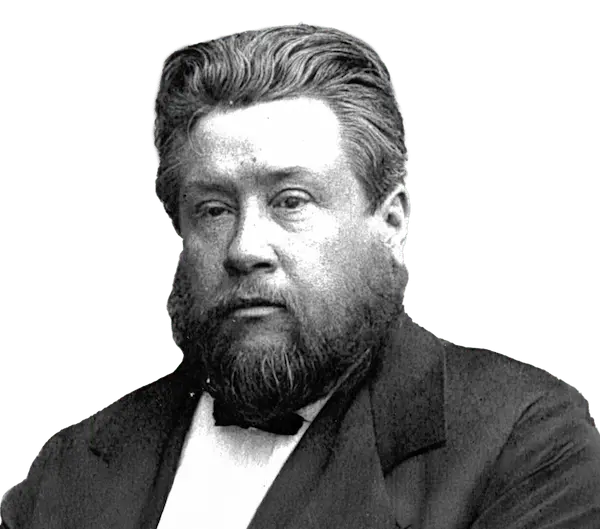
Charles Spurgeon • Jan 26, 1896
THIS verse is all about serving, and service, three times over you get the word “serve” or “servant.” Each clause of our text has in it a part of the verb “to serve.” You cannot have Christ if you will not serve Him. If you take Christ, you must take Him in al…
Charles Spurgeon • Feb 16, 1873
THE Thessalonians had been much disturbed by the predictions of divers persons that the day of Christ was at hand. There always have been pretenders to prophetic knowledge, who have fixed dates for the end of the world, and by their fanaticism have driven many…
Charles Spurgeon • Dec 7, 1873
I DESIRE at this time to speak to those who are much depressed in spirit, the sons of despondency and daughters of mourning, who dwell upon the dreary confines of despair. It may seem objectionable among so large an audience to address my discourse to a class…
Charles Spurgeon • Aug 15, 1907
THIS expression, “Verily, verily,” seems to me to have been the peculiar idiom of our Lord Jesus Christ. He has absolutely forbidden His people ever to take an oath. [Mr. Spurgeon has written at length upon this subject in pages 29, 207, and 208 of The Gospel…
Charles Spurgeon • Feb 19, 1882
DELIVERED ON LORD’S-DAY MORNING, FEBRUARY 19, 1882, BY C. H. SPURGEON, AT THE METROPOLITAN TABERNACLE, NEWINGTON.
Charles Spurgeon
NO. 377 WEDNESDAY EVENING, APRIL 3, 1861 AT THE METROPOLITAN TABERNACLE, NEWINGTON FOR THE PURPOSE OF HEARING ADDRESSES ON CHRISTIAN UNITY.
Charles Spurgeon • Dec 5, 1880
LAST Lord’s-Day morning we considered the lamentations of Jesus. [#1570 – The Lamentations of Jesus .] We will now turn our thoughts to the joys of Jesus. It is remarkable that this is the only instance on record in the gospels in which our Lord is said to hav…
Charles Spurgeon
THERE is an old proverb which says, “When a man is 40 he is either a fool or a physician,” that is to say, he either does not know anything or else be begins to know what is good for him! Some of us who are beyond that age think that we know, in some measure,…
Charles Spurgeon • Mar 25, 1894
YOU remember that these were the words of a man of God, a man after God’s own heart, a man undoubtedly the possessor of the grace of God. They were the words also of a preacher, one who could say, “I have preached righteousness in the great congregation....I h…
Charles Spurgeon • Mar 7, 1869
“HAVE you marked the old way?” Antiquity is no guarantee for truth. It was the old way, but it was the wrong way. If our religion is to be settled by antiquity, we shall presently pass back to the worst form of idolatry, for we would have to become Druids. It…
Charles Spurgeon • Aug 1, 1869
IF MAN were a mere animal, his joy and sorrow would depend entirely upon outward things. Let but the trough be full and the swine are happy. Let the pasture be abundant and the sheep are content. In the sunshine every sparrow will be twittering on the trees. L…
Charles Spurgeon • Feb 6, 1881
OUR first thought is that no mere man would have said this concerning himself unless he had been altogether eaten up with vanity, for Solomon was, among the Jews, the very ideal of greatness andwisdom. It would be an instance of the utmost self-conceit if any…
Charles Spurgeon • Jan 14, 1904
THIS is a text for summertime rather than for a winter’s evening. It is only on one of our hottest summer days that we could fully appreciate the illustration here employed, we need to be parched with thirst to be able to feel the value of cold waters to quenc…
Charles Spurgeon
THE acts of Elijah were very singular. It had not been known from the foundations of the earth that a man could shut up the doors of the rain for the space of three years. Yet Elijah suddenly leaped upon the scene, announced the judgment of the Lord, and then…
Charles Spurgeon • Jan 1, 1888
BEING one evening in Exeter Hall, I heard our late beloved brother, Mr. Mackay, of Hull, make a speech, in which he told us of a person who was under very deep concern of soul, and felt that he could never rest till he found salvation. So, taking the Bible int…
Charles Spurgeon • Mar 12, 1865
SOME of the most learned works in the world smell of midnight oil, but the most spiritual and most comforting books and sayings of men usually have a savor about them of prison-damp. I might quote many instances. John Bunyan’s Pilgrim may suffice instead of a…
Charles Spurgeon • Sep 5, 1907
[Another sermon by Mr. Spurgeon on the same text is #1937, A Mingled Strain] YOU know how David had sinned. To the sin of adultery he had added that of murder. David felt like one who was shut out from God and was unworthy to approach Him. He could not be cont…
Charles Spurgeon • Jun 15, 1879
JUST a few observations upon the narrative itself. It was a feast day and Jesus Christ came up to Jerusalem to find opportunities for doing good among the crowds of His countrymen. I see all the city glad. I hear the voice of rejoicing in every house as they h…
Charles Spurgeon
YOU who are conversant with Scripture will recollect that these are the words of the apostle Peter.
Charles Spurgeon • Aug 25, 1887
IN reading this chapter, dear friends—this very terrible chapter—you must have been struck, I think, with the forces of God. How great are the armies of the Lord of hosts! As the mighty Jehovah smote Pharaoh with overwhelming plagues, so does the Lord in this…
Charles Spurgeon • Nov 28, 1907
[Other sermons by Mr. Spurgeon upon Christ’s cries from the cross (in addition to those mentioned later) are as follows:
Charles Spurgeon • Aug 27, 1865
THE last month has been a peculiarly gloomy season. Evil tidings have followed on one another’s heels like Job’s messengers. Epidemics have been rampant among our families, and many are the early graves which have been filled by contagious diseases. It is grea…
Charles Spurgeon • Dec 24, 1914
THIS is said of Christ Jesus several times in the New Testament. The original word is a very remarkable one. It is not found in classic Greek. It is not found in the Septuagint. The fact is, it was a word coined by the evangelists themselves. They did not find…
Charles Spurgeon • Jun 17, 1883
THERE is a semicolon in our translation, but we need not take notice of it. It should not be there, since the text is the second of two parallel sentences arranged according to the method of Hebrewpoetry—