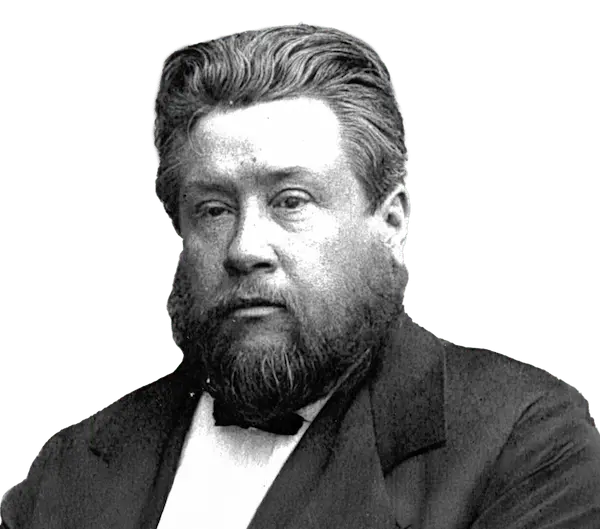
Charles Spurgeon • May 17, 1868
IN traveling in the East, inscriptions upon the rocks are often met with, which have remained almost as sharp and clear as when they were first cut by the graver’s tool. Some of these owe their indelible character to the hardness of the rocks upon which they h…
Charles Spurgeon • Jul 18, 1875
THIS is one of the supreme sayings of Scripture. It rises like an alpine summit, clear above all ordinary heights of speech. It pierces the clouds, and glistens in the light of God. If I were required to quote a selection of the sublimest utterances of the hum…
Charles Spurgeon • Jul 6, 1905
THIS is one of the charges brought by Eliphaz the Temanite against Job, “Yea, thou castest off fear, and restrainest prayer before God.” I shall not use this sentence as an accusation against those who never pray, though there may be some in this house of pray…
Charles Spurgeon • Aug 20, 1908
[Another Sermon by Mr. Spurgeon on the same text is #2839, Prisoners of Hope] THIS morning, [See sermon #1186, The Blood of the Covenant], I tried to show that in consequence of the blood of the covenant having been shed, and the covenant having so been fulfil…
Charles Spurgeon • May 25, 1905
THE paschal lamb was not killed in order to be looked at only, but to be eaten. And our Lord Jesus Christ has not been slain merely that we may hear about Him, and talk about Him, and think about Him, but that we may feed upon Him. Everything that has to do wi…
Charles Spurgeon • Apr 18, 1880
THE idea of salvation by the merit of our own works is exceedingly insinuating. It matters not how often it is refuted, it asserts itself again and again, and when it gains the least foothold it soon makes great advances. Hence Paul, who was determined to show…
Charles Spurgeon • Jun 4, 1893
THESE were the dying words of our Lord Jesus Christ, “Father, into thy hands I commend my spirit.” It may be instructive if I remind you that the words of Christ upon the cross were seven. Calling each of His cries, or utterances, by the title of a word, we sp…
Charles Spurgeon
DAVID experienced what Paul afterwards so aptly described as “cruel mockings.” Note theadjective cruel, it is well chosen. Mockings may not cut the flesh, but they tear the heart; they may shed no blood, but they cause the mind to bleed internally. Fetters gal…
Charles Spurgeon • Jul 18, 1886
THE heart of the Gospel is redemption, and the essence of redemption is the substitutionary sacrifice of Christ. They who preach this truth preach the Gospel in whatever else they may be mistaken, but they who preach not the atonement, whatever else they decla…
Charles Spurgeon • Apr 25, 1886
PAUL’S great work was saving souls. Whatever else he might be doing, he never forgot “by all means to save some.” Whatever else he aimed at in his epistles, he always took care so to write that men might, by his teaching, be led to the Lord Jesus. He sought so…
Charles Spurgeon • Feb 6, 1908
THE conversion of Paul is one of the evidences of the truth of our holy religion. So far as this life was concerned, he had nothing to gain, but everything to lose by becoming a Christian. From being a great Rabbi he came to be the companion of poor fishermen…
Charles Spurgeon • Aug 30, 1885
LAST Lord’s-day I tried to say cheering and encouraging words to “Little-faith.” I trust that the Holy Spirit, the Comforter, did thereby strengthen some to whom the Savior said, “O you of little faith, wherefore did you doubt?” But none of us would desire to…
Charles Spurgeon
THIS is a message to the angel of the church at Philadelphia, and it is full of instruction to churches and ministers at this present time. “He that has an ear let him hear what the Spirit says unto the churches.” The Philadelphian church was not great, but it…
Charles Spurgeon • Oct 10, 1875
I WAS settling myself down yesterday to meditate upon the Word of God, and to prepare my mind to preach the Gospel to you today, when on a sudden, I had my subject marked out for me by a mournful messenger, for the angel of death pointed to it with his finger.
Charles Spurgeon • Mar 15, 1903
OUR only subject on this occasion is CHRIST IN BONDS—the Son of God as an Ambassador in bonds, a King in chains—the God-man sent, bound, to take His trial in the court of the high priest, Caiaphas.
Charles Spurgeon • Feb 2, 1888
OUR Savior’s words are infinite. Some men use a great deal of language to convey a very little meaning. But our Savior compacts boundless instruction into short sentences. If all the preachers in Christendom were to preach from this one verse for the next twel…
Charles Spurgeon • Jan 27, 1910
[Another sermon by Mr. Spurgeon upon the same subject is #1024, The Throne of Grace—] PRAYER occupies a most important place in the life of the Christian. “Behold, he prayeth,” was one of the first and also one of the surest indications of the conversion of Sa…
Charles Spurgeon • Oct 20, 1878
WHEN our Lord blessed the little children He was making His last journey to Jerusalem. It was thus a farewell blessing which He gave to the little ones, and it reminds us of the fact that among His parting words to His disciples, before He was taken up, we fin…
Charles Spurgeon
MAY God the Holy Spirit guide our meditations to the best practical result this evening, that sinners may be saved and saints stirred up to diligence. I do not intend to treat my text controversially. It is like the stone which makes the corner of a building a…
Charles Spurgeon • Jan 27, 1889
, 6. THE love of Jesus, the Great Shepherd, is very practical and active. There is a sheep lost and the Lord regrets it; but His love does not spend itself in regrets; He arises and goes forth to seek and to save that which was lost. The love of Jesus Christ i…
Charles Spurgeon • Feb 4, 1883
JAMES calls the converted among the twelve tribes, his brethren. Christianity has a great uniting power. It both discovers and creates relationships among the sons of men. It reminds us of the ties of nature and binds us with the bonds of grace. Everyone that…
Charles Spurgeon • Apr 17, 1887
EVERY doctrine of the Word of God has its practical bearing. As each tree bears seed after its kind, so does every truth of God, bring forth practical virtues. Hence you find the apostle Paul very full of therefores —his therefores being the conclusions drawn…
Charles Spurgeon • Nov 5, 1882
THE whole passage will be considered, but our special central text will be verse twenty-three, “To the general assembly and church of the firstborn, which are written in heaven.” Paul is displaying the superiority of the new covenant to the old. He tells us wh…
Charles Spurgeon
KINGS in Solomon’s day had a vast amount of power, for their word was absolute. They didaccording to their own will, and none could check them, for as Solomon said, “the king’s wrath is as theroaring of a lion: whoever provokes him to anger sins against his ow…