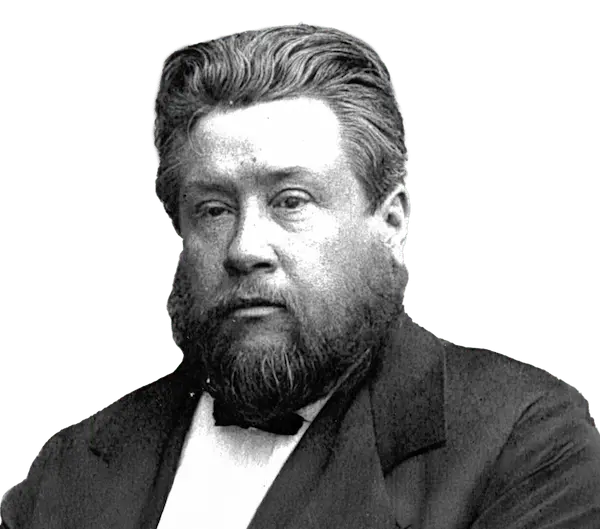
Charles Spurgeon • May 17, 1903
OBSERVE, dear friends, that the apostle says in the second verse of this chapter, “Bear ye one another’s burdens, and so fulfill the law of Christ.” These Galatians had been trying to bear the heavy burden of the law of Moses. They had, as far as they could, p…
Charles Spurgeon • Feb 8, 1885
THE text begins with “Woe,” but when we get a woe in this book of blessings it is sent as a warning, that we may escape from woe. God’s woes are better than the devil’s welcomes. God always means man’s good, and only sets ill before him that he may turn from t…
Charles Spurgeon • Jul 13, 1916
I CAN scarcely tell you under what singular feelings I am led to adopt this text. It has entered my mind, whispered in my ears, and I might almost say it has haunted my thoughts, for all the day long has it been fresh in my memory, and again and again it has r…
Charles Spurgeon • Jan 19, 1873
TO seek aid in time of distress from a supernatural being is an instinct of human nature. We say not that human nature unrenewed ever offers truly spiritual prayer or ever exercises saving faith in the living God. But still, like a child crying in the dark, wi…
Charles Spurgeon • Mar 25, 1883
THIS verse is guarded before and behind by two notable statements. Before it we hear the Master say, “I lay down My life for the sheep,” and immediately after it we meet with another grand sentence, “I lay down My life, that I might take it again.” The first s…
Charles Spurgeon • Apr 4, 1875
IT is a great blessing when food and appetite meet together. Some have appetite and no meat, they need our pity. Others have meat but no appetite. They may not perhaps win our pity, but they certainly require it.
Charles Spurgeon • Feb 13, 1887
—“And having spoiled principalities and powers, He made a show of them openly, triumphing over them in it.” On the resurrection morning it would have been correct poetically to have used the language of our text. Unseen spirits, viewing our Lord after a spirit…
Charles Spurgeon • Jan 22, 1893
ABRAHAM’S life, taken literally, is full of instruction, but we shall be wise to take the spirit of it and endeavor to make it our own. We cannot live just as Abraham did, but we can carry out the great principles which lay at the root of Abraham’s life, and i…
Charles Spurgeon • Jun 7, 1874
THE general strain of the Apostle Paul is confident and even jubilant; where in the whole compass of Revelation do you meet with bolder writing than that which comes from his pen? “There is therefore now no condemnation to them that are in Christ Jesus.” “For…
Charles Spurgeon • Jul 7, 1910
THIS means that the film upon Saul’s eyes was comparable to the scales of a fish, or else that it fell off as scales might fall. When the blinding film was gone, light broke into the darkness of Saul. In different men, sin manifests its chief power in differen…
Charles Spurgeon • Nov 17, 1867
IN great ranges of mountains there are lofty peaks which pierce the clouds, but on the other hand, there are, here and there, lower parts of the range which are crossed by travelers, become national highways, and afford passages for commerce from land to land.…
Charles Spurgeon • Jul 9, 1914
ACCORDING to the judgment of Calvin, and some of the ablest commentators, there is a kind of pettishness in this verse. The context appears to imply that David had grown impatient under the chastening hand of God. Job, under similar circumstances, longed to ac…
Charles Spurgeon • Mar 11, 1888
WHAT Isaiah said was, therefore, spoken by Jehovah. It was audibly the utterance of a man, but,really, it was the utterance of the Lord Himself. The lips which delivered the words were those of Isaiah, but yet it was the very truth that “The mouth of the Lord…
Charles Spurgeon • Mar 31, 1867
THE heathen described their fabled deity, Jove, as sitting far aloft, regardless of the common affairs of this lower world. Upon a few kings and princes he might turn an observant eye, but the most of men were creatures far too insignificant to affect the mind…
Charles Spurgeon
IT was the evening, in all probability it was the evening of a Sabbath day. The Jews were so tender not to break the Sabbath that they did not even bring forth the sick to the Savior until the even was come. The Savior would gladly have healed them on the Sabb…
Charles Spurgeon • Jun 21, 1896
I THINK that the patriarch Jacob may well serve as the type and emblem of a doubting soul, one who has been told the good news of salvation, the Gospel of God’s grace, but who cannot bring his mind to believe it.
Charles Spurgeon • Dec 13, 1866
ON Monday evening we expounded this Psalm [See The Sword and the Trowel , Vol. 3, page 27, January Number]. We then enlarged upon the glorious ascension of our Lord Jesus Christ, and His triumphal entrance within the pearly gates of the New Jerusalem, to which…
Charles Spurgeon • Oct 29, 1903
DAVID had in his heart, an intense love to God. During Saul’s reign, God had been well-nigh forgotten in the land. The ordinances of His house had been almost, if not entirely, neglected, and when David found himself firmly seated upon his throne, one of his f…
Charles Spurgeon • Feb 2, 1911
THE Christian is a man of much present enjoyment. “Beloved, now are we the sons of God and being God’s sons, we cannot be altogether unhappy.” Relationship to the ever-blessed God must bring with it a measure of joy. “Happy art thou, O Israel,” sang Moses, “wh…
Charles Spurgeon • Sep 22, 1872
I THINK you will find the prayer for quickening repeated nine times in this psalm. The form of it differs, but it is always the same vehement cry, “Quicken thou me, O LORD.” In addition to this, you will hear David twice acknowledge that God had quickened him,…
Charles Spurgeon
PAUL fell to the ground overcome by the brightness of the light which outshone the midday sun and as he lay there he cried, “Who are You, Lord?” After receiving an answer to his first question, he humbly asked another, “Lord, what will You have me to do?” This…
Charles Spurgeon • May 12, 1889
UNDER the leadership of Moses the children of Israel had been journeying towards the land of promise. Owing to their waywardness, what might have been done in less than a month occupied many years. They wandered up and down in the wilderness, sometimes close o…
Charles Spurgeon • Sep 15, 1904
NOTICE in this verse, the very remarkable change of persons which you find in it, for you have first, the first person, and then the third, “They shall look upon me whom they have pierced, and they shall mourn for him.” It is the same person who speaks in each…
Charles Spurgeon • Nov 26, 1908
THAT was a large request for Moses to make. He could not have asked for more, “I beseech thee, shew me thy glory.” Why, it is the greatest petition that man ever asked of God. It seems to me the greatest stretch of faith that I have either heard or read of. It…