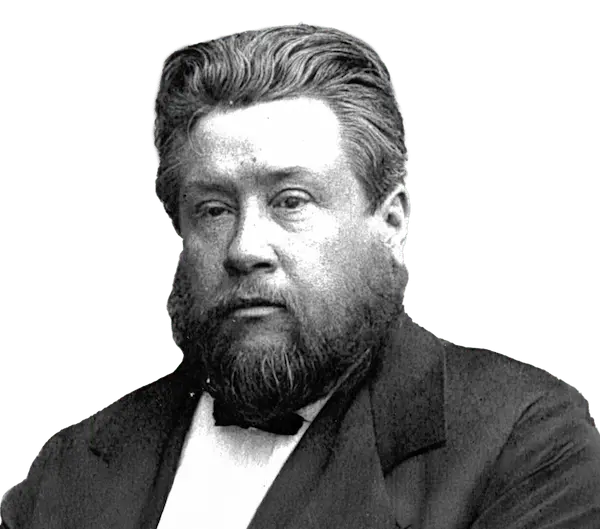
Charles Spurgeon • Nov 24, 1861
WE might use this text, if we chose, as a picture of the ease with which faith repels all attacks that are made upon Christ, the great sacrifice of the new covenant. Ainsworth tells us that the original word which we translate “drove” has in it the force of “p…
Charles Spurgeon • Sep 13, 1857
THE apostle, in this chapter, was endeavoring to stir up the Corinthians to liberality. He desired them to contribute something for those who were the poor of the flock, that he might be able to minister to their necessities. He tells them that the churches of…
Charles Spurgeon • May 27, 1855
NO one here requires to be told that this is the name of Jesus Christ, which “shall endure for ever.” Men have said of many of their works, “They shall endure for ever,” but how much have they been disappointed! In the age succeeding the flood, they made the b…
Charles Spurgeon • Sep 23, 1855
ONE of the greatest obstacles which the Christian religion ever overcame was the inveterate prejudice which possessed the minds of its earliest followers. The Jewish believers, the twelve apostles, and those whom Jesus Christ had called from the dispersed of I…
Charles Spurgeon • Sep 30, 1860
IF the life of a Christian may be compared to a sacrifice, then humility digs the foundation for the altar, prayer brings the unhewn stones and piles them, one upon the other, penitence fills the trench round about the altar with water, obedience lays the wood…
Charles Spurgeon • Dec 13, 1857
WHEN a farmer comes to thrash out his wheat and get it ready for the market, there are two things that he desires—that there may be plenty of it, of the right sort—and that when he takes it to market, he may be able to carry a clean sample there. He does not l…
Charles Spurgeon • Mar 2, 1856
THERE cannot be a greater difference in the world between two things than there is between law and grace. And yet, strange to say, while the things are diametrically opposed and essentially different from each other, the human mind is so depraved, and the inte…
Charles Spurgeon • Aug 18, 1861
WE have read the chapter from which our text is taken. Let me now rehearse the incident in your hearing. There was an expectation upon the popular mind of the Jewish people, that Messiah was about to come. They expected Him to be a temporal prince, one who wou…
Charles Spurgeon • Oct 9, 1859
THERE is something very touching in this admonition, “Grieve not the holy Spirit of God.” It does not say, “Do not make Him angry.” A more delicate and tender term is used—“Grieve him not.” There are some men of so hard a character, that to make another angry…
Charles Spurgeon
THE prophets of God were anciently called seers, for they had a supernatural sight which could pierce through the gloom of the future and behold the things which are not seen as yet, but which God has ordained for the last times. They frequently described what…
Charles Spurgeon
A MOMENT’S contemplation would suffice to arouse any man to the terror of the position involved in being at war with God. For a subject to be in a state of sedition against a powerful monarch is to commit treason and to incur the forfeiture of his life. But fo…
Charles Spurgeon • Aug 21, 1859
AN ASSURANCE of our safety in Christ will be found useful to us in all states of experience. When Jesus sent forth His seventy chosen disciples, endowed with miraculous powers, they performed great wonders, and naturally enough they were somewhat elated when t…
Charles Spurgeon • Jan 18, 1857
I. The first case I shall bring before you is that of the HARDENED SINNER, who, when under terror, says, “I have sinned.” And you will find the text in the book of Exodus, the ninth chapter and twenty-seventh verse, “And Pharaoh sent and called for Moses and A…
Charles Spurgeon • Mar 6, 1859
THE great book of God’s decrees is fast closed against the curiosity of man. Vain man would be wise, he would break the seven seals thereof, and read the mysteries of eternity. But this cannot be, the time has not yet come when the book shall be opened, and ev…
Charles Spurgeon • Jan 20, 1861
THE Jews had been chosen by God to be a special people separated to Himself forever. By sundry miracles, by divers mercies, by strange deliverances, He had proved Himself to be to them a God worthy of their trust. Yet, strange to say—and yet not strange when w…
Charles Spurgeon • Oct 18, 1857
I. WE have here the description of a true Christian and a declaration of that Christian’s blessedness. We have him first very succinctly, but very fully described in these words—“Them that love God, them who are the called according to his purpose.” These two…
Charles Spurgeon • May 27, 1860
YOU will remember that Luke in his letter to Theophilus speaks of things which Jesus began both to do and to teach, as if there was a connection between His doings and His teachings. In fact, there was a relation of the most intimate kind. His teachings were t…
Charles Spurgeon • Apr 22, 1860
ON two or three former occasions I have endeavored to insist upon the fact that God always puts a distinction between Israel and Egypt. He constantly speaks of the Israelites as “My people,” of the Egyptians he speaks to Pharaoh as being “thy people.” There is…
Charles Spurgeon • Dec 22, 1861
WE have nothing to do this morning with the question of moral evil, and indeed with the awful mystery of the origin of moral evil, we have nothing to do at any time. There may have been some few speculators upon this matter, who like Shadrach, Meshach, and Abe…
Charles Spurgeon • Dec 15, 1861
THE overwhelming national calamity announced to the citizens of London at midnight, by the solemn tolling of the great bell of St. Paul’s, was unknown to most of us until we entered this sanctuary.
Charles Spurgeon • Apr 12, 1857
IT might naturally be expected that I should have selected the topic of the resurrection on what is usually called the Easter Sabbath. I shall not do so—for although I have read portions which refer to that glorious subject, I have had pressed on my mind a sub…
Charles Spurgeon • Jan 9, 1859
GOD has so made men that there are two things essential for their comfort, if not for their very existence, namely, sleep and clothing . Had God so pleased it, He might have made man an everlasting watcher, upon whose eyes the mists of night never should desce…
Charles Spurgeon • May 16, 1858
THE peculiar sin of the Jews, the sin which aggravated above everything their former iniquities, was their rejection of Jesus Christ as the Messiah. He had been very plainly described in the books of the prophets, and they who waited for Him, such as Simeon an…
Charles Spurgeon • Sep 18, 1864
GREAT and grievous was the apostasy of the seed of Abraham from the Lord their God. They had been chosen by special grace from among all people, and had the high honor to receive the oracles of God. Yet they were bent on backsliding from God, and were unfaithf…