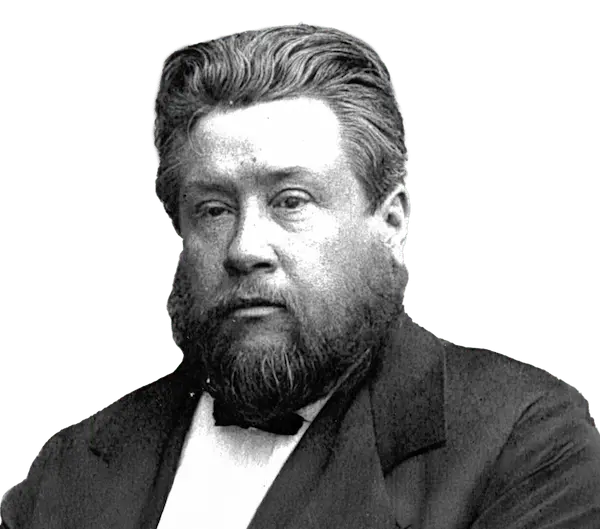
Charles Spurgeon • Jan 1, 1885
HOW pleased we are with that which is new! Our children’s eyes sparkle when we talk of giving them a toy or a book which is called new, for our short-lived human nature loves that which has lately come, and is therefore like our own fleeting selves. In this re…
Charles Spurgeon
THAT is a bit of genuine experience, honestly told, in the most natural manner. How glad we ought to be that David never fell into the hands of an ordinary biographer, for such a piece of weakness as this text records would have been carefully repressed lest t…
Charles Spurgeon • Oct 26, 1862
WHAT power resides in “Thus saith the Lord!” The man who can grasp by faith, “He hath said,” has an all-conquering weapon in his hand. What doubt will not be slain by this twoedged sword? What fear is that which shall not fall smitten with a deadly wound befor…
Charles Spurgeon • Aug 7, 1887
WE have carefully read John’s description of the manner in which his Lord and Master revealed His glory to him. The figure is colossal, and I had almost said inconceivable. It would be quite impossible to draw a picture from the apostle’s words. If any artist…
Charles Spurgeon • Sep 22, 1889
OUR first anxious desire is that our hearers would come to Christ. We lay ourselves out to lift Him up, as Moses lifted up the serpent in the wilderness, and to bid men look to Him and live. There is no salvation except by faith in the Lord Jesus Christ. He sa…
Charles Spurgeon
IT is the preacher’s principal business, I think I might say, his only business, to cry, “Behold the Lamb of God!” For this reason was John born and sent into the world, and such were the prophecies which went before concerning him. If he had been the most elo…
Charles Spurgeon • May 30, 1886
IF I were to put to you the question, “Do you pray?” the answer would be very quickly given by every Christian person, “Of course I do.” Suppose I then added, “And do you pray every day?” the prompt reply would be, “Yes, many times in the day. I could not live…
Charles Spurgeon • Sep 15, 1895
IT is something when a man truly knows that there is a God. Behind the doubt of the existence of God, many men shield themselves and permit themselves to indulge in iniquities of which they might be ashamed if they did not make a cloak of their atheism. I woul…
Charles Spurgeon • May 25, 1862
THE love of God changes us into its own image, so that what the Lord says concerning us, we also can declare concerning Him . God is love essentially, and when this essential love shines forth freely upon us, we reflect it back upon Him. He is like the sun, th…
Charles Spurgeon • Feb 9, 1873
“Philosophers have measured mountains, Fathom’d the depths of seas, of states, and kings, Walked with a staff to heav’n and traced fountains: But there are two vast, spacious things, The which to measure it doth more behoove: Yet few there are that sound them;…
Charles Spurgeon • Sep 27, 1885
THERE was a time when God freely communed with men. The voice of the Lord God was heard walking in the garden in the cool of the day. With unfallen Adam the great God dwelt in sweet and intimate fellowship, but sin came and not only destroyed the garden, but d…
Charles Spurgeon • Feb 26, 1888
AFTER the Flood, when men began to multiply and increase in the earth, it was not very long before they began to turn aside from the living and true God. At first the sons of Noah walked in the light of divine knowledge, though even among them was found an evi…
Charles Spurgeon • Jan 30, 1898
PERHAPS the legitimate topic of this discourse, after such a text, ought to be the resurrection of the dead. Lazarus had died—he had lain in his grave, at the invitation of his sisters, Jesus Christ came to see them, and His visit answered the double purpose o…
Charles Spurgeon • Dec 18, 1870
WE cannot readily tell which action in a gracious life God may set the most store by. The Holy Spirit in this chapter selects out of good men’s lives the most brilliant instances of their faith. I should hardly have expected that He would have mentioned the dy…
Charles Spurgeon • Jul 25, 1912
WHEN our Saviour was upon this earth, there were some persons who, having had their eyes divinely opened, could see His true beauty, and who admired His every action, and said, “He hath done all things well.” But there were others, whose eyes were blinded by s…
Charles Spurgeon • Mar 22, 1885
THIS text is written by the apostle as a reason why salvation cannot be a thing of human merit, “not of works, lest any man should boast, for we are His workmanship.” The, for, indicates an argument. It is a conclusive reason why salvation cannot be by our goo…
Charles Spurgeon • May 18, 1882
YOU recollect, dear friends, that Paul is writing to the Hebrews concerning Abraham, Isaac, and Jacob, and he says, “God is not ashamed to be called their God.” Then, when you turn back to our text in Exodus, you find that God was called their God at the burni…
Charles Spurgeon • Jul 13, 1911
YONDER is a wreck. After a terrible tempest, that is all that remains of a once fine vessel, and on the wreck, lashed to the mast, I see a number of mariners clinging, almost frost-bitten with the cold, and drenched through and through with brine. But there go…
Charles Spurgeon • Sep 24, 1899
A FRIEND observed to me, just before the service, that after the earnest endeavor this morning to magnify the grace of God, he did not want to hear any more for a week. He was perfectly satisfied with what he had heard and was only afraid lest the sermon of th…
Charles Spurgeon • Jun 10, 1894
I AM very weary tonight, having had day after day, almost without cessation, to make a supreme effort to address large assemblies. I felt therefore, that the only subject that I could handle would be some theme that was restful, and did not require any great t…
Charles Spurgeon • Mar 16, 1916
I DESIRE to continue the topic of the morning [Sermon #1003, Volume 17, “YOUR OWN SALVATION”], only we will look at another side of the same important matter.
Charles Spurgeon • Dec 2, 1894
THE psalmist here evidently perceives that his Lord is near, he does not so much speak of God as to Him, “Thou shalt guide me with thy counsel.” You know what the French call, tutoyage —thou-ing and thee-ing, there is something of that kind of language in the…
Charles Spurgeon • Aug 23, 1868
BRIEFLY consider this poor woman’s case. She was afflicted with a disease of exceedingly long standing, which not only wasted her strength and threatened to bring her speedily to the grave, but rendered her according to the Jewish ceremonial law unclean, and t…
Charles Spurgeon • Jul 17, 1892
NOTICE that I make a correction in the version from which I am reading. The Authorized Version has it, “Thou hast multiplied the nation, and not increased the joy.” This is not consistent with the connection, and the Revised Version has very properly put it, “…