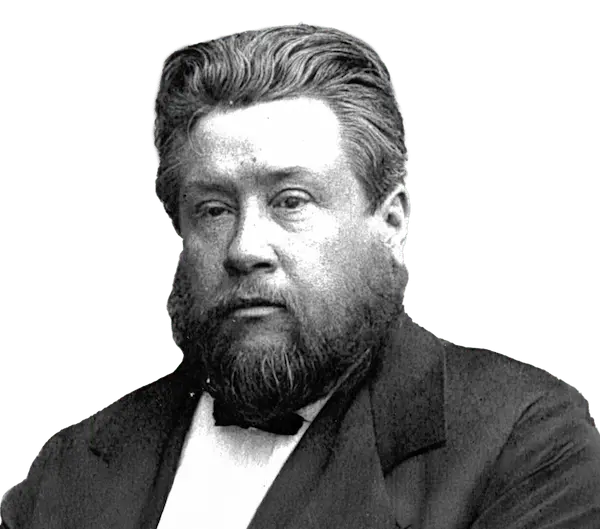
Charles Spurgeon • Jun 19, 1870
WE endeavored this morning, to prove the profitableness of godliness as to the life which now is, and to discriminate as to what the promise of this life really is. We tried to prove that “the promise” of the life that now is, its real and highest beauty and e…
Charles Spurgeon • Aug 15, 1886
THE dread of divine justice has often driven men to seek mercy. Many have been caught in the whirlwind of wrath, and in their dismay they have fled for refuge to that Man who is a covert from the tempest. Hence the Lord does not decline to work upon the minds…
Charles Spurgeon • Aug 10, 1884
THE translation into the word “Shulamite” is unhappy, it is unmusical, and misses the meaning. The Hebrew word is a feminine of “Solomon.” “Solomon” may stand for the bridegroom’s name, and then the well-beloved bride takes her husband’s name in a feminine for…
Charles Spurgeon
“THE fruit of the lips”! The lips are neither trees of the orchard nor herbs of the garden. What fruit can they bear? The scattering of Babel came of human speech when languages were multiplied, and the united race split up into fragments. Wars and fighting, a…
Charles Spurgeon • Jan 26, 1890
STUDY carefully the story of the enthusiastic Christian woman who poured the alabaster box of very precious ointment upon the head of our ever-blessed Lord and Savior. Honored as that action is by the universal church of God, it did not escape criticism among…
Charles Spurgeon • Nov 14, 1897
WITHOUT any preface we will go straight to our text at once. In the words of the prophet, we have two things brought before us—first, a resolution to be glad , and secondly, the reasons for being glad. Whenever a man makes a resolution, it should be because he…
Charles Spurgeon • Apr 21, 1861
WHILE I was meditating in private upon this text, I felt myself carried away by its power. I was quite unable to calmly consider its terms or to investigate its argument. The command with which the text concludes repeated itself again, and again, and again in…
Charles Spurgeon • Nov 26, 1893
DAVID was a poet and when he found that his best-beloved friend had fallen by the arrows of the Philistines, he wept greatly, and then he cheered his heart by writing the very fine elegy, which in after years was called “The Song of the Bow.” Even if David’s l…
Charles Spurgeon • Dec 10, 1899
THESE Jews had claimed to be of the seed of Abraham and the Lord Jesus Christ admitted their claim as far as it was a valid one. It is always best, in argument, to concede as much as you can fairly grant to your opponent. Sometimes, we take a few steps backwar…
Charles Spurgeon • Jul 16, 1899
GOD had chosen the children of Israel, and He had determined to make of them a great nation and a peculiar people, to whom He could communicate the law and the testimony, that they might keep the heavenly lamp burning until Christ should come. Jacob and his fa…
Charles Spurgeon • May 17, 1896
I INTEND chiefly to call your attention to this verse, but it will be necessary also to refer to the rest of the chapter, “Go ye therefore, and teach all nations, baptizing them in the name of the Father, and of the Son, and of the Holy Ghost: teaching them to…
Charles Spurgeon
OUR Lord, before His enemies, was silent in His own defense, but He faithfully warned and boldly avowed the truth. His was the silence of patience, not of indifference—of courage, not of cowardice. It is written that “before Pontius Pilate He witnessed a good…
Charles Spurgeon • Apr 13, 1874
BEFORE we enter the common hall of the soldiers and gaze upon “the sacred head once wounded,” it will be well to consider who and what He was who was thus cruelly put to shame. Forget not the intrinsic excellence of His person, for He is the brightness of the…
Charles Spurgeon • Sep 26, 1886
JOB suffered from a terrible sickness, which filled him with pain both day and night. It is supposed that, in addition to his grievous eruptions upon the skin, he endured great difficulty in breathing. He says in the eighteenth verse, “By the great force of my…
Charles Spurgeon • May 2, 1880
WE are justified, dear friends, in speaking about our own experience when the mention of it will be for the benefit of others. Especially is this the case with leaders in the church such as Paul, for their experience is rich and deep and the rehearsal of it co…
Charles Spurgeon • Nov 7, 1912
IF we regard the Christian as a racer contending for the great prize, we see that he is subject to several dangers. He may give up the race and turn back unless everlasting mercy shall prevent so dreadful a calamity. He may leap out of the track, and leave for…
Charles Spurgeon • Jun 13, 1875
NO doubt this prophecy had a fulfillment in the restoration of the captive Jews from Babylon, in the rebuilding of the temple, and the completion of the walls of Jerusalem. This made the nation rejoice with unspeakable joy, and made them cry, “Sing together, y…
Charles Spurgeon • Jul 23, 1908
THE Jewish high priest went within the veil once a year, and represented the people there, but he was never their forerunner, for no one followed him into the most holy place. His entrance within the veil did not admit another human being, and when he came for…
Charles Spurgeon • Sep 2, 1877
OBSERVE the close connection between privilege and duty. “Thou art my portion, O LORD.” This is an unspeakable happiness. “I have said that I would keep thy words”—this is the fitting return for such a blessing. Every mercy given us by the Lord brings with it…
Charles Spurgeon • Oct 13, 1904
THE twelve apostles were favored with the most intimate communion with our blessed Lord, but I can hardly say that they entered into fellowship with Him during His life on earth. Each of them might have been asked the question that our Savior put to one of the…
Charles Spurgeon • May 19, 1895
OUR Savior was very gentle with those who had real difficulties. He would argue with them over and over again. He would state a truth, and re-state it. He would cast it into the form of a parable, or He would condense it into a sentence comparable to a proverb…
Charles Spurgeon • Jul 29, 1909
[In the year 1873, Mr. Spurgeon delivered what he called “a series of sententious homilies” on the Beatitudes. After an introductory discourse upon the Sermon on the mount and the Beatitudes as a whole, he intended to preach upon each one separately, but eithe…
Charles Spurgeon • Mar 1, 1891
WE are in the last chapter of the book of the prophet Hosea. Throughout the book there has been thunder; sometimes a low rumbling, as of a distant tempest, sometimes peal on peal, as of a storm immediately overhead. And now the tempest has gathered all its for…
Charles Spurgeon • Oct 15, 1876
THE sermon of last Sabbath morning, [#1317, Overcome Evil with Good ] in which I earnestly endeavored to teach the doctrine of overcoming evil with good, and the frank and full forgiveness of all injuries for Christ’s sake, has raised much discussion. I know t…