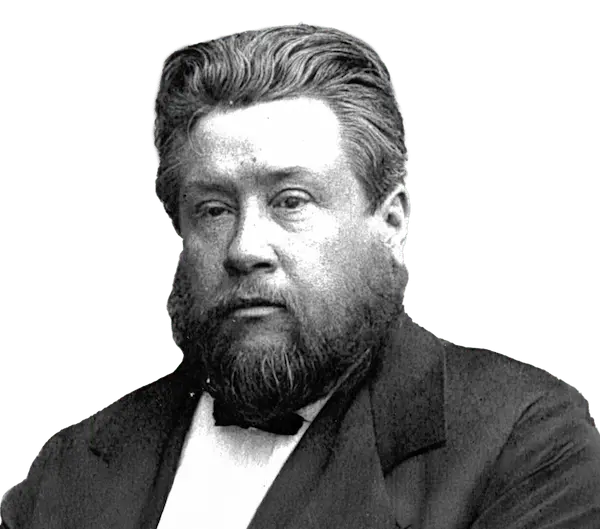
Charles Spurgeon
CANAAN may be considered as a type of two states or conditions in the Christian’s life. It was the land of rest to the children of Israel after a weary pilgrimage in the wilderness. Now it is written that, “We who believe do enter into rest.” A true Christian,…
Charles Spurgeon • Jan 13, 1878
The outward features of a day none can change. The kings of the earth cannot command for themselves bright days nor inflict upon their enemies days of tempest. It belongs to a higher than they to command the morning and cause the daystar to know its place. It…
Charles Spurgeon • May 19, 1872
I SHOULD not have addressed you upon the subject of intercession today if this week had not been set apart for general prayer, for it is only a very few Sabbaths ago that I endeavored to set before you the duty and privilege of intercession. However, as our mi…
Charles Spurgeon • Jun 22, 1905
MARY’S Magnificat was a song of faith. You have thought, perhaps, that you could easily have sung this song if you had been as highly favored as she was, but are you sure that you could have done so? Have you ever realized the difficulties under which this hym…
Charles Spurgeon • Mar 21, 1867
You observe that a very speculative question had been put to our Lord, and His answer to that very speculative question is, “ I must work. ” His disciples wished to know something about the mysterious fact that some persons are born in an unhappy condition—bli…
Charles Spurgeon • Oct 2, 1913
INTO the connection of these words our time, which is very short this evening, will not permit us to enter. It was something like this—Paul was showing that the law could not make a man holy, and he observes that he had himself found that, when the law came in…
Charles Spurgeon • Apr 13, 1890
APOLLOS is not Paul, and Paul is not Apollos. To blend the two in one would be to spoil each one of the two without producing a good third. It is a great mercy that we have Paul, Apollos, Cephas, and other varieties of preachers, for not only is variety charmi…
Charles Spurgeon • Dec 9, 1877
“JESUS CHRIST himself” is to occupy all our thoughts this morning. What an ocean opens up before me! Here is sea-room for the largest barque! In which direction shall I turn your thoughts? I am embarrassed with riches. I know not where to begin—and when I once…
Charles Spurgeon • Jan 15, 1899
IT tends to excite gratitude in our hearts if we remember what the Lord has done for us. It is not wrong for us to think of all that we still need from God, but it would be exceedingly ungrateful if we were to forget what we have already received. By far the g…
Charles Spurgeon • Sep 29, 1910
ALL the histories of Scripture are written for our examples, but especially the story of the Israelites in the wilderness, which is given to us at a length far exceeding the value of the narrative unless it is intended for purposes of spiritual instruction, fo…
Charles Spurgeon • May 5, 1895
THERE are some people who are not saved, though we should have expected that they would have been converted long ago. Our text explains the reason, so, without any preface, let us come to it at once.
Charles Spurgeon • May 3, 1891
TO my great sorrow, last Sunday night I was unable to preach. I had prepared a sermon upon this text, with much hope of its usefulness, for I intended it to be a supplement to the morning sermon [Sermon #2202, “Lo, I Come”: Exposition” ], which was a doctrinal…
Charles Spurgeon • Jun 16, 1901
I DO not intend to speak so much upon the whole of this text as to use the latter part of it as a sort of motto for an appeal to Christian people to be diligent in the service of their Lord. If we wish to do good to our fellow creatures, the best thing that we…
Charles Spurgeon • Jun 19, 1892
NO. 2261 A SERMON INTENDED FOR READING ON LORD’S-DAY, JUNE 19, 1892 DELIVERED BY C. H. SPURGEON AT THE METROPOLITAN TABERNACLE, NEWINGTON ON THURSDAY EVENING, AUGUST 14, 1890 THIS sermon is intended for reading on the first anniversary of the beloved preacher’…
Charles Spurgeon • Jun 17, 1894
THERE is a book called The Museum of Natural History, and the most singular animal in that museum is man. It would be far easier to understand any other creature than to understand a human being. He is worthy of very great study, and the more he is studied, th…
Charles Spurgeon • Oct 7, 1900
YOU have only to look at the preceding verse, and you will discover in a single moment, who are the people here spoken of who shall speak of the glory of God’s kingdom and talk of His power. They are the saints, “All thy works shall praise thee, O LORD; and th…
Charles Spurgeon • Sep 12, 1886
THIS is the passage which was quoted by the apostle Paul in the tenth chapter of his Epistle to the Romans. At the twentieth verse of that chapter he says—“Isaiah is very bold, and says, I was found of them that sought Me not; I was made manifest unto them tha…
Charles Spurgeon • Aug 4, 1895
THIS man who talks about his song, and seems to be very much struck with the fact that he has become a singer, was formerly a man of prayer. I doubt not that he was still praying while he was praising, but he began to pray before he began to praise. It is ill…
Charles Spurgeon • May 27, 1915
THE Psalmist was full of praise and, therefore, felt that he could not fully express the glory of God, but desired to enlist others in the sacred service. You hear him often calling upon sea and land, upon earth and heaven, upon mountain and valley, upon plant…
Charles Spurgeon • Oct 5, 1884
NOTICE at the outset the logic of this verse. It is very simple, very forcible, very accurate logic. It runs thus, “You have,” “You will.” “Lord, You have heard the desire of the humble: You will prepare their heart.” When you know that the Lord God is immutab…
Charles Spurgeon • Feb 26, 1871
THE preacher is under no difficulties this morning as to the practical object to be aimed at in his discourse. Every subject should be considered with an object, every discourse should have a definite spiritual aim, otherwise we do not so much preach as play a…
Charles Spurgeon • Oct 11, 1888
VENGEANCE was in full career. The armies of divine justice had been called forth for war, “They shall run like mighty men; they shall climb the wall like men of war.” They had invaded and devastated the land and turned the land from being like the garden of Ed…
Charles Spurgeon • Jan 21, 1894
IN the original Greek of John’s Gospel, there is only one word for this utterance of our Lord. To translate it into English, we have to use three words, but when it was spoken, it was only one—an ocean of meaning in a drop of language, a mere drop, for that is…
Charles Spurgeon • Dec 15, 1867
AS far as we know, out of the many thousands who had come to Jerusalem from the utmost ends of the earth to keep the Passover, none were left unaccommodated with a guestchamber except our Lord Jesus Christ. Jerusalem, at the time of the Passover, was one great…