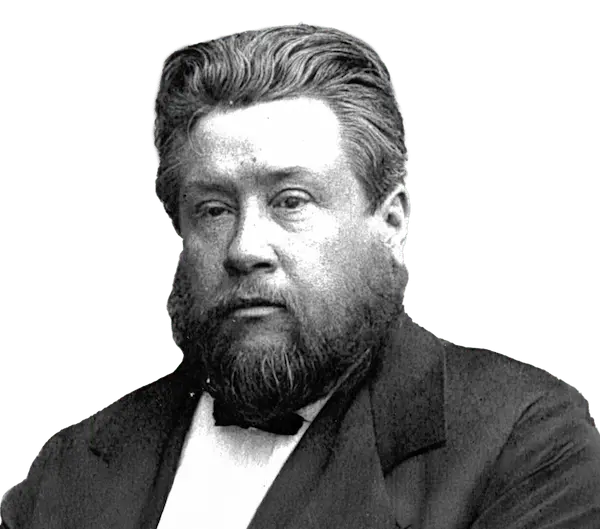
Charles Spurgeon • Jul 25, 1886
HOW weary the Savior must have been of the idle prattle of the scribes and Pharisees! They are forever talking about washing hands before meals, and washing pots and cups, and He is all the while occupied with the great griefs and sins of men, and how He can s…
Charles Spurgeon • Jun 9, 1910
THIS is spoken, I suppose, in the first place, of the Jewish people, who have been so afflicted on account of their sin that they almost cease to be a nation, and they are driven hither and thither among the lands, and made to suffer greatly. In the last time,…
Charles Spurgeon • Dec 29, 1901
IT has often been insinuated, if it has not been openly affirmed, that the contemplation of divine things has a tendency to depress the spirits. Religion, many thoughtless persons have supposed, is not becoming to the young—it checks the ardor of their youthfu…
Charles Spurgeon
THE gospel does not merely supply us with directions for holy living, but furnishes us with reasons for obedience, and tells us where to find the power to obey. Hence in the commencement of this chapter, before the apostle comes to any practical exhortation, h…
Charles Spurgeon
I SUPPOSE that Timothy was a somewhat retiring youth and that from the gentleness of his nature he needed to be exhorted to the exercise of the bolder virtues. He is bidden not to be ashamed of the testimony of our Lord, and to endure hardness as a good soldie…
Charles Spurgeon • Feb 3, 1916
THERE has long been war between man and his Maker. Our federal head, Adam, threw down the gauntlet in the garden of Eden. The trumpet was heard to ring through the glades of paradise, the trumpet which broke the silence of peace and disturbed the song of prais…
Charles Spurgeon • Apr 19, 1903
WE spent this morning at the foot of the cross [Sermon #1362, Mourning for Christ]. I hope that some of us, at least, were helped by the Spirit of grace and of supplication to look unto Him whom we have pierced by our sins, and to “mourn for him, as one mourns…
Charles Spurgeon
YOU will find the same narrative in Luke, at the fourth chapter, from the thirty-first to the thirty-seventh verse. It will be handy for you to be able to refer to the second passage, from which I shall quote one or two matters.
Charles Spurgeon • Nov 6, 1892
PAUL wishes to unite the saints in Philippi in the holy bands of love. To do this, he takes them to the cross. Beloved, there is a cure for every spiritual disease in the cross. There is food for every spiritual virtue in the Savior. We never go to Him too oft…
Charles Spurgeon • Oct 7, 1915
THIS passage may be read in several ways. Literally, when Christ tabled among men, when He did eat and drink with them, being found in fashion as a man, the loving Spirit broke the alabaster box of precious ointment on His head while the king was sitting at Hi…
Charles Spurgeon • Jul 16, 1882
OUR blessed Lord had two great objectives before Him in His ministry. The first was to preach the Word to the outlying masses, that out of them He might gather a people to Himself who should be His disciples. This part of His work He carried on with great assi…
Charles Spurgeon • Jun 10, 1915
IN the days when this prophecy was written, there were certain great nations of the earth that sought and obtained their wealth, not by commerce, but by rapine—not by fair trading, but by fiercely invading their richer neighbors. The Babylonians and the Chalde…
Charles Spurgeon • Nov 28, 1912
IN the splendid Psalm that sets forth the diving glory of the matchless Word of God as compared even with the greatest wonders of God’s visible creation—viz., in the nineteenth Psalm—we read in the tenth verse, “Sweeter also than honey and the honeycomb.” This…
Charles Spurgeon • Apr 30, 1865
WELL said the apostle in another place, “All things are of God,” for here in this passage all works of divine grace are evidently so. The pronoun “he” is repeated yet again and again, as if to set the Lord always before us. “Whom he did foreknow, he also did p…
Charles Spurgeon • Nov 19, 1876
YOU remember we spoke last Sunday morning of “the days of the Son of man.” Oh that every Sunday might be a day of that kind in the most spiritual sense. I hope that we shall endeavor to make each Lord’s day as it comes round a day of the Lord, by thinking much…
Charles Spurgeon
LET us, with deep attention, consider the miracle of the loaves, lest we fall into the same evil as that which happened to the disciples in the text. When they saw Jesus walking on the sea, “They were sore amazed in themselves and wondered: for they considered…
Charles Spurgeon • Sep 24, 1865
ISAAC walked in the fields at eventide to meditate. I commend him for his occupation . Meditation is exceedingly profitable to the mind. If we talked less, read less, and meditated more, we should be wiser men. I commend him for the season which he chose for t…
Charles Spurgeon
SEE here the germ of the Christian’s life! See, too, how it blooms, blossoms, and bears! But observe it is not said the just shall live for his faith, or because of the merit of his believing in God. This were to place the Christian virtually under the old cov…
Charles Spurgeon • Mar 30, 1884
WHEN a prince dies they toll the great bell of the cathedral that the entire city may hear it, and that for miles around the tidings may spread. Swift messengers of the press bear the news through the length and breadth of the land, and all men’s ears are made…
Charles Spurgeon
CHILDREN are expected to bear some likeness to their parent. Children of God, born of the grandest of all parents, regenerated by the almighty energy of the divine Spirit, are sure to bear a high degree of likeness to their heavenly Father. We cannot be like G…
Charles Spurgeon • Feb 2, 1902
WE believe that, in the latter days, according to the Word of God, men will flock to Christ, and to His church, in far greater numbers than they have hitherto done. At present, we have to go to them, but by and by, they will come to us. Now, we have to search…
Charles Spurgeon • Jun 5, 1898
IT is very unpleasant to our poor flesh and blood to suffer. Physical pain is a grievous infliction, mental agony or spiritual sorrow is still worse. Irons around the wrists can be worn till they fit easily, but when the iron enters into the soul, how it rusts…
Charles Spurgeon • Feb 14, 1897
I WANT to lay the stress especially upon these three sentences in my text— “God prepared a gourd.” “God prepared a worm.” “God prepared a vehement east wind.” The life of Jonah cannot be written without God. Take God out of the prophet’s history and there is n…
Charles Spurgeon • Oct 5, 1873
THESE words were addressed by our Savior to the common people who had gathered around Him.