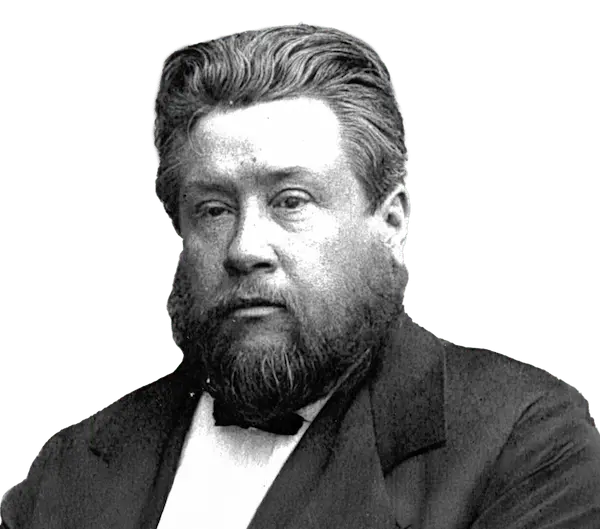
Charles Spurgeon • Dec 10, 1903
THE text does not say that time is short. That would have been a true statement. Compared with eternity, time, at the very longest, is but as a pin’s point. But note what the text does say, “The time is short.” It is the time of our life, the space of our oppo…
Charles Spurgeon • May 26, 1867
WHEN the Assyrians had invaded Judea with an immense army, and were about to attack Jerusalem, Rab-shakeh was sent with a railing message to the king and his people. When Hezekiah heard of the blasphemies of the proud Assyrian, he rent his clothes, put on sack…
Charles Spurgeon • Apr 3, 1887
CRIMINALS who were crucified by the Romans were allowed to rot upon the cross. That cruel nation can hardly be as severely condemned as our own people, who up to a late period allowed the bodies of those condemned to die to hang in chains upon gallows in consp…
Charles Spurgeon • Nov 23, 1862
HOLY Scripture seldom gives a special rule for each particular case, but it rather instructs us by general principles applicable to all cases. To meet every distinct moral emergency which could possibly arise, and solve every separate problem of action, would…
Charles Spurgeon • Mar 31, 1889
SHINING in the center of the verse, like a pearl in its setting, you find these words. Literally and accurately translated, they run thus—“The light of the gospel of the glory of Christ.” This is the form given to my text in the Revised Version and I shall fol…
Charles Spurgeon • May 30, 1897
MY mind alights with great joy upon the simple truth which gleams on the very surface of our text— then, man may pray. If men ought to pray, they may pray. Whatever a man ought to do, it is clear that he has the right and the privilege to do, and though this m…
Charles Spurgeon • Sep 5, 1869
“HE healed them that had need of healing,” that is to say, on this gracious occasion no single case came before Him which baffled Him. However rampant might be the disease, however extreme the condition of the patient’s malady, Jesus wrought an instantaneous c…
Charles Spurgeon • Oct 8, 1899
IN Solomon’s day, every man sat under his own vine and fig tree, and there was peace throughout the whole country. Then, God’s law about dividing out the land among the people, so that every man had his own plot, was rightly observed and each one had a fig tre…
Charles Spurgeon
NO. 376 TUESDAY, APRIL 2, 1861 AT THE METROPOLITAN TABERNACLE, NEWINGTON SIR MORTON PETO IN THE CHAIR A noble assembly having filled the house, after singing, the Rev. C. H. SPURGEON offered prayer.
Charles Spurgeon • Sep 1, 1889
THIS was the first public preaching of the gospel after our Lord was taken up into glory. It was thus a very memorable sermon, a kind of first fruits of the great harvest of gospel testimony. It is very encouraging to those who are engaged in preaching that th…
Charles Spurgeon • Apr 25, 1880
OBSERVE, dear friends, the wonderful contrast between the violent excitement of the enemies of the Lord and the sublime serenity of God Himself. He is not disturbed though the heathen so furiously rage and their kings and mighty ones set themselves in battle a…
Charles Spurgeon • Jun 6, 1875
THE people of Samaria had cast off their allegiance to JEHOVAH, and worshipped other gods, and therefore, according to His solemn threatening, the Lord visited them with sore judgments. They were so blockaded by Syrian armies that food failed them altogether,…
Charles Spurgeon • May 30, 1875
IT is not my main object at this time to expound the chapter before us. I scarcely consider myself qualified to explain any part of the Book of Revelation, and none of the expositions I have ever seen entice me to attempt the task, for they are mostly occupied…
Charles Spurgeon • Apr 9, 1893
IT is a very difficult task to show the meeting place of the purpose of God and the free agency of man. One thing is quite clear—we ought not to deny either of them, for they are both facts. It is a fact that God has purposed all things both great and little.…
Charles Spurgeon • Nov 3, 1889
DEAR friends, we long to have many converts. We count that church happy to which God adds daily of such as are being saved; but we are very much concerned about the quality of our converts. We do not wish to make up a church with a number of shallow professors…
Charles Spurgeon • Jun 21, 1868
THE prophets taught as much by their doings as by their sayings, they were as truly prophesying to the people by the miracles which they wrought, as by the messages which they delivered. There was oftentimes a symbolic meaning in their actions. In fact, they w…
Charles Spurgeon • Feb 15, 1906
OUR text reminds us that God does take notice of what men do, or of what they do not do. Here He complains—and there is a kind of mournful plaintiveness about His words—“Therefore have they forgotten me.” It is not a matter of indifference to God whether men r…
Charles Spurgeon • Feb 3, 1881
My discourse, this evening, will scarcely be a sermon—it will be an expository, rather, of the life and experience of Jacob upon one point. In order to bring it out I shall need four texts, but lest you should let any one of them slip, I will give them to you…
Charles Spurgeon • May 23, 1912
HILKIAH had found THE BOOK, and it was a more important find than if he had discovered a mine of diamonds, or perpetual motion, or a new world. Oh, that Book, that wonderful Book! Was there ever anything like it under heaven? Well may it be a power when we com…
Charles Spurgeon • Mar 25, 1915
WITH that, “God forbid,” Paul makes a clean sweep of every other ground of boasting and casts himself upon the one only chosen object of his soul’s glorying. And yet, if you will think of it, Paul had, after the fashion of other men, many things in which he mi…
Charles Spurgeon • Aug 6, 1865
IT is an ill thing to be always mourning, sighing, and complaining concerning the present . However dark it may be, we may surely recall some fond remembrances of the past . There were days of brightness, there were seasons of refreshing from the presence of t…
Charles Spurgeon • Jun 22, 1911
[Another Sermon by Mr. Spurgeon upon the whole verse is #1845, The Pity of The Lord—The Comfort of The Afflicted] WE need to be reminded of what we have heard , for we are far too ready to forget. We are also so slow to consider and meditate upon what we have…
Charles Spurgeon • Nov 12, 1865
THIS is, no doubt, a literal and accurate account of God’s first day’s work in the creation of the world, but the first creation is not the subject of this morning’s discourse. We would rather direct your minds to the second creation of God. Every man who is s…
Charles Spurgeon • Oct 15, 1914
THIS text is a great deep, but at the outset we must say that we have neither the time nor the skill at this time to attempt to fathom it. Our business just now is not so much to dive into its profound mystery, as to skim over its sparkling surface, to touch i…