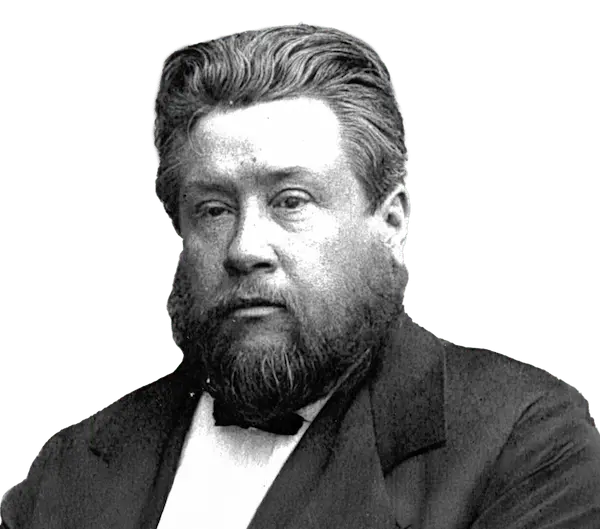
Charles Spurgeon • Jun 15, 1911
[Another Sermon by Mr. Spurgeon upon the same text is #873, Christ Made a Curse For Us] THE law of God is a divine law, holy, heavenly, perfect. Those who find fault with the law, or in the least degree depreciate it, do not understand its design and have no r…
Charles Spurgeon • Sep 8, 1904
“HOW will God come to us now that we have rebelled against Him?” That is a question which must have greatly perplexed our first parents, and they may have said to one another, “Perhaps God will not come to us at all, and then we shall be orphans indeed. If spa…
Charles Spurgeon • Mar 10, 1910
BELIEVERS are called to be good soldiers of Jesus Christ. As many of us as believe in Him, and have obtained eternal life through Him, are now enlisted beneath His banner to fight the battles of holiness against sin and of truth against error. We war not, howe…
Charles Spurgeon • Mar 29, 1868
MOSES lived to be one hundred and twenty years of age, and his life was divided into three periods of forty years. The first forty he spent as the son of Pharaoh’s daughter in the courts of Egypt, the second in the wilderness, at the foot of Horeb, as a shephe…
Charles Spurgeon • Feb 11, 1894
THIS morning [See sermon #2115, The Drought of Nature, the Rain of Grace, and the Lesson Therefrom], as well as I could, looking to God for help, I tried, in Christ’s stead, to persuade men to be reconciled to God. I showed that there was a great spiritual dro…
Charles Spurgeon • Aug 6, 1874
THESE two kings were about to proceed to war, and they irritated one another by insulting messages. That was the custom of all combatants in the old heathen times. They seemed to delight in stinging each other and exciting each other’s worst passions before th…
Charles Spurgeon • May 3, 1896
YOU hardly need that I should explain this action of the Samaritans. Probably our Savior’s nearest road to Jerusalem lay through Samaria, and He did not avoid that district, as many Jews did who went a long way around rather than pass through that unfriendly c…
Charles Spurgeon • Jul 27, 1916
MANY of the Rabbis, and I think with good reason, refer this to the Messias. We refer it to Jesus Christ, the man of Nazareth, the Son of God, who is the Messias of God to our souls. We are, no doubt, justified in referring it to our Lord Jesus Christ, because…
Charles Spurgeon • Sep 28, 1905
DID it ever strike you how wonderfully calm and collected our Lord must have been at this time? He had been preaching in the temple, talking to a multitude of Jews. They grew furious with Him—a number of stones which were used in repairing the temple were lyin…
Charles Spurgeon • Feb 20, 1881
BRETHREN in Christ, every word which proceeds out of our Master’s lips is precious to us. We make no distinction between His promises and His precepts, but prize every syllable above rubies. A doctrine from Him we value beyond the much fine gold and a command…
Charles Spurgeon • Jun 8, 1873
GODLY people are thoughtful people. Indeed it is often a sign of the beginning of grace in a man when he begins to consider. Want of thought has to do with the ruin of most of those who perish—it is not so much that they despise as that they neglect the great…
Charles Spurgeon • Feb 25, 1904
THIS solemn ordinance has been instituted and perpetuated to commemorate the death of our Lord Jesus Christ, but there is no ordinance to commemorate His life. One reason for this is because His death implies His life, when you commemorate His death, you testi…
Charles Spurgeon • May 13, 1915
WE read to you in the former part of the service the origination of the law of God by which the firstborn, both of man and beast, belonged to the Most High. That law seemed to be a very admirable memorial of what the Lord did, and also a very just requirement…
Charles Spurgeon • May 6, 1888
OUR discourse will follow the lines of the parable. A king desired to honor his son right royally. He loved his son well, for he deserved richly of him, and therefore, as the most fitting time had come, he resolved to honor him. His son was about to take to hi…
Charles Spurgeon • Oct 6, 1889
LAST Sabbath morning we were called to deep searching of heart. It was a very painful discourse to the preacher and it was not less so to many of his hearers. Some of us will never forget that fig tree, covered with untimely leaves, which yielded no fruit and…
Charles Spurgeon • Jul 11, 1886
TO read the whole chapter is most helpful to the understanding of our text. If we have studied it carefully we must have said to ourselves, “How full of their Lord were the minds of these holy writers!” Peter can scarcely write a verse without an allusion to t…
Charles Spurgeon • Mar 6, 1898
DID you notice, when we were reading this psalm, that it is entitled, “A Song of Degrees for Solomon”? The title may be either, “for Solomon” or “by Solomon.” If it is by Solomon, I can only say that it is worthy to be placed side by side with the book of Prov…
Charles Spurgeon • Mar 23, 1890
THIS is a remarkable passage. Its wording is singular. It begins with a, “but,” because the previous verses have been denouncing judgments upon Edom. When God comes forth to punish His enemies He also comes forth to bless His friends. When Pharaoh is overthrow…
Charles Spurgeon • Oct 13, 1867
IF we understand these words to be the exclamation of the evil spirit which tormented this poor demonian, they are very natural words, and one can very readily understand them, for the presence of Christ is such a great torment to the prince of evil, that he m…
Charles Spurgeon • Apr 14, 1904
YOU have, no doubt, met with various interpretations of this metaphor, “Open thy mouth wide, and I will fill it.” You will find that several expositors say that there is an allusion here to a custom which is said to have been observed by the late Shah of Persi…
Charles Spurgeon • Nov 5, 1893
I HAVE not observed that anyone has turned to account the fact that “the whole band of soldiers” gathered in the Praetorium, or common hall, for the purpose of mocking our Lord. That they did mock Him has often been noticed and preached upon, but that they sho…
Charles Spurgeon • Dec 31, 1914
A FEW thoughts, first, upon the things that wither, then a word or two upon that word which endureth, and then the lessons which the contrast will suggest.
Charles Spurgeon • Jan 6, 1889
I ONCE heard an old minister say that he thought the blessing of Asher was peculiarly the blessing of ministers. And his eyes twinkled as he added, “At any rate, they are usually blessed with children and it is a great blessing for them if they are acceptable…
Charles Spurgeon
SOME have considered that our text contains an allusion to a singular custom of showing favor which has been occasionally adopted by eastern monarchs. It is not a very long time ago that a former Shah of Persia bade an ambassador, who was in great favor with h…