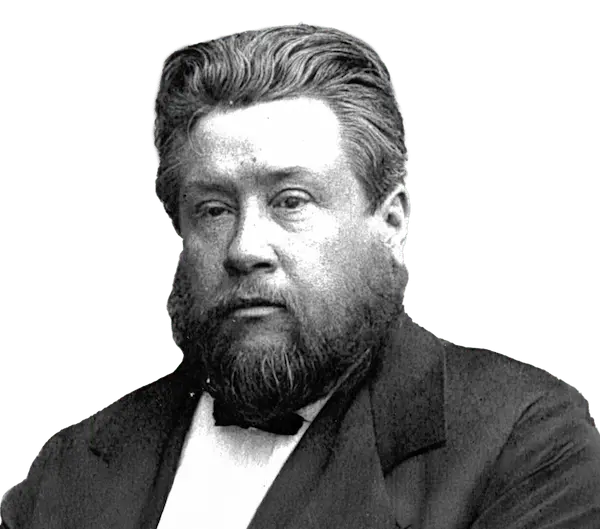
Charles Spurgeon • Oct 28, 1866
THE Hebrew seems to be very difficult to interpret in this verse, and there have been as many translations given of it as there are days in the month. Upon the whole one is most satisfied with the translation of our authorized version, and without troubling yo…
Charles Spurgeon
IT should be very encouraging to us to hear of the triumphs of the Gospel in the olden times. It is not only a matter of interest as to history, but it is a matter of practical consolation for the present day, for the Gospel is just the same today as it was ei…
Charles Spurgeon • Mar 9, 1911
[Two other Sermons by Mr. Spurgeon upon this same subject are #277, The Blood of the everlasting covenant and #1186, The Blood of the covenant] [Two other Sermons by Mr. Spurgeon upon Verses 11 and 12 are #2839, “Prisoners of Hope” and #2883, Prisoners Deliver…
Charles Spurgeon
THE apostle is speaking of the Lord Jesus, of whom he had previously said, “If so be ye have tasted that the Lord is gracious,” and he follows that sentence up with this, “To whom coming as unto a living stone.” Now, I want to call your special attention to th…
Charles Spurgeon • May 6, 1877
PILATE said much more than he meant, and therefore we shall not restrict our consideration of his words to what he intended. John tells us considering Caiaphas, “and this spoke he not of himself,” and we may say the same of Pilate.
Charles Spurgeon • May 30, 1869
THE apostle had been showing to the Galatians that salvation is in no degree by works. He proved this all-important truth in the verses which precede the text, by a very conclusive form of double reasoning. He showed, first, that the law could not give the ble…
Charles Spurgeon • Jul 17, 1898
AS we read this psalm, we noticed, from the opening verses of it, that David was in the depths. He is not the only one of God’s people who has been there. If we imagine that the experience of true saints is always a happy high level of peace, we make a great m…
Charles Spurgeon • Apr 21, 1889
PAUL, in the verses before the text, had deliberately laid aside his own personal righteousness. “But what things were gain to me, those I counted loss for Christ, for whom I have suffered the loss of all things and do count them but dung, that I may win Chris…
Charles Spurgeon • May 28, 1893
, 6 THIS is a very short Psalm, there are only six verses in it, but what a change there is between the beginning and the end of it! The first two verses are dolorous to the deepest degree, but the last verse is joyful to the highest degree. David begins many…
Charles Spurgeon • May 25, 1884
THE worst enemy we have is the flesh. Augustine used to frequently pray, “Lord, deliver me from that evil man, myself.” All the fire which the devil can bring from hell could do us little harm if we had not so much fuel in our nature. It is the powder in the m…
Charles Spurgeon
IN reading the chapter we observed how the beloved John saluted the seven churches in Asia with, “Grace and peace be unto you.” Blessed men scatter blessings. When the benediction of God rests on us we pour out benedictions upon others.
Charles Spurgeon • Jun 29, 1884
, 5 THE apostle had much joy in being the founder, the father, and the fosterer of so many churches, but this joy brought with it constant and heavy trial. Care pressed heavily upon him, for he mentions it as the crown and crush of all his burdens—“That which…
Charles Spurgeon
THIS ready response to a divine call may be looked at in three ways. It may be said of it, first, that it is the natural duty of man to God, such as his responsibility to his Creator demands. I would not like to think it necessary to prove that statement in th…
Charles Spurgeon • Dec 26, 1886
YOU have often heard the leprosy described, it was a very horrible disease, I should think the worst that flesh is heir to. We ought to be much more grateful than we are that this fell disease is scarcely known in our favored country. You have also heard what…
Charles Spurgeon • Jan 16, 1870
WHEN the old dispensation was becoming worn out, and like a vesture ready to be laid aside, when the end of the typical twilight had come, then Jesus Christ came forth from the Father, and brought the dawning with Him. When the often appearing of the Aaronic p…
Charles Spurgeon • Jan 31, 1869
In this refusal to be comforted, David is not to be imitated. His experience in this instance is recorded rather as a warning than as an example. Here is no justification for those professors who, when they suffer bereavements or temporal losses, repine bitter…
Charles Spurgeon • Aug 10, 1879
TWO great general principles are conspicuous in the Gospel. The first is that God gives of His grace to the empty, “He has filled the hungry with good things, and the rich he has sent away empty.” The second principle is that where God has given a measure of g…
Charles Spurgeon • Apr 8, 1877
ONE of the most serious calamities which can befall a church is to have her own ministers teaching heresy. Yet this is no new thing, it has happened from the beginning. Paul and Peter and James and John in their epistles had to speak of seducers in the churche…
Charles Spurgeon • Sep 30, 1915
Abraham left his country at God’s command and he never went back again. The proof of faith lies in perseverance. There is a sort of faith which does run well for a while, but it is soon ended and it does not obey the truth. The apostle tells us, however, that…
Charles Spurgeon • Sep 3, 1893
WHATEVER the saints are in heaven, they began to be on earth. There is, no doubt, a perfection of character in the world to come, but the character must be formed here. In the next world there will be no real change—where the tree falls, there it will lie. He…
Charles Spurgeon
AT the present moment, I am not able to enter fully into the subject of the new birth. I am very weary, both in body and mind, and cannot attempt that great and mysterious theme. To everything there is a season, and a time for every purpose under heaven, and i…
Charles Spurgeon • Feb 11, 1866
THERE is something very delightful in the springtime of nature, and though other seasons excel in fullness, spring must always bear the palm for freshness and for beauty. We are accustomed to thank God when the harvest hours draw near, and the golden grain inv…
Charles Spurgeon
The special cause of Hannah’s sorrow arose from the institution of polygamy, which, although it was tolerated under the old law, is always exhibited to us in practical action as a most fruitful source ofsorrow and sin. In no one recorded instance in Holy Scrip…
Charles Spurgeon • Aug 27, 1882
DELIVERED ON LORD’S-DAY MORNING, AUGUST 27, 1882, BY C. H. SPURGEON, AT THE METROPOLITAN TABERNACLE, NEWINGTON.