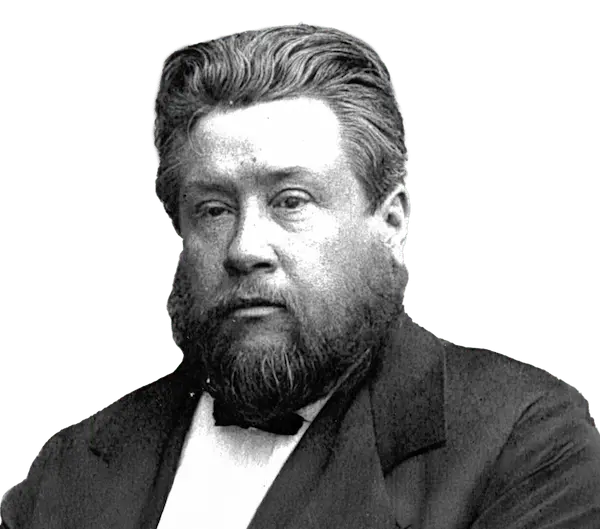
Charles Spurgeon • Jun 24, 1877
THE man who is righteous before God has a way of his own. It is not the way of the flesh, nor the way of the world. It is a way marked out for him by the divine command, in which he walks by faith. It is the King’s highway of holiness—the unclean shall not pas…
Charles Spurgeon • Aug 27, 1899
THE temple was intended to be the center of prayer for all the children of Israel. Those who could do so went up to it a certain number of times every year. Others, who were too far away to go, prayed with their window open towards Jerusalem, for there was the…
Charles Spurgeon • Dec 28, 1884
FOUR great events shine out brightly in our Savior’s story. All Christian minds delight to dwell upon His birth, His death, His resurrection, and His ascension. These make four rounds in that ladder of light, the foot of which is upon the earth, but the top wh…
Charles Spurgeon • Jan 24, 1907
CERTAIN Greeks desired to “see Jesus.” They informed Philip of their desire, Philip consulted with Andrew, and the two disciples together informed their Master of what seemed to them to be a very important matter. As wise men from the East once came to see Jes…
Charles Spurgeon • Sep 7, 1862
DOUBTLESS the Lord here describes the Jewish people when they began to multiply in the land of Egypt, and were grievously oppressed by Pharaoh. Pharaoh had commanded them to cast out the male children that they might perish. Hence, the figure of an infant dese…
Charles Spurgeon • Jan 1, 1882
IN all probability up to that time the year had been supposed to begin in the autumn. The question has been raised at what season of the year did God create man, and it has been decided by many that it must have been in autumn, so that when Adam was placed in…
Charles Spurgeon • Feb 15, 1885
THE disciples had come on board the vessel, and had forgotten to bring bread with them—good men’s memories sometimes fail them. For that reason they were greatly disturbed in mind, and they supposed that Jesus was disquieted also, and that He had shaped His sp…
Charles Spurgeon • Dec 5, 1907
[Another sermon by Mr. Spurgeon on the same text is #1908, Washed to Greater Foulness] WE are all, by nature and by practice, unclean in the sight of God. However excellent or virtuous we may seem before men, we have all broken God’s law, for that law requires…
Charles Spurgeon
WHEN the Lord is most intent on justice He is at the same time earnest in His love. The day of vengeance of our God is also the acceptable year of the Lord. In the Scripture before us, the prophet says, “Behold, the Lord comes out of His place to punish the in…
Charles Spurgeon • Sep 2, 1866
THE first shedding of human blood was a very terrible experiment. Whether Cain’s murderous blow was premeditated or not, the sight of a bleeding human corpse must have been a terrible novelty to him.
Charles Spurgeon • Apr 27, 1862
FROM this text certain persons, more desirous to find arguments for their theories, than a truthful exposition of the apostle’s meaning, have drawn the inference that a day in Scripture is typical of a thousand years, that is to say, that inasmuch as God was s…
Charles Spurgeon • May 21, 1908
[This sermon was preached during “The Rivulet Controversy,” of which an account is given in Volume II of C. H.
Charles Spurgeon
THE apostle had been putting forth all his strength to prove the doctrine of the resurrection, yet he was not diverted from his habitual custom of making practical use of the doctrine which he established.
Charles Spurgeon • May 20, 1909
[Other sermons by Mr. Spurgeon, upon parts of this passage, are as follows:
Charles Spurgeon • Nov 15, 1906
Not only was this the first text from which Mr. Spurgeon preached, but it was his theme on many subsequent occasions. Two of these discourses bear the same title—Christ Precious to Believers, although one of them is #242 in the New Park Street Pulpit and the o…
Charles Spurgeon • Aug 14, 1913
IT is a vulgar error that the conversion of the apostle Paul was an uncommon and exceptional event, and that we cannot expect men to be saved now-a-days after the same fashion. It is said that the incident was an exception to all rules, a wonder altogether by…
Charles Spurgeon • Jul 10, 1913
I INTEND this evening to have two texts, though I shall not therefore have two sermons and so keep you a double length of time. Our first text, which will suffice to begin with, is in the 56 th Psalm, at the 3 rd verse— “What time I am afraid, I will trust in…
Charles Spurgeon • Jul 6, 1873
BY the apple tree would probably be intended by the oriental writer either the citron, or the pomegranate, or the orange. I suppose he did not refer to the apple tree of our gardens, for it would scarcely be known to him. The word would not, however, be proper…
Charles Spurgeon • Feb 11, 1909
YOU will remember the occasion on which these words were spoken. Samson had been brought down from the top of the rock Etam, bound with cords by his own brethren, and given up as a captive into the hands of the Philistines. But no sooner did he reach the Phili…
Charles Spurgeon • Aug 5, 1894
[“We believe that David wrote this psalm. It is Davidic in tone and expression, and it tallies with David’s experience in many interesting points. In our youth, our teachers called it, ‘David’s pocketbook,’ and we incline to the opinion then expressed that her…
Charles Spurgeon • Feb 22, 1912
PERHAPS in the special sense in which Ezekiel uses this expression, we shall not expect to feel “the hand of the LORD” upon us. God may not call us to prophesy as Ezekiel did, although in the Scriptural use of the word “prophesy” the preacher of the Word is st…
Charles Spurgeon
EVEN when addressing our fellow men there should be flatness about our speech. ThereforeSolomon represents the preacher as seeking out acceptable words, or words meet for the occasion. When we approach those who are high in authority, this necessity becomes co…
Charles Spurgeon • Apr 24, 1913
OUR Lord, on this occasion, was addressing a number of captious critics who, instead of listening to what He said and giving it the attention due to its own weight, said, “Show us a sign.” Our Lord replies to them that He will give them no sign except the two…
Charles Spurgeon • Sep 6, 1896
WE learn from this chapter, dear friends, that our Master was tired of battling with hypocrites and formalists, and therefore withdrew Himself from them. They had come to Him with their foolish charges that His disciples did not observe the traditions of the e…