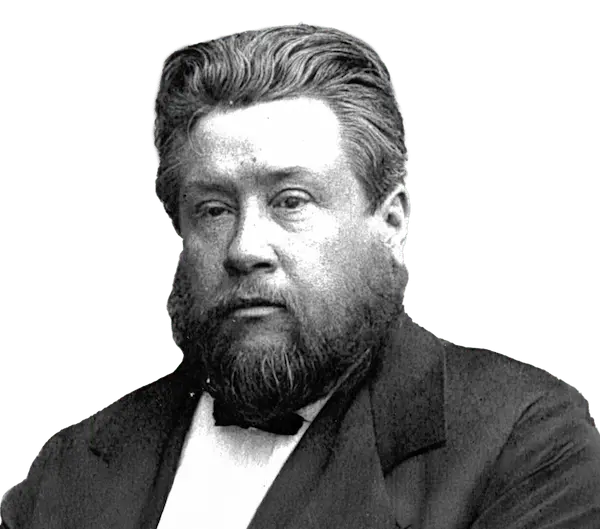
Charles Spurgeon
THESE are dainty words—a grateful anodyne for a troubled conscience. Such singular comfort is fitted to cheer up the soul, and put the brightest hue on all her prospects. The person to whom it is addressed has an eminently happy position. Satan will be very bu…
Charles Spurgeon • Feb 25, 1900
PAUL thus describes himself. It was necessary that Paul, as an apostle, should have seen the Lord.
Charles Spurgeon • May 4, 1890
THE eyes of the Lord Jesus are always on His chosen, and He knows every circumstance which occurs to them. “Jesus heard that they had cast him out.” Our Lord had done too much for this man to forget him. Where divine grace has worked a great work, its memory l…
Charles Spurgeon • Jul 15, 1894
ALL through Holy Scripture you constantly meet with the mention of “blood.” “Without shedding of blood is no remission.” “The blood of Jesus Christ, his Son, cleanses us from all sin.” “Ye were not redeemed with corruptible things, as silver and gold, from you…
Charles Spurgeon • Mar 27, 1870
GOD had in the days of Amos by different ways rebuked the sin of His people Israel. He had wasted them with famine and sword, He had withheld the rain. He had sent forth the pestilence after the manner of Egypt. He had smitten their fields and gardens with bla…
Charles Spurgeon • Jun 23, 1872
THEY had come out of Egypt, they had gone up and down in the wilderness, but they had not before crossed the Jordan. It was new ground to them, a new difficulty, and a new series of events lay before them. As a fresh emergency had arisen, they had new orders d…
Charles Spurgeon • Jan 5, 1896
I MEAN to dwell specially upon those words at the end of the verse, “Be it unto thee even as thou wilt,” but before we consider them, I should like again to remind you, as I did in the reading, that our Lord admired this woman’s faith. He said unto her, “O wom…
Charles Spurgeon • Aug 18, 1872
I REMEMBER to have heard it said that when a church is in a right condition, all that it wants on the Sabbath day is that the sermon should be like the orders given by a commanding officer to his troops: it need not be rhetorical or eloquent, it only need be c…
Charles Spurgeon • May 20, 1894
“A CERTAIN scribe”—“One scribe”—it is said in the original, perhaps to mark the noteworthy fact that he should be a scribe, and yet should wish to be a disciple of Christ. The Lord has some of His own in every class of men. You may go as low as you will, but g…
Charles Spurgeon • Sep 12, 1880
WE shall chiefly dwell upon the last line, “To walk humbly with your God.” Man asks, “Why should I come before the Lord and bow myself before the high God?” and as if he must set himself to answer his own question, he further inquires, “Shall I come before Him…
Charles Spurgeon • Jul 14, 1895
I THINK I have read that, once, when the seraphic Samuel Rutherford was preaching, he came ere long to speak on the high praises of the Lord Jesus Christ. That was a theme upon which he was at home, and when he reached that point, and had spoken a little upon…
Charles Spurgeon • Jan 7, 1915
WHEN our Lord Jesus Christ was transfigured, there came a voice from the bright, overshadowing cloud, which said, “This is my beloved Son, in whom I am well pleased. Hear ye him.” It was the voice of the Father concerning His Son—a testimony to His person, a n…
Charles Spurgeon
NATURE is selfish, but grace is loving. He who boasts that he cares for nobody, and nobody cares for him, is the reverse of a Christian, for Jesus Christ enlarges the heart when He cleanses it. None so tender and sympathetic as our Master, and if we be truly H…
Charles Spurgeon
THERE are various estimates of the Christian church. Some think everything of her. Some think nothing of her. And probably neither opinion is worth the breath which utters it. Neither Ritualists, who idolize their church, nor skeptics, who vilify all churches,…
Charles Spurgeon
MOAB, which had threatened Israel, was to be so completely subdued, and become so utterly contemptible as to be likened to a washpot or basin in which men wash their feet. More than this, however, may have been intended—nay, we feel sure was intended by the ex…
Charles Spurgeon • Nov 9, 1902
EVEN concerning those who have heard the Gospel, it can still be said, “They have not all obeyed the gospel.” And this, dear friends, is one of the plainest proofs of the deep depravity of human nature.
Charles Spurgeon • Dec 14, 1902
THE fact that these words are so frequently found in the Word of God is a sufficient justification for often preaching from them. There seems to be, among certain preachers and hearers, some sort of question about preaching more than once from the same text, y…
Charles Spurgeon • Sep 7, 1911
IN this epistle Peter is speaking of the scattered saints in all parts of the world, and taught by the Holy Spirit, he says of them that they were “an holy priesthood.” He is not talking about ministers. He is not speaking of a certain number of men who have p…
Charles Spurgeon • Jun 3, 1883
ALL who were present on the occasion are sure to remember our meditation upon, “Supposing Him to be the gardener” [Sermon #1699, Volume 29]. Although it was only supposition, and evidently a mistake, yet it yielded us most profitable thought. Here is another s…
Charles Spurgeon • Aug 11, 1901
IT is a very rare thing to meet with people who say that they have enough, for those who have most generally desire more, and those who have little feel that contentment is a thing which cannot reasonably be expected from them. For any person honestly and trut…
Charles Spurgeon • Jan 1, 1893
IT has been truly said that if the members of our churches were in a right condition of heart, the work of the pastor towards them would be no more difficult than that of a commanding officer to his troops. A general, or a captain has never to study eloquence—…
Charles Spurgeon
ZACHARIAS and the Virgin Mary were both very dear to God and therefore highly honored and greatly favored. The points of likeness between them are many. They were both persons of eminent character, for Zacharias walked blameless in all the ordinances and comma…
Charles Spurgeon • Apr 10, 1870
I THINK I addressed you from this text four years ago [“Sin Laid on Jesus,” #694, Metropolitan Tabernacle Pulpit], but I feel quite safe in returning to it, for we shall never exhaust it. It is a verse so wealthy in meaning that if I had during the whole four…
Charles Spurgeon • Dec 22, 1910
[Another sermon by Mr. Spurgeon upon the same verse is #1301, “A Prince and a Saviour.] THIS was part of the answer of Peter and the other apostles to the question and declaration of the high priest, “Did not we straitly command you that ye should not teach in…