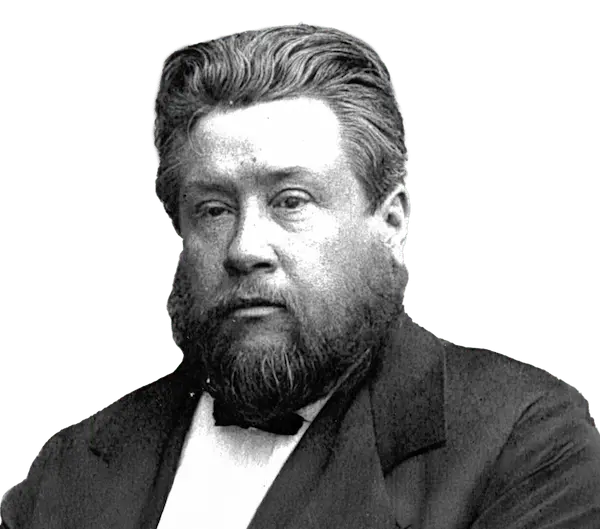
Charles Spurgeon • Jul 21, 1867
FOR a considerable season the country of Moab had been free from the inroads of war and the terrors of pestilence. The nation had, therefore, become so conceitedly secure, that the Lord said, “We have heard the pride of Moab (he is exceeding proud), his loftin…
Charles Spurgeon
I SEE many ministering brethren here. I think I shall follow the example of Martin Luther, who observes that he frequently saw in the church at Wittenberg sundry learned doctors, and there usually sat Dr. Justus Jonas and others, of whom he said, that they wer…
Charles Spurgeon
THE most dreadful alarm that can disturb a reasonable man is the fear of being condemned by the Judge of all. To be condemned of God, how dreadful! To be condemned of Him at the last great day, how terrible! Well might Belshazzar’s loins be loosed when the han…
Charles Spurgeon • May 19, 1867
THE distinguishing mark of a Christian is his confidence in the love of Christ and the yielding of his affections to Christ in return. First, faith sets her seal upon the man by enabling the soul to say with the apostle, “Christ loved me and gave himself for m…
Charles Spurgeon • Jun 29, 1905
IT seems to me that the Lord’s supper should be received by us often. When the apostle says, in our text, “As often as ye eat this bread, and drink this cup,” and our Lord said, in instituting the ordinance, “This do ye, as oft as ye drink it, in remembrance o…
Charles Spurgeon • Jan 7, 1900
COME, believer, and contemplate this sublime truth, thus proclaimed to you in simple monosyllables, “He laid down his life for us.” There is not one long word in the sentence. It is all as simple as it can be and it is simple because it is sublime. Sublimity i…
Charles Spurgeon • Jun 28, 1891
I SHALL call your attention to the near neighborhood of these two phrases, “Not of works,” and “Created in Christ Jesus unto good works.” The text reads with a singular sound, for it seems strange to the ear that good works should be negatived as the cause of…
Charles Spurgeon • Sep 28, 1879
THE apostle Paul shall be our interpreter here. You remember how in the tenth chapter of his Epistle to the Romans he quotes from this chapter and says, “Isaiah is very bold and says, I was found of them that sought Me not; I was made manifest unto them that a…
Charles Spurgeon
EVERY sensible man endeavors to adapt his purposes to his strength. He does not begin to build a house which he will not be able to finish, nor commence a war which he cannot hope to fight through.
Charles Spurgeon • Sep 21, 1905
A COUNTRY gentleman is expecting a number of persons to come and dine with him. He has as little side swing-gate at the entrance to the park, through which people generally come. But on the day when he expects company, he says to one of his men, “John, be sure…
Charles Spurgeon • Jan 18, 1903
YOU have probably heard a great many sermons on the first part of the text, “I am thy shield,” so, on this occasion, I am going to leave that portion, in order more fully to consider the second part, “I am thy exceeding great reward.” Notice first, the circums…
Charles Spurgeon • Aug 16, 1896
THE spouse in this verse styles her Lord, “my beloved,” from which it is easy for us to gather that it is of the utmost importance that our heart’s affection should be really and truly set upon Christ Jesus, our Lord. We must trust Him, and we must love Him. C…
Charles Spurgeon • Jul 16, 1876
I MAY not hope that I shall see you all again, and so, as I have the opportunity of only preaching one sermon to you, I must make it as full as I can of essence of Gospel, from beginning to end. We have heard of a chaplain who preached in a jail, who selected…
Charles Spurgeon • Jun 20, 1880
IT is very suggestive of the way in which our Lord Jesus took the sinner’s place that we are here in the context compared to sheep, “All we like sheep have gone astray,” and then, He who comes to take our place is also compared to a sheep, “As a sheep before h…
Charles Spurgeon • Feb 6, 1870
THE apostle Paul could very truthfully assert that he labored and agonized. When the Holy Spirit had anointed the apostles, they all became ardent enthusiasts for the spread of the Redeemer’s kingdom.
Charles Spurgeon • Aug 12, 1888
THE story of the passage of the Jordan might instructively be used in many ways. It was a very wonderful event. It occurred on the tenth day of the first month, on the same day of the year as the passage of the Red Sea. Of that glorious miracle it was the fort…
Charles Spurgeon • Jan 23, 1898
IT would seem, dear friends, that there have been trials and difficulties connected with the church of Christ in every age. We dream that our temptations are worse than those of our fathers, but they are not.
Charles Spurgeon • Nov 21, 1907
[Other Sermons by Mr. Spurgeon, upon this passage are as follows:
Charles Spurgeon • Jun 7, 1891
READ the chapter, and carefully note how the apostle goes to the back of everything, and commences with those primeval blessings which were ours before time began. He dwells on the divine love of old, and the predestination which came out of it, and all that b…
Charles Spurgeon • Apr 7, 1889
SOME time ago I preached upon the whole story of the dying thief. I do not propose to do the same today but only to look at it from one particular point of view. The story of the salvation of the dying thief is a standing instance of the power of Christ to sav…
Charles Spurgeon • Aug 5, 1915
IF one were about to have an audience with the Queen, or with some other royal personage, he might be apt to say, “How shall I behave myself? What am I expected to do? What is the proper form of address?” Now, in entering into the presence of the great King of…
Charles Spurgeon • Dec 27, 1868
IN the pursuit of holiness the pilgrim is often surrounded with darkness, while in the pathway of evil the traveler is dazzled with a glare of light. It is the way of the tempter to make the downward path as attractive as possible with the flaring splendor of…
Charles Spurgeon • Oct 27, 1910
I REMINDED you, this morning [See sermon #485, No Room for Christ in the Inn], that there was no room for Christ and His parents in the inn at Bethlehem, and also that there were then other places where, although there was no room for Christ, far inferior pers…
Charles Spurgeon
THE apostle, in this place, does not claim to have seen the Lord in the flesh, although he boasts in another passage that he has done so, and asserts it as one of the proofs of his apostleship. He is not, indeed, in this text referring to any seeing of the Lor…